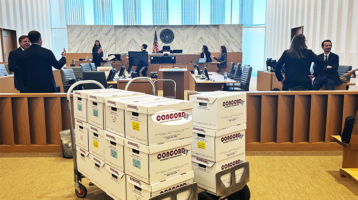
A trial team can have the evidence, the witnesses, and the legal argument right, then lose valuable courtroom time because the paper set is difficult to use. Trial binders for Stanley Mosk Superior Court need to be built for fast retrieval, dependable reference, and controlled last-minute change management. In a high-pressure Los Angeles trial setting, a binder is not just a stack of documents. It is a working courtroom tool for counsel, witnesses, the court, and the litigation support team.
For complex matters, the production decision should begin well before the final night of trial preparation. The right binder format, exhibit sequence, tab system, Bates range verification, and delivery plan all affect whether the team can put the correct record in front of the right person without delay.
What Trial Binders Must Accomplish
A trial binder should make a document easy to locate and easy to verify. That sounds straightforward, but the challenge increases quickly when a case includes hundreds of exhibits, deposition designations, demonstratives, confidential material, or documents that have been revised during motion practice.
The baseline is a clean, consistent organization that tracks the trial team’s actual workflow. Exhibits should be ordered according to the approved exhibit list or the team’s designated trial sequence. Tabs must be readable, durable, and matched to the index. Page numbers and Bates numbers need to be legible after copying, drilling, and binding. If a document is likely to be used with a witness, the presentation copy must be immediately accessible without forcing counsel to sort through unrelated material.
A useful binder also recognizes that not every recipient needs the same set. Counsel’s binder may include work product, witness outlines, or reference notes that do not belong in a court or witness copy. A witness binder may require only marked exhibits and should be reviewed carefully for annotations, privileged content, and restricted information. Court-facing copies should follow the assigned department’s requirements and any applicable standing orders.
Planning Trial Binders for Stanley Mosk Superior Court
The Stanley Mosk Courthouse handles a heavy volume of significant civil matters. That setting rewards preparation, but it also demands flexibility. Courtroom procedures can vary by department and judicial officer, so trial teams should confirm current requirements with the applicable department rather than assume that a format used in another case will be accepted here.
Start by defining the purpose of each binder. A complete trial exhibit binder serves a different function from a witness examination binder, a deposition-designation binder, or a daily bench-book update. Combining every category into one oversized volume may look comprehensive, but it can slow the team down at the exact moment speed matters. Dividing materials by witness, subject, exhibit range, or trial day is often more practical.
The physical build should match the expected use. Large-capacity three-ring binders are flexible for late insertions, while comb or wire binding can create a more stable final presentation for a fixed set. Oversized binders are harder to carry, harder to place on counsel table, and more likely to fail under frequent use. In many matters, several clearly labeled volumes are safer than one overloaded binder.
Color coding can help, particularly when it distinguishes counsel materials, witness materials, and court copies. It should not be the only navigation method. A binder still needs plain-English spine labels, volume numbers, tab labels, and a reliable index. The courtroom is not the place to rely on institutional memory.
Exhibit Lists, Tabs, and Indices Must Match
Most binder failures are preventable production-control failures. The exhibit list says Exhibit 42, the tab says 42, but the document behind it is Exhibit 43. Or the PDF used for printing contains an earlier version of the index. Or a late-added exhibit is inserted without updating the volume spine and table of contents.
A disciplined quality-control process checks the source file, final exhibit list, tabs, Bates ranges, and physical pagination against one another. The goal is not merely attractive printing. It is a dependable chain from the exhibit identifier to the exact document counsel expects to use.
For high-volume exhibits, a detailed index should include the exhibit number, short description, Bates range where applicable, and binder volume. When documents contain multiple parts, such as an agreement with schedules or a report with attachments, the index should identify those components clearly enough that a user does not need to guess what is included.
Protect Confidential and Sensitive Records
Trial production frequently involves personal data, financial records, medical information, trade secrets, government records, or materials designated confidential under a protective order. Those documents require more than accurate printing. They require controlled handling from file receipt through delivery.
Before production, the team should identify redacted versions, confidential designations, sealing issues, and restrictions on who may receive each set. A single unredacted copy placed in the wrong binder can create a serious problem. Secure file transfer, documented handling procedures, limited-access production, and careful final packaging are operational safeguards, not extras.
This is also where a provider experienced in both paper production and electronic discovery can reduce risk. The same team that manages source files, scanning, OCR, Bates labeling, and review exports is better positioned to identify whether the printed exhibit set reflects the approved source material.
The Production Workflow That Prevents Last-Minute Errors
Trial teams rarely receive a perfectly final document set days in advance. A deposition clip changes. Opposing counsel withdraws an exhibit. A new demonstrative is approved. The solution is not to treat every late change as a separate emergency with no controls.
First, establish a single source of truth for the final exhibit list and binder index. Assign responsibility for authorizing changes, and distinguish between additions, replacements, and removals. A replacement may preserve the same exhibit number but require a new page count or Bates verification. An addition may require updates to tabs, indexes, electronic folders, and all affected volumes.
Second, use version control that the legal team can understand at a glance. Files should have unambiguous names and release dates. Production staff should not have to infer whether “final,” “final2,” and “final_revised” are current. A clear approval checkpoint before printing protects against expensive rework and courtroom confusion.
Third, leave room for a controlled supplemental volume. If the primary binders are already complete, it may be better to produce a clearly labeled supplemental binder than to reopen every volume for one late document. It depends on the number and significance of the changes. The important point is consistency: every recipient must receive the same authorized update, or the team must know exactly which sets differ and why.
Delivery Is Part of Trial Preparation
A flawless binder that arrives after the needed hearing or trial session does not solve the problem. For matters at Stanley Mosk, delivery timing should be planned around courtroom access, firm logistics, security procedures, and the realities of Los Angeles traffic. Same-day or overnight production capability matters most when it is paired with clear cutoff times, confirmed delivery instructions, and a responsible point of contact.
Packaging should protect the binders without making them difficult to distribute. Each carton should identify the case, binder type, volume range, and intended recipient group where appropriate. A packing list helps the receiving team confirm that all sets arrived. For sensitive matters, documented delivery and controlled custody may be essential.
Concord Document Technologies supports trial teams with 24/7 production capacity, legal copying, scanning, Bates labeling, electronic discovery workflows, and overnight trial exhibit binder delivery to Stanley Mosk and other courthouse locations. For a trial team, the advantage is operational continuity: the provider handling the electronic record can also produce the physical materials needed in court.
A Final Check Before the Binders Leave Production
Before release, the litigation team and production partner should confirm the case caption, department information if included, exhibit sequence, recipient count, confidentiality treatment, and delivery destination. They should also spot-check every volume for tab order, document completeness, print quality, legibility, and secure binding.
The last useful question is simple: if lead counsel asks for a specific exhibit in the middle of examination, can anyone at counsel table find it in seconds? If the answer is not clearly yes, the binder needs another pass. Trial preparation rewards the teams that treat document production as a controlled legal operation, not a last-minute print job.