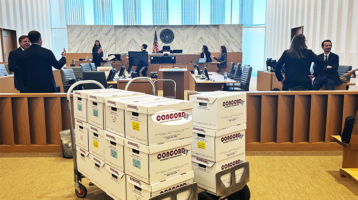
A trial team usually discovers the real deadline when a judge sets a hearing, opposing counsel updates an exhibit list at 6:40 p.m., and the binders still need to be on counsel table the next morning. That is where overnight exhibit trial binders for all Los Angeles and Orange County courthouses stop being a convenience and become a litigation necessity.
For firms handling emergency motions, evidentiary hearings, ex parte applications, or trial call, the work is rarely just printing. It is indexing, separator tabs, exhibit numbering, courtesy copies, chamber copies, hole drilling, redactions, color inserts, oversized sheets, and making sure each set matches the filing and the courtroom’s expectations. If one volume is out of sequence or one exhibit sticker is inconsistent, the problem shows up at exactly the wrong moment.
What overnight exhibit trial binders actually require
When legal teams ask for overnight exhibit trial binders, they are usually asking for compressed project management under litigation conditions. The binder itself is only the visible output. Behind it are document intake, quality control, print decisions, version checks, assembly, packaging, and delivery timing that has to account for courthouse access, messenger cutoffs, and local practice.
That matters in Los Angeles and Orange County because volume and pace are unforgiving. Stanley Mosk, the Spring Street and First Street federal venues, and Superior Court locations across the region all create their own practical demands. Some matters call for formal chamber copies with strict tabbing and bookmarking. Others require multiple coordinated sets for the bench, witness, clerk, and opposing counsel. In many cases, the team also needs matching digital productions for remote attorney review or presentation use.
Overnight exhibit trial binders for all Los Angeles and Orange County courthouses
The phrase sounds broad, but the need is specific. Legal professionals are looking for a provider that can accept files late, identify production issues quickly, and assemble court-ready binders overnight without introducing risk. That means more than having printers running after hours. It means having staff who understand exhibit conventions, litigation deadlines, and the consequences of even minor production errors.
A dependable overnight workflow starts with intake discipline. Files often arrive in mixed formats – native email exports, PDFs, scanned records, spreadsheets, photographs, and last-minute revised pleadings. Before any binder is built, the source set needs to be normalized so the exhibit list, file names, and printed output align. If a team skips that step, the binder may look finished while still being wrong.
Quality control is the second pressure point. In trial support, speed without verification is expensive. A serious provider checks for missing pages, upside-down scans, inconsistent Bates ranges, unreadable color copies, and tab sequences that do not match the index. If there are conflicts, experienced staff escalate them fast instead of burying them in production.
Delivery is the third point that separates routine copying from actual litigation support. Overnight service only has value if the binders arrive where they need to be, labeled correctly, and ready for use. For courthouse delivery, that often means accounting for building access, department timing, filing windows, and whether messenger coordination is part of the assignment. Shipping overnight can work for out-of-area teams, but local hand delivery is often the safer option when next-morning use is non-negotiable.
What legal teams should expect from a serious provider
A credible litigation support partner should be able to handle both the physical and electronic sides of the matter. Trial binders rarely stand alone anymore. The same matter may involve scanned source records, Bates labeling, online attorney review, forensic data collection, or production sets prepared for discovery and hearing use. When those services sit under one operational umbrella, handoff risk drops.
That does not mean every job needs a full managed-services model. Sometimes the assignment is straightforward – three hearing binders, one set of tabs, and delivery by 8:00 a.m. Other times it is a rolling overnight production tied to revised witness materials, impeachment exhibits, and late-arriving records from custodians or third parties. The right support model depends on the stakes, the volume, and how much version volatility the case is experiencing.
Legal teams should also expect confidentiality controls that fit the matter. High-stakes commercial litigation, regulatory investigations, employment disputes, and public-sector matters often involve restricted records and sensitive personal information. Bonded and insured operations, controlled handling procedures, and staff accustomed to chain-of-custody discipline are not extras in that environment. They are part of basic risk management.
The trade-offs in overnight binder production
Not every overnight binder project should be treated the same way. There is a trade-off between speed and customization, and experienced teams are upfront about it. If the priority is pure delivery time, the binder design may need to stay simple – clean indexing, standard tabs, efficient assembly. If the case demands highly customized witness kits, color-coded sections, enlarged exhibits, embedded media references, and multiple courtroom sets, production complexity rises quickly.
There is also a practical decision between physical binders and hybrid production. Some judges, departments, and trial teams still rely heavily on paper. Others want a parallel digital set that can be searched, shared to co-counsel, or loaded for presentation. In many matters, the safest approach is not paper versus digital. It is both. A coordinated provider can produce the hard-copy binders while also preparing a consistent electronic set for attorney access and backup.
Another trade-off involves file readiness. When clients provide a clean, final exhibit list and production-ready PDFs, turnaround is faster and costs are easier to predict. When files arrive fragmented, unlabeled, or still changing, overnight service remains possible, but the project becomes more labor-intensive. The best providers can absorb that pressure, but legal teams should understand that late-stage cleanup affects both production planning and review cycles.
Why local courthouse familiarity still matters
National print vendors can ship binders overnight. That is not the same thing as supporting active litigation in Southern California. Familiarity with courthouse geography, access patterns, and timing realities still matters when the assignment involves a next-morning appearance.
This is especially true when a matter shifts at the last minute. Counsel may need revised tabs, an added volume, replacement pages, or additional courtesy copies after the original request is already in motion. A provider with local production capacity and messenger coordination can usually absorb those changes more effectively than a general commercial printer working from a standard shipping schedule.
For many firms, that local responsiveness is the difference between hitting a deadline and explaining a preventable failure. The most valuable vendor in that moment is not the one with the cheapest print rate. It is the one that can say yes at night and execute by morning with accuracy.
How overnight exhibit binders fit into broader litigation support
Exhibit binders are often the final visible step in a much larger workflow. The same case may involve document scanning, OCR, database exports, forensic preservation from iPhones or email, online review, and deposition or hearing preparation. When those functions are disconnected across multiple vendors, errors tend to surface at the production stage.
A more integrated approach gives legal teams better control. If the records were scanned, labeled, reviewed, and prepared for print by the same support organization, inconsistencies are easier to catch before they reach the courtroom. That is one reason institutional clients often prefer a provider built for both legacy document operations and modern eDiscovery demands.
Concord Document Technologies has operated in that space since 1996, supporting law firms, corporations, and government agencies that need dependable execution under pressure. For trial teams, that combination of production depth and litigation familiarity matters when the binder deadline is measured in hours, not days.
When to call for overnight exhibit trial binders
The best time is before the panic window. As soon as a hearing date tightens, exhibit lists start moving, or a partner says the team may need chambers copies overnight, production planning should begin. Even a preliminary file handoff gives a serious provider time to flag issues, organize components, and hold capacity.
That said, litigation rarely rewards ideal timing. If the request comes late, what matters most is finding a partner that can assess the file set quickly, identify what can realistically be produced by morning, and move without confusion. Clear communication, disciplined quality control, and courthouse-aware delivery logistics are what keep overnight binder work from turning into overnight damage control.
When the record has to be in the room the next morning, precision is the service. Speed is simply the standard.