What is an “Agreement for the Production of Electronically Stored Information” ?
An agreement for the production of electronically stored information (ESI) is typically a stipulated protocol used in litigation to govern how parties identify, preserve, collect, review, and exchange electronic data during discovery. These agreements help ensure compliance with rules like the Federal Rules of Civil Procedure (e.g., Rules 16, 26, 34) or state equivalents, while minimizing disputes and costs. They often address formats, scope, privilege protections, and technical details. Such agreements are negotiated between parties and may be court-approved.
Common elements in ESI agreements include:
- Definitions of key terms (e.g., ESI, metadata, native files).
- Preservation obligations and litigation holds.
- Production formats (e.g., native, TIFF/PDF, with or without metadata).
- Search and review methodologies (e.g., keywords, de-duplication).
- Handling of privileged or inadvertently produced information (clawback provisions).
- Cost-sharing for inaccessible data.
- Dispute resolution processes.
How can CONCORD help with your “Meet & Confer”?
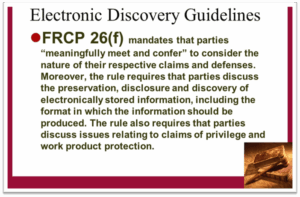
ESI agreements are discussed topics that stem from the mandatory elements in Rule 26(f), which emphasize preserving discoverable information, developing a joint plan, and addressing ESI-specific issues. CONCORD has been working lawyers for over 30 years, so most questions and requests are almost standard now. CONCORD can help you navigate with unfamiliar procedures for collecting, preserving & production of data (or documents). Please call CONCORD before your meeting … to avoid uncomfortable, unknown topics to your legal team. CONCORD is a champion of assisting small or boutique firms going up against the large national firms or Federal / State D.O.J.
For a sample "Agreement for the Production of Electronically Stored Information", complete below.

Below is a sample template for an ESI production agreement, adapted from standard models used in U.S. federal and state courts. This is not legal advice; consult an attorney to customize it for your jurisdiction and case. It’s based on suggested protocols like those from the U.S. District Court for the District of Maryland.
Sample Stipulated Agreement for Production of Electronically Stored Information (ESI)
IT IS HEREBY STIPULATED AND AGREED by and between the parties [Plaintiff(s)] and [Defendant(s)], through their respective counsel, that the following protocol shall govern the discovery and production of electronically stored information (ESI) in this action:
1. Definitions
- Electronically Stored Information (ESI): As defined in [Fed. R. Civ. P. 34(a)] or equivalent state rule, including but not limited to emails, documents, databases, spreadsheets, images, audio/video files, web content, and metadata.
- Metadata: Information embedded in or associated with ESI, such as author, date created/modified, file path, and application data. Subdivided into system metadata (auto-generated) and substantive metadata (user-edited).
- Native Format: The original file format in which ESI was created or maintained (e.g., .docx, .xlsx).
- Static Image: A non-editable representation of ESI, such as TIFF or PDF, with accompanying load files for databases or searchability.
- Custodian: Individuals or entities likely to have relevant ESI.
2. Scope and Cooperation
The parties agree to cooperate in good faith to conduct discovery in a just, speedy, and inexpensive manner per [Fed. R. Civ. P. 1] or equivalent. This includes early discussions on ESI sources, accessibility, and proportionality. Discovery of ESI shall be limited to information relevant to claims and defenses, considering factors in [Fed. R. Civ. P. 26(b)(1)].
- The parties will identify key custodians, data sources (e.g., email servers, cloud storage, backups), and time periods within [X] days of this agreement.
- If ESI is not reasonably accessible due to undue burden or cost (e.g., legacy systems, backups), the producing party shall provide a detailed affidavit explaining why, including estimated retrieval costs. The requesting party may challenge this, and the court may order cost-shifting.
3. Preservation
Each party represents that it has implemented a litigation hold to preserve relevant ESI, including suspending routine deletion/overwriting policies. Preservation includes:
- ESI from identified custodians and sources.
- Metadata, deleted files (if recoverable without undue burden), and backup media.
- The parties agree to a “safe harbor” provision: Absent exceptional circumstances, no sanctions for failure to preserve ESI lost through routine, good-faith system operations per [Fed. R. Civ. P. 37(e)].
4. Search and Identification
- The parties will confer on search methodologies, including keywords, date ranges, file types, and Boolean operators. Sampling or testing may be used to refine searches.
- De-duplication: Global de-duplication across data sources is permitted, using hash values (e.g., MD5 or SHA-1). Duplicates shall be disclosed to the requesting party.
- Technology-assisted review (TAR) or predictive coding may be used if agreed upon, with transparency on training sets and validation.
5. Production Format
- Default format: Single-page TIFF images (300 DPI, Group IV compression) with extracted text (OCR for non-text ESI), load files (e.g., .DAT, .OPT), and metadata fields (e.g., author, dates, file name, custodian). Bates numbering shall be applied.
- Native format: Produced for files like spreadsheets or databases where functionality is needed, upon reasonable request. Redactions in native files require conversion to static images.
- Metadata: System metadata shall be produced unless burdensome; substantive metadata only if relevant and requested. If withheld, notify in writing.
- Paper production: Permissible for small volumes if agreed, but ESI should generally be produced electronically.
- Volume limits: Productions in rolling batches, not exceeding [X GB] per batch unless agreed.
6. Privilege and Clawback
- Inadvertent production of privileged or protected ESI does not waive privilege per [Fed. R. Evid. 502(b)] or equivalent.
- Clawback procedure: Upon notice of inadvertent production, the receiving party shall promptly return, sequester, or destroy the ESI and any copies. No use in proceedings until resolved.
- Quick peek option: If agreed, the producing party may provide unreviewed ESI for initial inspection, with privilege asserted later.
- Privilege logs: Provided within [X] days of production, in Excel format, including bates range, description, and basis for privilege.
7. Costs
- Each party bears its own costs for preservation and production of reasonably accessible ESI.
- For inaccessible ESI, costs may be shared or shifted based on [Fed. R. Civ. P. 26(b)(2)(B)] factors, subject to court order.
8. Confidentiality and Protective Order
- ESI designated as confidential shall be handled per any existing protective order.
- Third-party ESI: Producing party shall notify third parties of subpoenas and allow objections.
9. Dispute Resolution
- The parties will meet and confer in good faith on any disputes before seeking court intervention.
- If unresolved, disputes shall be submitted via joint letter to the court.
10. Modification and Termination
This agreement may be modified by written consent or court order. It terminates upon final resolution of the action.
SO STIPULATED:
[Signature lines for parties and counsel]
[Date]