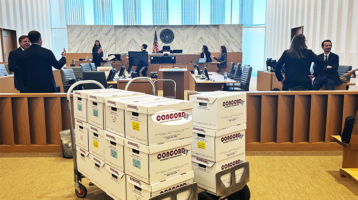
A filing deadline can turn a routine copy job into a risk event fast. When case files include privileged material, medical records, oversized exhibits, color-coded tabs, Bates ranges, and same-day courtroom delivery, legal copying services are no longer an admin task. They become part of litigation strategy, compliance, and production control.
For law firms, corporate legal departments, and government agencies, the real question is not whether a vendor can make copies. It is whether that provider can handle chain of custody, follow production specifications exactly, protect sensitive information, and scale under pressure. In complex matters, the answer has to be yes across both paper and digital workflows.
What legal copying services actually cover
Legal copying services sit at the intersection of document reproduction, litigation support, and records handling. At the basic level, that includes copying pleadings, discovery sets, deposition exhibits, trial binders, and archived files. In practice, the work is broader. Many matters require intake, indexing, document preparation, Bates labeling, OCR, scanning, blowbacks, color enlargements, slip-sheeting, native file handling, and final production in both paper and electronic formats.
That range matters because legal teams rarely deal with one document type at a time. A single matter may involve banker boxes of hard-copy records, email exports, iPhone collections, PDFs with poor text recognition, and trial exhibits that must be organized for multiple recipients. If those tasks are split across several vendors, errors and delays become more likely. A unified provider can reduce handoffs and keep the production chain tighter.
Why legal copying services matter in complex litigation
In high-stakes matters, document reproduction is tied directly to defensibility. If documents are copied out of sequence, produced with inconsistent Bates numbering, or delivered without clear handling controls, the problem is not cosmetic. It can affect review efficiency, motion practice, deposition prep, and courtroom readiness.
Accuracy is the first standard. Legal teams need every page accounted for, every set complete, and every instruction followed precisely. That includes duplex rules, tabs, labeling conventions, redaction handling, and court-specific presentation requirements. Speed is the second standard, but speed without process control is not enough. Rush production only helps if the final set is correct.
Confidentiality is equally central. Many legal copying projects involve personnel records, protected health information, trade secrets, law enforcement files, or internal investigations. A provider should be equipped to handle sensitive material with disciplined intake procedures, controlled access, and secure production practices. Bonded and insured status, experienced staff, and established workflows are not marketing details in this environment. They are part of the risk equation.
Paper and digital cannot be treated as separate worlds
One of the biggest mistakes in legal operations is assuming paper services and electronic discovery can be managed independently without consequence. That may work on a small matter. It often fails on a large one.
A hard-copy archive may need to be scanned, OCR-processed, and organized for online attorney review. A forensic collection may need print-ready subsets for witness prep or hearing binders. A production may begin as paper and end in a hosted review platform. When those stages are disconnected, metadata issues, indexing inconsistencies, duplicate effort, and avoidable delays tend to appear.
The better model is operational continuity. Legal copying services should connect naturally to scanning, electronic processing, attorney review, and trial preparation. That does not mean every matter requires every service. It means the provider should be able to support the next step without forcing the legal team to rebuild the workflow from scratch.
What to look for in a legal copying provider
Institutional buyers usually know the basics. They need turnaround, professionalism, and fair pricing. For complex legal work, the screening standard should be higher.
Production capacity matters more than a sales promise. A provider that can handle after-hours intake, weekend work, and large-volume jobs is different from a local copy shop that occasionally serves legal clients. Matters with emergency filings, rolling productions, or overnight exhibit deadlines require a team that is built for sustained output.
Experience with legal formats is another dividing line. Legal documents are not generic business records. They come with exhibit stickers, deposition designations, privilege concerns, court deadlines, and strict formatting instructions. A provider should understand how these materials are used in litigation, not just how they are copied.
Flexibility also matters. Some projects belong offsite in a controlled production environment. Others require onsite service because records cannot leave the client location. Government agencies, hospitals, regulated businesses, and internal investigation teams often need that option. The right provider should be able to support both without lowering quality.
Then there is delivery. In many matters, the final mile is where pressure peaks. Trial exhibit binders may need to arrive at a courthouse early the next morning. Courtesy copies may have to be prepared to exact specifications. Department sets, chambers copies, expert sets, and service copies may all differ slightly. Reliable legal copying services account for that complexity instead of treating shipping as an afterthought.
Where mistakes usually happen
Most document failures are not caused by one dramatic breakdown. They come from small preventable misses.
Instructions get relayed informally and change midway through production. Bates ranges overlap. Tabs are applied inconsistently. Originals are not tracked carefully. Scan quality is accepted too quickly, which creates OCR problems later. Color pages are reproduced in black and white when color carried meaning. Documents arrive on time but not in the right order. Each issue sounds minor until it affects attorney review or appears in front of the court.
This is where process discipline separates vendors. The strongest providers confirm specifications, document changes, quality-check outputs, and maintain accountability from intake through delivery. They know that legal teams do not need excuses. They need certainty.
Legal copying services and procurement value
For procurement teams and legal operations leaders, consolidation often has practical value. Managing one partner for scanning, legal copying, digital printing, forensic data collection, hosted review support, and trial exhibit production can reduce administrative drag and improve accountability.
That said, consolidation is not always the right answer by itself. If a provider claims broad capability but executes unevenly, the convenience disappears quickly. Breadth only helps when supported by real expertise, reliable staffing, and production controls. The right partner earns trust through repeatable performance, especially when deadlines tighten and document volume spikes.
This is why long operating history still carries weight in legal support. A provider that has worked through rush filings, emergency hearings, agency productions, internal investigations, and trial prep over many years has likely already solved the kinds of problems that derail less experienced vendors. For buyers responsible for sensitive matters, that experience reduces uncertainty.
When standard copy services are not enough
There are situations where ordinary reproduction support simply does not fit the job. If records require forensic preservation before review, if originals need onsite handling, if document populations must move into a platform such as RelativityOne, or if exhibit binders must be assembled and delivered on an overnight court schedule, the work calls for a legal services operation, not a retail print environment.
This is where Concord Document Technologies reflects what sophisticated buyers look for in a provider: legal copying backed by broader litigation support capability, 24/7 production strength, and experience serving law firms, corporations, and government agencies on sensitive, document-intensive matters. That combination is often what keeps a project moving when the scope expands without warning.
Choosing for reliability, not just price
Price always matters, especially on large matters with recurring volume. But the cheapest option can become the most expensive if the job has to be redone, if privileged material is mishandled, or if production errors force legal staff into cleanup mode right before a deadline.
A more useful evaluation looks at total operational risk. Can the provider maintain confidentiality? Can they scale? Can they work onsite if needed? Can they integrate paper and electronic workflows? Can they meet delivery windows that actually reflect legal practice rather than standard business hours? Those answers usually tell you more than a line-item quote.
The best legal copying services do not ask your team to lower its standards to meet the clock. They are built to support the way serious legal matters actually move – fast, exacting, and with no room for sloppy execution.
When the record matters, the copy process matters too. Choose a partner that treats every production as if it may end up under scrutiny, because in legal work, it often does.