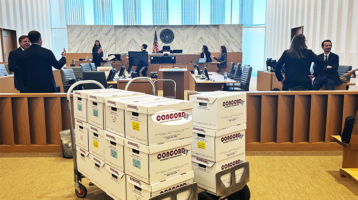
A trial binder that arrives with a missing exhibit, an incorrect Bates range, or tabs that do not match counsel’s outline creates a problem no legal team needs on a hearing morning. First Street Federal Courthouse exhibit binder printing requires more than fast copies. It requires controlled production, careful version management, secure handling, and a delivery plan built around the realities of federal litigation.
Call CONCORD today! (213) 745-3175 … cs@concorddt.com
For attorneys, paralegals, and litigation support professionals, the binder is often the physical working record of a complex matter. It may be used at counsel table, in witness preparation, during a deposition designation dispute, or as a backup when courtroom technology is unavailable. The production standard must reflect that role.
What First Street Federal Courthouse Exhibit Binder Printing Requires
A properly prepared exhibit binder starts with a complete, approved source set. That sounds basic, but late substitutions, revised demonstratives, changed deposition clips, and duplicate document families can quickly create conflicts between a binder index and its contents. Before printing begins, the production team should know which files are final, which are reference-only, and who has authority to approve last-minute changes.
Bates accuracy is equally critical. A binder should preserve the document numbering used in discovery and motions practice, including prefixes, leading zeros, and any existing confidentiality designations. If an exhibit is being created from native material, emails, or scanned records, the production workflow should identify whether the item needs conversion, image quality review, slip sheets, or additional labeling before it reaches the binder stage.
Federal matters also call for discretion. Exhibit binders can contain sensitive corporate records, personal information, protected materials, sealed filings, or work product. A production provider should handle source files through a defined chain of custody, limit access to authorized personnel, and maintain the discipline expected in high-stakes legal work.
Build the Binder Around How the Team Will Use It
The right binder format depends on the proceeding. A short evidentiary hearing may call for concise, tabbed binders with a clean index and one exhibit per tab. A lengthy bench trial may require multiple volumes organized by witness, issue, or exhibit range. There is no single format that works for every case, which is why production should begin with the litigation team’s actual use case.
A practical binder plan identifies the number of sets needed for the court, opposing counsel, witnesses, experts, and the internal trial team. It also accounts for reserve sets. A replacement binder is not an unnecessary expense when a key copy is misplaced, marked up beyond use, or needed in a different room during preparation.
Binder components commonly include a printed cover identifying the matter and volume, a detailed index, numbered divider tabs, exhibit cover sheets, and clearly marked confidentiality pages where appropriate. For large records, durable D-ring binders may make it easier to add a late-approved document. For a fixed, presentation-ready set, post binders or professionally bound volumes can provide a more controlled final product. The choice depends on whether the record is still moving.
Indexes and tabs are operational tools
An index should help counsel find a document under pressure, not simply satisfy a filing checklist. It should track the exhibit number, Bates range, short description, and volume or tab location. If the team has an exhibit list maintained in a spreadsheet or case database, that information should be reconciled before tabs are produced.
Tabs should match the terminology trial counsel uses. A tab labeled with a generic file name may be technically correct but unhelpful in a live proceeding. Clear exhibit numbers and concise descriptions reduce the risk of reaching for the wrong document during examination.
Image quality cannot be assumed
Poor scans, faint originals, color-coded annotations, oversized engineering drawings, and email threads all require inspection. A document that looks acceptable on a monitor may be difficult to read once printed, especially if it contains small type, highlighted text, or redline changes. Color printing may be necessary where color carries evidentiary meaning, while black-and-white production may be appropriate for routine materials and budget control.
The trade-off is straightforward: color, specialty stock, oversized pages, and intensive finishing increase production time and cost. They are worthwhile when they make the record clearer or preserve meaning. They should not be used as a substitute for organizing the evidence correctly.
A Production Checklist Before Files Go to Print
The most preventable exhibit-binder errors occur when instructions are incomplete. Before releasing a job, the litigation team should confirm the following production decisions:
- Final approved exhibit list, with any withdrawn or superseded items clearly identified
- Required number of sets, volumes, and reserve copies
- Bates range, confidentiality language, and any required footer or cover-sheet treatment
- Tab labels, index format, color requirements, and treatment of oversized or native-file exhibits
- Delivery contact, requested arrival time, and the designated person authorized to receive the binders
This review is especially valuable when several people have contributed files. A paralegal may be working from the exhibit list, an associate may be revising demonstratives, and a vendor may be receiving materials from litigation support. One designated approval point prevents production from moving forward on a mixture of drafts.
Delivery Planning Matters as Much as Print Quality
First Street Federal Courthouse exhibit binder delivery should never be treated as an afterthought. Security procedures, recipient availability, courthouse access rules, and courtroom-specific instructions can affect the handoff. A courier may be able to reach the courthouse but still be unable to deliver directly to a courtroom or chambers without prior coordination.
The dependable approach is to confirm the recipient’s name, mobile contact information, arrival window, and preferred handoff location before dispatch. Teams should also allow time for building entry and security screening. Where direct courthouse delivery is not permitted or is impractical, delivery to counsel’s office, hotel, war room, or a designated team member may be the better choice.
For urgent matters, overnight production capacity has real value, but it does not eliminate the need for a clear cutoff and a controlled final-file release. A last-minute binder can be produced quickly. It cannot be made accurate if nobody has confirmed which version is final.
When Digital Files Still Need a Physical Trial Set
Electronic trial presentation is standard in many federal proceedings, but physical binders remain essential. They provide a dependable fallback if a display system fails, a courtroom connection is delayed, or a witness needs to review a document away from a screen. They also give attorneys a marked, familiar reference set that can be used without searching folders during a fast-moving examination.
The strongest workflow connects the physical binder to the electronic record. Source files can be organized through a legal document production process, reviewed against the exhibit list, printed with consistent Bates information, and retained in a controlled digital repository. This is particularly useful when a case includes scanned hard-copy records, email collections, mobile-device evidence, or documents reviewed in a platform such as RelativityOne.
Concord Document Technologies supports this broader workflow with legal copying, high-volume digital printing, scanning, Bates labeling, eDiscovery support, and trial exhibit production. For matters moving quickly through Los Angeles federal court, one accountable production partner can reduce the handoffs that create version and delivery errors.
Choose a Provider Built for Legal Deadlines
A general print shop may produce an attractive binder, but legal exhibit production demands different controls. The provider should understand document confidentiality, exhibit sequence, Bates conventions, quality checks, and the consequences of a late or incomplete set. Ask whether the team can handle late-night production, whether sensitive materials are managed by trained personnel, and how the final job is checked against instructions before dispatch.
Capacity also matters. A few binders can become dozens of sets when a hearing expands or multiple parties need complete copies. The right provider has the equipment, staffing, finishing capability, and delivery coordination to scale without changing the standard of care.
When the record is headed to First Street, treat every binder as a litigation tool rather than a printing order. Confirm the source set, control the final version, plan the handoff, and give counsel a physical record they can trust when the courtroom is waiting.