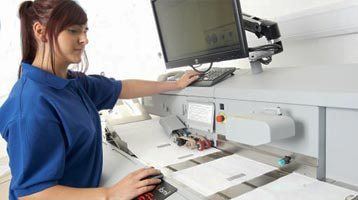
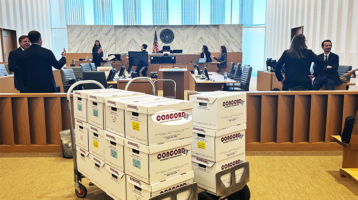
When a hearing is moved up, a judge requests chambers copies, or opposing counsel drops late-filed exhibits into the record, trial exhibit binders overnight stop being a convenience and become a case-critical requirement. At that point, speed matters, but speed without control creates its own risk. A binder that arrives on time but contains the wrong tabs, missing stamps, or inconsistent indexing can create avoidable problems in court.
For legal teams, the real issue is not whether binders can be assembled quickly. Plenty of providers can print fast. The question is whether the production process holds up under litigation pressure, with the right chain of custody, version control, labeling discipline, and delivery coordination to match the procedural demands of the matter.
Call CONCORD today! (213) 745-3175 … cs@concorddt.com
What overnight trial exhibit binder service actually needs to cover?
A true overnight service is more than after-hours printing. It typically involves receiving updated exhibit lists, reconciling document versions, confirming whether the set is for court, witness, opposing counsel, or internal use, and then producing binders that are immediately usable the next morning. That means tabs, cover sheets, spines, indexes, separator pages, Bates or trial exhibit labels, and quality control all need to happen in sequence without delays.
The pressure point is usually not the physical assembly. It is the decision-making around the binder. Which version of Exhibit 42 is final? Does the court want side tabs or bottom tabs? Are color originals needed for key photos, diagrams, or medical records? Is there a sealed subset that cannot be packaged with the general set? If those questions are not managed correctly, overnight production can become expensive rework.
In high-stakes matters, legal support teams also need to think beyond one binder. A single overnight request may involve multiple complete sets for the courtroom, the judge, the witness stand, trial counsel, and internal backup. Each set may require slight differences. A witness binder may exclude privileged material. A chambers set may need a specific cover page format. Those distinctions are where experienced legal document providers earn their value.
Why trial exhibit binders overnight can fail
Most failures come from handoff problems, not equipment limitations. Files arrive from multiple sources. Exhibit numbering changes late. Email chains contain conflicting instructions. Someone approves a draft index while someone else sends revised PDFs ten minutes later. If there is no disciplined intake and production workflow, the binder reflects the confusion.
Formatting is another common issue. Trial teams often assemble exhibits from scans, native exports, deposition transcripts, photos, spreadsheets, and correspondence. These files do not always print uniformly. Page sizes vary. Orientation is inconsistent. Optical character recognition may be irrelevant to the printed set, but poor image handling still affects readability. A production team that understands litigation documents will normalize those issues before the binder is built.
Delivery can also be the weak link. Overnight means very little if the final mile is vague. Court-specific timing, building access, messenger coordination, and recipient confirmation all matter. For firms filing or appearing in busy courthouses such as Stanley Mosk or First Street Federal, execution depends on understanding the practical realities of courthouse delivery, not just putting a shipping label on a box.
What legal teams should expect from an overnight provider
An overnight provider should operate like an extension of litigation support, not a generic print shop. That starts with intake. Instructions should be confirmed clearly, including quantity, tab scheme, index format, delivery destination, deadline, and any confidentiality restrictions. If production involves late revisions, there should be a defined cutoff and a process for documenting post-cutoff changes.
Quality control must be built into the job, not added at the end as an afterthought. That includes checking binder order against the index, verifying tab sequence, confirming print quality, and making sure all required copies are present. For matters involving protective orders, agency records, personnel files, medical records, or trade secret material, confidentiality controls should be as serious as the production timeline.
Legal teams should also expect the provider to ask intelligent questions. If nobody is asking whether the exhibit list matches the latest pleadings, whether over-sized documents need foldouts, or whether color sections should be duplicated in black and white for additional sets, that is a warning sign. Fast service is valuable. In legal production, informed service is what prevents mistakes.
The operational advantage of one provider for print and digital workflows
Overnight binders are often the visible output of a larger document workflow. The exhibits may come from scanned banker boxes, collected mobile device data, downloaded email productions, or attorney review exports. When those upstream processes sit with different vendors, overnight production becomes harder because every transfer adds delay and risk.
That is why many law firms and institutional clients prefer one provider that can manage scanning, Bates labeling, digital printing, review support, and final exhibit production in a coordinated environment. If the same team that handled document intake or hosted attorney review also supports trial prep, there is less guesswork around document versions and less time lost tracking source files.
For complex matters, this integrated model is especially useful when overnight requests are tied to ongoing discovery events. A late production from an opposing party may need to be reviewed, marked, and added to next-day court binders within hours. That kind of turnaround is easier when the production partner already understands the case materials and maintains the necessary infrastructure to shift from digital workflow to physical production without friction.
Where precision matters most in trial exhibit binders overnight
The most important detail is usability in court. A binder should let attorneys and staff find the right document immediately, under pressure, without second-guessing the index or flipping through unlabeled sections. Clean tabbing, logical organization, legible printing, and accurate page sequence matter more than flashy presentation.
There is also a practical balance between durability and speed. Heavier stock covers, reinforced tabs, and custom finishing can improve presentation, but not every overnight job benefits from additional complexity. If a binder is being used for a one-day hearing, a streamlined format may be the right choice. If it is a multi-week trial set that will be handled repeatedly by several users, stronger assembly and more durable tabs are worth the extra effort.
Color is another judgment call. It should be used where it adds evidentiary clarity, such as photographs, maps, financial charts, or highlighted timelines. It does not need to be used indiscriminately across every section. A credible provider will advise based on function, deadline, and budget, rather than defaulting to the most expensive option.
Court delivery, shipping, and timing realities
Not every overnight request follows the same path. Some sets need direct courthouse delivery early the next morning. Others should be shipped overnight to out-of-state counsel, experts, or co-counsel offices. Each route has different timing risks.
Courthouse delivery requires local knowledge and disciplined coordination. Shipping requires packaging that protects the binders, complete recipient information, and enough margin for carrier cutoffs. If the matter is truly urgent, firms should ask what backup plan exists if there is a late file revision, a building access issue, or a carrier delay. A provider that handles these jobs regularly will have a more realistic answer than one that simply promises fast turnaround.
This is where a production team with 24/7 capacity stands apart. Overnight legal work rarely starts at 9:00 a.m. It starts when trial prep runs late, when final exhibit stipulations are signed in the evening, or when a partner approves changes after business hours. Concord Document Technologies has built its reputation on supporting exactly that kind of legal deadline, with the production strength and litigation experience serious matters require.
How to reduce risk before you send the job
Even with an experienced provider, legal teams can make overnight binder production smoother by sending one clean set of instructions. The best overnight jobs have a final exhibit list, clearly named files, quantity by recipient type, and a direct contact who can approve questions quickly. If there are known uncertainties, flag them early rather than hoping they will sort themselves out during production.
It also helps to identify what cannot go wrong. Sometimes that is tab order. Sometimes it is color fidelity for key exhibits. Sometimes it is split packaging because one binder contains confidential material. When the production team knows the non-negotiables, they can focus quality control where it matters most.
Overnight trial binder service is not just about speed. It is about producing a court-ready set under pressure, with accuracy, custody, and delivery discipline intact. When the deadline is real and the record matters, the safest choice is the team that already knows how legal documents behave when there is no room for error.
The night before court is a bad time to discover your vendor is only a printer. Call the experts who understand the case file, the courthouse, and the deadline.