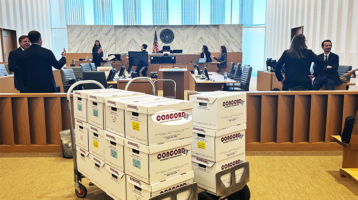
A box of legacy files arrives two days before a deposition. A custodian’s iPhone must be preserved before data changes. A court requires a production set with exact Bates ranges by morning. In each scenario, document processing is not an administrative back-office task. It is a litigation workflow that affects defensibility, attorney time, case strategy, and the ability to meet a hard deadline without compromising sensitive information.
For law firms, corporate legal departments, and government agencies, the issue is not simply converting paper into PDFs or loading files into a review platform. The work must preserve source integrity, maintain chain of custody, make information searchable, apply the correct production specifications, and remain responsive when the scope changes. That requires an experienced partner with both physical production capacity and electronic discovery capability.
Document Processing Is a Litigation Workflow
Legal matters generate information in many forms: banker boxes, medical records, engineering drawings, email archives, mobile-device data, native spreadsheets, prior productions, and hard-copy exhibits marked during witness preparation. Each format has different handling requirements. Treating them as one undifferentiated pile creates unnecessary risk.
A defensible workflow begins at intake. Materials should be inventoried, tracked, and assessed for condition, volume, confidentiality, and downstream use. Original records may need secure pickup, onsite scanning, or controlled processing in a production facility. Electronically stored information may require forensic collection and preservation before filtering, review, or export. The right path depends on the matter, the source, governing obligations, and the receiving party’s specifications.
This is why a provider that understands both litigation support and eDiscovery is materially different from a general print shop or a standalone software vendor. Legal teams need execution across the full chain: collection, scanning, coding, OCR, indexing, hosting, attorney review support, production, and trial presentation materials.
Intake and chain of custody set the foundation
If the origin and movement of records cannot be explained, later processing accuracy has limited value. Every transfer should be documented, whether records are collected from an office, received through a secure delivery, scanned onsite, or ingested from a custodian’s account or device.
For sensitive records, access controls matter as much as speed. Files may contain privileged communications, personally identifiable information, protected health information, trade secrets, law-enforcement material, or confidential business records. Bonded and insured personnel, documented handling procedures, and secure production environments help legal teams meet their confidentiality obligations while keeping a matter moving.
Physical records also need practical judgment. Staples, tabs, oversized pages, handwritten notes, fragile originals, and mixed-color documents can affect scanning quality and later review. A fast scan that loses a margin annotation or fails to capture a color-coded exhibit can create more work than it saves.
From Paper Files to Searchable Evidence
Scanning is often the visible part of document processing, but quality control determines whether the resulting images are useful. Legal scanning should deliver legible, complete images with appropriate resolution, correct orientation, and reliable document breaks. Depending on the project, the output may include single-page TIFFs, searchable PDFs, native files, or a format specified in a discovery protocol or court order.
Optical character recognition, or OCR, gives scanned documents searchable text. That can reduce the time attorneys and review teams spend manually locating names, dates, contract terms, or key events. OCR is especially valuable for older files and paper-heavy investigations, but it is not perfect. Faint copies, handwriting, stamps, unusual fonts, and poor originals can reduce accuracy. Quality checks and targeted reprocessing are often necessary for documents central to the case.
Coding and indexing add another layer of control. A matter may require document-level fields such as date, author, recipient, document type, confidentiality designation, or custodian. Trial teams may need exhibit labels, folder structures, bookmarks, and hyperlinked indices. The correct level of coding depends on how the materials will be used. Over-coding routine material wastes budget; under-coding a trial-critical record set can slow the team when time is most limited.
Bates labeling must also be handled with care. Numbering should be consistent, legible, and placed according to the production agreement. Any changes to document families, redactions, or replacement pages can affect numbering integrity. A disciplined production team plans for these details rather than trying to repair them after files have been distributed.
Electronic Data Requires a Different Discipline
Email, cloud content, chat messages, and mobile devices are not merely digital versions of paper. They carry metadata, attachments, relationships, and system information that may be relevant to collection, authentication, review, and production. A screenshot or informal export can omit material information and may be difficult to defend.
Forensic data collection is appropriate when preservation requirements are high or when the source may change. iPhone and email collections, for example, should be performed with methods that preserve relevant data while documenting the source and collection process. The precise approach depends on the device, account environment, consent, applicable policy, and legal requirements. The objective is not to collect everything without judgment. It is to collect what is necessary in a manner that can withstand scrutiny.
After collection, processing prepares data for review. This may include extracting metadata, deduplicating files, preserving family relationships, filtering by date or custodian, identifying system files, and preparing exception reports. Every filtering decision has a trade-off. Aggressive culling can reduce review cost, but it can also remove material that should be considered. Legal teams need clear reporting and consultation before consequential decisions are applied.
For matters requiring hosted review, platforms such as RelativityOne can provide a controlled environment for searching, tagging, redacting, producing, and managing review teams. Technology does not replace process. It gives the team a place to execute a well-defined process, with permissions, reporting, and production controls that fit the matter.
Production Must Be Defensible and Usable
A production is more than a folder sent to opposing counsel. It is a deliverable that must conform to agreed specifications and remain usable by its recipient. Common requirements include image files, load files, extracted text, native productions, metadata fields, confidentiality designations, and redactions. A small formatting error can delay delivery, trigger disputes, or force costly rework.
Before release, a production should be validated against the requested format and against the source population. Quality control may include checking Bates ranges, document counts, parent-child relationships, redaction burn-in, text availability, native-file naming, and load-file compatibility. The review should also confirm that privileged or restricted material has not been included inadvertently.
The same discipline applies to paper or courtroom-ready materials. Trial exhibit binders require accurate tabs, clear labels, complete inserts, and a logical organization that lets counsel find a document instantly. When a hearing is imminent, overnight delivery to Stanley Mosk, First Street Federal, Superior Courthouses, or another venue may be as important as the production itself. Speed matters, but only when paired with verification.
Choosing the Right Document Processing Partner
The right provider should be evaluated on more than a price per page or per gigabyte. High-stakes matters require operational depth, available capacity, and people who can recognize a litigation issue before it becomes a deadline problem.
Ask how the provider documents chain of custody, manages restricted data, performs quality control, and handles exceptions. Confirm whether the team can support onsite and offsite work, accommodate overnight production, process physical records and electronic data under one engagement, and scale when a matter expands unexpectedly. Also ask who will be available after standard business hours. A 24/7 production claim should mean there is a real operating capability behind it.
Experience with regulated and sensitive records is particularly relevant for matters involving public agencies, financial information, healthcare data, employment files, or high-profile litigation. The provider should understand that security, responsiveness, and documentation are not optional extras. They are part of the work product.
Concord Document Technologies supports these integrated workflows with legal scanning, copying, forensic collection, RelativityOne-based review support, digital printing, litigation production, and trial exhibit services. For matters that cross from paper archives to mobile data to courtroom exhibits, one accountable team can reduce handoffs and provide clearer control over the process.
The next time a document-intensive matter lands with an impossible-looking deadline, start by defining the source, the required output, the security constraints, and the decision points that need attorney input. That early discipline gives the legal team something more valuable than faster files: confidence that the record will be ready when the case demands it.