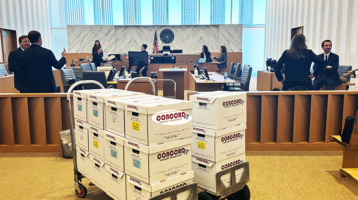
A trial binder that looks right on a conference-room table can still fail at the courthouse. A missing tab, an exhibit printed two-sided when it should be single-sided, or a late correction inserted into only one set can slow counsel down at the exact moment the record needs to be clear. Santa Monica courthouse trial binder printing requires more than fast copying. It requires disciplined production, careful instructions, and a legal support team that understands how courtroom materials are used.
For attorneys, paralegals, and litigation support professionals, the objective is straightforward: place complete, legible, properly organized materials in the hands of the trial team without creating a last-minute production problem. That objective becomes harder when pleadings, demonstratives, deposition designations, confidential records, and exhibit lists are all moving at once.
What Court-Ready Trial Binders Need to Accomplish
A trial binder is a working tool, not a presentation piece. Counsel must be able to find an exhibit quickly, confirm that the correct version is in front of the witness, and follow along with the court, opposing counsel, and the client team. Production choices should support that use.
The best format depends on the matter. A concise bench binder may require only pleadings, key orders, witness outlines, and a tabbed exhibit index. A complex commercial, employment, or regulatory trial may require multiple coordinated sets: attorney binders, witness binders, court copies, exhibit binders, and separate confidential or attorneys’-eyes-only materials. The quantity is less important than version control across every set.
Each binder should be assembled to a defined specification. That generally includes the binder type and spine width, tab sequence, divider language, pagination instructions, print orientation, color requirements, and whether documents should be hole-punched, stapled, clipped, or left loose. When a production team receives those decisions in writing, it can build a reliable quality-control process around them.
The exhibit index is the production map
The exhibit list is often the document that determines whether a binder is usable under pressure. It should correspond exactly to tab labels and the documents behind them. If Exhibit 42 is revised, renumbered, or withdrawn, the change needs to be reflected throughout the affected binder sets.
For that reason, send the latest exhibit index with the source files and clearly identify the controlling version. If changes are expected, establish a cutoff time and a procedure for late additions. A vendor can accommodate an urgent update, but clear instructions prevent a single correction from turning into a full reprint.
Santa Monica Courthouse Trial Binder Printing: Plan for the Last Mile
Courthouse delivery is a legal logistics assignment. The production schedule must account for final attorney review, any required corrections, binder assembly, quality checks, packaging, and delivery coordination. A binder finished at the printer is not necessarily a binder ready for use.
Start by identifying where the materials must go and who is authorized to receive them. Confirm the recipient’s name, mobile number, department or courtroom information when available, delivery deadline, and whether the materials should be delivered to counsel, a runner, an office, or another approved location. Court operations and access conditions can change, so avoid relying on assumptions from a prior appearance.
The timing should reflect the consequences of delay. If the binder is needed for a morning hearing, completing the job the night before may be appropriate only if delivery and receipt have been confirmed. For a high-stakes trial day, producing an additional sealed contingency set can be prudent. The right approach depends on the size of the set, the distance to the delivery point, and whether the legal team expects overnight revisions.
Separate production deadlines from filing deadlines
A court deadline and a printing deadline are not the same thing. Documents may be filed electronically by one time, but trial materials may still need final approval, printing, assembly, and physical delivery afterward. Build enough time for the people who must review the finished materials, not just the people who submit the source PDFs.
This distinction matters most with late evidentiary rulings and revised witness examinations. If a document may be excluded, substituted, or used only for impeachment, it should not be treated like a routine print job. Flag those materials so they can be produced in a separate, clearly marked set or held for final instruction.
Control the Source Files Before Production Begins
Most trial-binder errors begin before printing. Source files can contain duplicate pages, incomplete scans, unreadable exhibits, mixed page sizes, broken bookmarks, or Bates ranges that do not match the exhibit list. These issues are manageable when discovered early and expensive when discovered after binders are assembled.
Provide final PDFs whenever possible, along with a written binder manifest. The manifest should identify each tab, the corresponding file name, the number of copies, print instructions, and any special handling requirements. If the production includes native files, oversized plans, photographs, color demonstratives, or media, call those out separately rather than burying the instruction in an email thread.
Bates labeling also requires a deliberate decision. If documents have already been Bates stamped for discovery, the trial set may need to preserve those labels exactly. If trial exhibit labels are being added, confirm their placement so they do not cover existing bates numbers, signatures, annotations, or document text. A small label-placement choice can become significant when a witness is asked to identify a page on the record.
Color, size, and readability are evidentiary considerations
Not every document needs color production. Routine correspondence or black-and-white pleadings may be fully effective in grayscale. Photographs, spreadsheets with color-coded fields, medical images, maps, and demonstratives may not be. The production plan should distinguish between documents that can be printed economically and documents whose meaning depends on color fidelity.
Likewise, do not force every page into letter size. Large spreadsheets and engineering drawings may be easier to use as foldouts, reduced-format inserts, or separately mounted boards. The best choice depends on how counsel intends to use the item in court and whether the court, witness, and examining attorney need to view it simultaneously.
Protect Confidentiality and Chain of Custody
Trial binders frequently include personal information, trade secrets, protected health information, financial records, or material subject to a protective order. Physical production should be treated with the same care as electronically stored information.
Use secure file transfer methods, limit access to the assigned production team, and maintain clear instructions for materials that require special handling. Completed binders should be packaged to prevent mix-ups between matters, parties, or witness sets. When sensitive records are involved, labeled sealed packages and documented handoff procedures provide a practical record of who received the materials and when.
This is also where a legal document provider’s experience matters. General print shops can produce pages and tabs, but high-stakes matters benefit from teams accustomed to confidential legal records, production logs, version-sensitive materials, and after-hours changes. Concord Document Technologies has supported document-intensive litigation workflows since 1996, combining secure legal printing and trial exhibit production with scanning, Bates labeling, eDiscovery, and forensic collection services when the matter requires broader support.
A Practical Final Review Before Delivery
Before the binders leave production, the final review should compare a completed set against the approved manifest and exhibit index. The review is not merely a page count. It should confirm that the right documents appear behind the right tabs, tab labels are readable, pages are oriented correctly, color pages are present where required, and every set contains the same approved materials.
For larger matters, review one master set in detail, then conduct consistency checks across the remaining sets. This approach is efficient, but only when the master set itself has been carefully validated. If attorney work product, confidential exhibits, or witness-specific materials are included, those should receive an additional recipient-level check.
Packaging should make the delivery easy to receive and easy to verify. Mark each carton or package with the matter name, binder range, number of sets, and recipient instructions without disclosing unnecessary confidential detail. Include a packing list when the shipment contains multiple volumes or separate exhibit categories.
Choose a Provider Built for Litigation Timing
The lowest per-page price is rarely the deciding factor when a trial team is preparing for court. The meaningful question is whether the provider can execute the complete assignment accurately: interpret legal production instructions, accommodate changes, protect sensitive information, assemble consistent sets, and coordinate delivery on the required timeline.
Ask about 24/7 production capacity, rush procedures, quality control, secure handling, and the ability to support related needs such as scanning, copying, exhibit labeling, electronic review, or overnight shipping. The answer may determine whether your team manages one vendor relationship or spends the final hours before court coordinating several.
When the record matters, trial binders should not be an afterthought. Give the production team a clean manifest, a confirmed delivery plan, and enough time to perform real quality control. That preparation gives counsel one less variable to manage when the courtroom day begins.