A production set can look complete and still create a serious problem if its identifiers shift, duplicate, disappear, or fail to match the load file. PDF Bates numbering is the control that lets counsel, reviewers, experts, and the court refer to the same document page with confidence. In high-stakes litigation, investigations, and regulatory responses, it is not a cosmetic finishing step. It is part of the production record.
Why PDF Bates Numbering Matters in Legal Work
A Bates number gives every produced page a unique, sequential reference. That reference becomes the common language of the matter: a deposition question cites it, a privilege log may reference it, an expert report relies on it, and a trial exhibit list may inherit it. When documents move between native files, TIFF images, searchable PDFs, review platforms, and printed exhibit binders, a reliable numbering plan maintains continuity.
The risk of getting it wrong is practical and immediate. A duplicate range can create confusion over which document was produced. A skipped prefix can cause a review team to question whether a family is incomplete. A number placed over text can obscure evidence. A late correction can require revised production media, replacement PDFs, updated metadata, and notice to opposing counsel.
The right approach depends on the production protocol, court order, and the matter’s volume. A small stipulated production may only need a clean sequential range and readable placement. A rolling production involving multiple custodians, confidentiality designations, and electronically stored information requires stricter controls. The numbering system should be decided before files enter final production, not after thousands of pages have been converted.
Build the Numbering Plan Before You Stamp
The strongest productions begin with a written specification. It does not need to be long, but it should state the prefix, starting number, digit length, placement, font, color, and treatment of attachments, slip sheets, and native productions. It should also identify who can approve exceptions and who performs the final quality check.
A prefix distinguishes one producing party or collection from another. For example, a party might use `ACME_0000001` rather than a bare number. Prefixes are particularly useful in multiparty disputes, coordinated matters, or productions assembled from several business units. They reduce the chance that a citation such as “0001250” points to more than one source.
Digit length deserves attention. A seven-digit number may be sufficient for a modest matter, while an eight- or nine-digit range provides room for large collections and continuing productions. Changing the digit length halfway through a case can complicate sorting and references. Plan for realistic growth, especially when the first production is only a fraction of the expected data population.
Placement should be consistent and legible. The lower right corner is common, but it is not automatically correct for every document. A stamp can collide with footer text, page numbers, handwritten notes, or scanned content. Before processing the full set, review representative samples that include pleadings, spreadsheets, photographs, emails, medical records, engineering drawings, and poor-quality scans.
Color is also a production decision, not merely a design choice. Black numbering is generally easy to reproduce and read. Red may be useful for printed trial binders, but it can be less suitable when a document contains red annotations or when a stipulated protocol requires black-and-white images. The production specification should settle these details early.
Preserve Families and Production Order
Email families require special care. The parent email and its attachments are usually kept together in logical sequence, so the attachment begins with the next available Bates number after the email ends. Breaking a family apart can make review and later authentication more difficult, even if every page has a valid number.
Production order can follow several approaches: document date, custodian, source folder, or an order generated by an eDiscovery platform. There is no universal answer. The important point is that the order must be deliberate, reproducible, and reflected in the metadata and load files. If documents are resorted after numbering, their Bates ranges may no longer align with the expected record.
Applying PDF Bates Numbering Without Creating New Risk
A PDF is often treated as the final production format, but not all PDFs behave the same way. Some are text-based, some are image-only scans, some contain embedded attachments, and some include page sizes or orientations that vary within a single document. A dependable workflow identifies these differences before numbering begins.
For straightforward, low-volume PDFs, a controlled software workflow may be appropriate. The operator should work from a verified source set, save a separate produced version, and maintain a production log showing the range assigned. The source files should not be overwritten. That separation matters when a later question arises about whether a stamp, redaction, or conversion altered the original.
For larger productions, the process should be integrated with conversion, endorsement, redaction, OCR, and load-file generation. Applying Bates labels in isolation can create avoidable mismatches. A page may be numbered correctly in the PDF but absent from the image volume, listed incorrectly in metadata, or tied to the wrong document boundary in the review database.
Native productions require a defined substitute. If a spreadsheet, database export, audio file, or other native item cannot be meaningfully stamped page by page, the protocol may call for a placeholder or slip sheet carrying the Bates identifier. The corresponding native file name, metadata record, and placeholder should point to the same production reference. This allows counsel to cite the item without pretending that a native file has conventional pages.
Redactions must be completed before final numbering whenever possible. If the redacted document is later regenerated, page counts can change and invalidate the assigned sequence. Where late redactions are unavoidable, the production team should determine whether replacement pages, a supplemental range, or a full corrected production is required under the governing agreement.
Quality Control Is What Makes the Numbers Defensible
Bates numbering should be checked as a production-level control, not simply viewed on a few pages. A sound QC process verifies that the first and last numbers match the production log, numbering is sequential, prefixes are correct, and no numbers are duplicated. It also confirms that every page intended for production received an identifier and that excluded pages did not accidentally enter the range.
Visual inspection remains necessary. Automated checks can identify sequence problems, but they cannot reliably judge whether a stamp covers a signature, is cut off at the page edge, or becomes unreadable on a rotated scan. Reviewers should sample document types and page orientations, then inspect any exceptions identified by the system.
The following controls are especially valuable for sensitive or high-volume productions:
- Reconcile the total produced page count against the assigned Bates range.
- Compare PDF endorsements with the load file’s beginning and ending Bates fields.
- Confirm parent-child relationships for emails and attachments.
- Test searchable text and redactions in the final, produced files rather than in an earlier working copy.
- Retain a dated production log, source inventory, and record of any corrected or supplemental ranges.
These controls are not paperwork for its own sake. They allow the producing party to answer basic questions quickly: What was produced? When? Under which range? Was the cited page included? If a dispute develops, that record can be far more useful than recreating a workflow from email threads and temporary folders.
Coordination Across Review, Copying, and Trial Preparation
The value of a consistent Bates range increases as the matter progresses. Attorneys can search and cite documents accurately in a review platform. Litigation support teams can build deposition sets from stable references. Trial teams can prepare exhibit binders without manually renumbering pages. When a document needs to be printed, copied, or presented in court, the identifier should remain visible and consistent with the produced version.
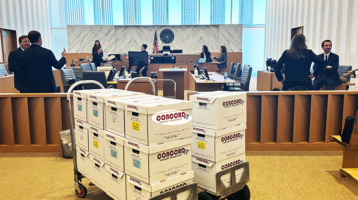
This is where one-provider coordination can reduce risk. Concord Document Technologies supports document scanning, legal copying, RelativityOne-based review workflows, production processing, and trial exhibit preparation under controlled procedures. For matters that require both electronic production and overnight courthouse-ready binders, continuity between those workflows helps protect the record from avoidable handoffs and version changes.
There are still circumstances where a different process is appropriate. A court may prescribe its own exhibit labels. Parties may agree to use TIFF images rather than PDFs. A confidential or attorney-eyes-only designation may need to appear beside the Bates number. The production specification should accommodate those requirements without compromising the uniqueness and readability of the underlying identifier.
When the page number becomes the citation everyone relies on, it deserves more than a last-minute stamp. Set the range early, preserve the source, verify the output, and keep a production record that can withstand the pace of litigation.