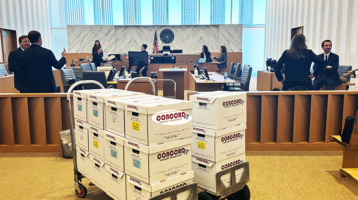
A mediation can turn on a single timeline, contract provision, damages chart, or photograph. Mediation exhibit printing is not simply a production task completed the night before a session. It is a strategic part of presenting the case in a format a mediator, decision-maker, adjuster, or opposing party can absorb quickly and trust.
When the record is extensive, counsel needs more than a stack of documents. They need organized, accurate, and visually controlled materials that put the relevant facts in front of the right people without distracting production errors, missing pages, or confusing labels. The goal is not to try the case at mediation. The goal is to make risk understandable enough to support a serious settlement discussion.
Why Mediation Exhibits Need a Different Approach
Trial exhibits are often designed for formal admission, witness examination, and use in a courtroom setting. Mediation materials serve a different purpose. They must help participants evaluate the matter under time pressure, often after reviewing competing briefs, confidential submissions, and a substantial factual record.
That distinction affects production decisions. A fifty-page exhibit may be technically relevant but ineffective if the key provision is buried on page 37. A damages spreadsheet may be accurate but unhelpful if its columns are too small to read across a conference table. A chronological record can be powerful, but only when dates, source documents, and major events are presented in a sequence that makes immediate sense.
Effective exhibit sets give counsel control over how the record is encountered. They allow the mediation team to direct attention to the documents that establish liability, causation, notice, damages, mitigation, or a disputed contractual obligation. They also give the mediator usable reference materials for caucuses, where a well-marked exhibit can carry more weight than a broad description of the evidence.
Mediation Exhibit Printing Starts With a Production Plan
The strongest exhibit production begins before files are sent for printing. Counsel and litigation support teams should identify who will use the materials, how they will be used, and what form will best support the session.
A mediator may need a concise shared exhibit book. The client representative may need a separate binder with selected damages support and internal notes excluded. Counsel may need a working set with tabbed sections, outlines, and larger-format demonstratives. If a mediation is hybrid or remote, corresponding electronic files may be needed for screen sharing or secure distribution.
Those audiences do not always require identical materials. Producing one generic binder for everyone can create avoidable confidentiality concerns or leave key participants without the context they need. A production plan should establish which exhibits are shared, which are confidential, which are attorney work product, and whether any material will be exchanged with the other side before the session.
It should also establish a final source of truth. Late revisions are common in active litigation. Without a controlled file set, teams can accidentally print superseded reports, incomplete email threads, or an earlier version of a settlement analysis. Version control is especially critical when multiple offices, experts, insurers, and co-counsel are contributing documents.
Build for Fast Understanding
Exhibit selection should follow the story of the dispute, not the order in which documents were collected. In most matters, a concise group of clearly organized exhibits is more persuasive than a comprehensive record that requires the reader to hunt for the point.
Use meaningful section titles and divider tabs. Keep Bates numbers visible where appropriate, particularly when the documents have already been produced in discovery. Include a clean exhibit index that identifies the document, date, source, and Bates range. For lengthy documents, consider excerpting the relevant pages while preserving enough surrounding context to avoid claims of selective presentation.
The right approach depends on the dispute. In a commercial case, the operative contract, amendment history, correspondence showing notice, invoices, and a damages analysis may form the core set. In an employment matter, the timeline may need to connect personnel records, complaints, investigation documents, performance history, and wage records. In a construction or insurance dispute, large-format plans, photographs, repair estimates, and expert visuals may be central to the discussion.
Production Details That Affect Credibility
Small production failures can create disproportionate friction at mediation. A divider tab that does not match the index, a missing continuation page, inconsistent Bates labels, poor color reproduction, or an unreadable spreadsheet gives the other side an opening to question the care behind the presentation.
Legal teams should confirm pagination, orientation, document breaks, color requirements, and exhibit numbering before release. Every binder should be checked against the final index. If documents are printed double-sided, teams should verify that tabs, foldouts, and mixed page orientations remain easy to navigate. For critical materials, a page-by-page quality-control review is worth the time.
Color is not cosmetic when meaning depends on it. Highlighted contract language, redline comparisons, medical imaging, photographs, maps, native spreadsheets, and data visualizations can lose critical detail in black and white. At the same time, full-color production is not automatically necessary for every record. A disciplined approach reserves color for pages where it improves comprehension and controls cost on routine text documents.
Paper stock and binding should also fit the use case. A compact, professionally bound shared exhibit book may be appropriate for a single-day mediation. Larger working sets may call for durable three-ring binders with reinforced tabs, allowing counsel to insert late materials or reorganize sections. Oversized charts, site plans, and timelines may require mounted boards, foam-core displays, or wide-format prints that can be reviewed across a conference room.
Protect Confidentiality and Chain of Custody
Mediation often involves highly sensitive records: personnel files, medical information, financial data, trade secrets, privileged analyses, and materials subject to protective orders. The production process must protect that information as carefully as the legal team does.
Files should move through a controlled workflow with clear instructions on access, redactions, copy quantities, distribution lists, and delivery. Redactions must be reviewed in their final printed form, not only on screen. A redaction that appears solid in a PDF can fail if an underlying layer remains in an electronic file, while a print artifact can obscure more information than intended.
For confidential binders, label covers and spines consistently and avoid leaving sensitive descriptions visible in common areas. Maintain a count of produced sets and identify who receives each one. If materials are delivered directly to a mediation location, confirm the recipient, delivery window, and whether the package should be held for counsel or the mediator.
These safeguards matter even more when the session is scheduled on short notice. Speed should never mean abandoning production controls. Experienced legal document providers can maintain confidentiality, quality assurance, and documented handling while meeting overnight deadlines.
When Digital and Print Exhibits Should Work Together
A printed binder remains useful because it is immediate, stable, and easy to annotate during a difficult negotiation. Yet many mediations also require digital access. Remote participants may need secure electronic copies, and even in-person teams may want searchable PDFs available on laptops for quick reference.
The best workflow treats print and digital materials as coordinated formats, not competing choices. The printed index should correspond to the electronic folder structure. Exhibit numbers, document names, and Bates ranges should match across both versions. If counsel intends to display a timeline or damages model on screen, the printed counterpart should be legible enough for participants to follow without relying exclusively on the presentation.
Electronic discovery workflows can materially improve this process. Documents collected, processed, reviewed, and tagged in a managed review environment can be identified more efficiently for mediation use. That reduces the risk of manually pulling the wrong version and makes it easier to create targeted production sets from a larger case record.
Choose a Provider Built for Legal Deadlines
Mediation exhibit printing is often requested after briefing is complete, new settlement authority arrives, or the mediator asks for additional support. At that point, a general print shop may not understand Bates continuity, confidentiality designations, legal tabbing conventions, or the consequences of a missed delivery.
A legal document partner should be able to handle scanning, copying, Bates labeling, digital printing, exhibit binders, oversized graphics, secure file intake, and coordinated delivery under one controlled process. Ask about after-hours capacity, quality-control procedures, secure handling, and experience delivering to offices, mediation sites, courthouses, and hotel conference facilities.
For high-stakes matters, location and timing matter. A team mediating in Los Angeles may need binders delivered to counsel, a neutral’s office, or a downtown conference site before an early session. A provider with 24/7 production capacity and legal delivery experience can prevent logistics from becoming the issue everyone remembers.
Concord Document Technologies supports complex legal productions with the operational discipline required for sensitive records, compressed timelines, and exhibit sets that must be right the first time.
Before the mediation date is fixed, identify the documents that will frame the negotiation and give them the production attention they deserve. Clear, controlled exhibits help the mediator focus the conversation where it belongs: on the evidence, the exposure, and the practical path to resolution.