A banker’s box is not just paper when a filing deadline, regulatory inquiry, or trial date is approaching. It may contain privileged correspondence, original records, handwritten annotations, medical files, contracts, and evidence that must remain traceable from pickup through production. Document scanning for legal matters must therefore do more than convert pages into PDFs. It must create usable, defensible records without losing control of the source material.
For law firms, corporations, and government agencies, the right scanning workflow reduces the physical burden of a matter while supporting review, discovery, deposition preparation, and trial production. The standard is not simply whether a page is readable. The standard is whether the resulting image, metadata, index, and production process can withstand scrutiny.
What Legal Document Scanning Must Accomplish
Legal files arrive in inconsistent conditions. A collection may include clean letter-size pages, bound volumes, oversized engineering drawings, color exhibits, thermal fax paper, sticky notes, photographs, and fragile originals. Treating all of it as a routine office scan creates risk. Different materials require different handling, image settings, and quality controls.
A litigation-ready process begins with documented intake and chain of custody. Each box, file, or item should be identified before preparation starts, with clear records of where it came from, who handled it, and where it is stored. This matters when originals have evidentiary value or when documents contain confidential, personal, financial, health, or regulated information.
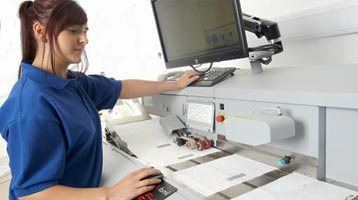
Preparation is equally important. Staples, clips, and bindings must be removed carefully, pages repaired when necessary, and documents kept in their original order unless the client directs otherwise. Separators, folder labels, and handwritten notes may contain context that is essential to review. A provider that scans only the pages and ignores the file structure can create significant downstream work for the legal team.
Document Scanning That Supports Review and Production
The value of document scanning is realized after the images are delivered. If files cannot be searched, sorted, identified, or loaded into the appropriate review environment, the conversion has solved only part of the problem.
OCR makes scanned records searchable
Optical character recognition, or OCR, turns image-based text into searchable text. This allows attorneys and reviewers to locate names, dates, terms, and concepts across a large collection without reading every page manually. OCR accuracy will vary based on source quality. Typed, clean documents generally perform well, while handwriting, low-resolution faxes, faded pages, and unusual fonts may require additional review.
OCR should not be mistaken for a substitute for the original image. The image remains the reliable visual record, particularly where formatting, signatures, annotations, stamps, or handwritten changes matter. The practical objective is to preserve both: a faithful image and a text layer that improves search and review speed.
Indexing preserves context
A scanned PDF named “Scan_001.pdf” has limited value in a large matter. Useful indexing can capture box numbers, folder titles, document dates, document types, custodians, client matter numbers, and other agreed fields. The appropriate index depends on the case and the intended workflow.
For a small set of transactional files, folder-level indexing may be sufficient. For a large litigation collection headed to attorney review, document-level identification and load-file-ready metadata may be necessary. There is a cost and timing trade-off: richer coding supports more precise retrieval, but it requires clearer instructions and additional quality control. The right scope should be determined before production begins, not after thousands of pages have been processed.
Bates labeling requires discipline
Bates numbering is more than a stamp at the bottom of a page. Numbering must be sequential, legible, correctly formatted, and applied according to production requirements. It must account for confidential designations, endorsements, slip sheets, native-file placeholders, and exhibit references where applicable.
A reliable provider verifies image counts, document breaks, and numbering continuity before release. Errors discovered after opposing counsel, a regulator, or the court receives a production can consume valuable time and undermine confidence in the process.
Security and Chain of Custody Are Not Optional
Sensitive legal records require safeguards that extend beyond a locked room. The service provider should be able to explain how materials are received, inventoried, transported, stored, scanned, accessed, and returned or securely destroyed. Bonded and insured operations, restricted access, trained personnel, and documented procedures are practical safeguards, not marketing language.
For onsite scanning, the same discipline applies within the client’s office, records facility, or secure location. Onsite work can be the right choice when records cannot leave the premises, when a matter involves particularly sensitive information, or when teams need immediate access to originals. Offsite processing may be more efficient for high-volume collections when secure logistics and around-the-clock production capacity are available.
Before work begins, legal teams should confirm the handling requirements for privileged material, personally identifiable information, protected health information, sealed records, and documents subject to agency or contractual restrictions. A blanket instruction to “scan everything” is rarely enough for a complex collection.
When Speed Matters, Planning Matters More
Emergency scanning requests are common in litigation. A hearing moves up. A client discovers a warehouse of files. A regulator issues a request. Trial counsel needs a searchable set of exhibits before the next morning. Fast turnaround is essential, but speed without a production plan can introduce avoidable errors.
A strong project intake identifies the source volume, document types, deadline, required resolution, color requirements, OCR needs, indexing fields, Bates format, delivery method, and treatment of originals. It also identifies the decision-maker who can resolve exceptions quickly. That preparation allows the production team to scale resources without repeatedly stopping for clarification.
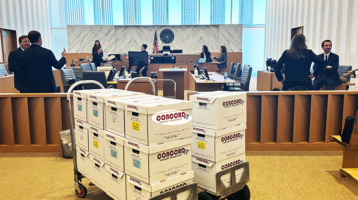
For active matters, 24/7 capacity can make the difference between a controlled overnight production and a last-minute scramble. In Southern California, legal teams preparing filings or trial binders for Stanley Mosk, First Street Federal, and Superior Court locations often need physical and electronic deliverables working in parallel. Scanned records may feed attorney review while selected documents are printed, Bates labeled, and assembled as exhibits.
Choose a Provider That Understands the Full Matter
The best scanning provider for a legal matter is not necessarily the lowest-cost per-page option. Per-page pricing may not reflect document preparation, oversized materials, color pages, OCR, indexing, quality assurance, secure transport, rush handling, or the work required to prepare files for a review platform.
Ask practical questions before assigning a large or sensitive collection:
- How are originals logged, secured, and returned?
- Can the team handle mixed media, oversized records, bound materials, and fragile documents?
- What quality-control checks confirm page completeness, image quality, document breaks, and Bates continuity?
- Can scanned records be prepared for attorney review, including RelativityOne workflows, when needed?
- Is trained support available after normal business hours when a production deadline changes?
These questions reveal whether a provider is equipped for legal operations or only for basic office conversion. They also help establish a clear statement of work, which protects both the client and the production team when the collection contains surprises.
A Single Workflow Reduces Handoffs
Complex matters often involve both paper evidence and electronically stored information. A legal team may need to scan hard-copy personnel files, preserve an iPhone, collect email, process data for review, and prepare trial exhibits from the resulting record. Managing each stage through a different vendor creates more transfers, more handoffs, and more opportunities for inconsistent instructions.
Concord Document Technologies supports this broader workflow by combining secure document scanning, legal copying, forensic data collection, online attorney review, digital printing, and trial exhibit production. For teams handling sensitive or time-critical matters, working with one experienced provider can simplify project management while preserving accountability across physical and electronic records.
The correct scanning plan depends on the facts of the matter, the condition of the records, and the deadline. Start with custody, clarity, and the end use of every file. When the scanning process is built around those requirements, the legal team receives more than digitized paper: it receives records ready to work when the matter demands them.