A litigation hold is issued at 4:30 p.m. The relevant custodians use iPhones, Microsoft 365, personal text messages, shared drives, and a legacy application no one in legal has touched in years. Outside counsel needs a case assessment by Monday. The business wants assurance that operations will not be disrupted. This is where eDiscovery services for general counsel become a matter of legal control, not simply document processing.
For general counsel, the risk is rarely limited to whether data can be collected. The real question is whether the organization can preserve, process, review, produce, and explain its decisions when the matter is under scrutiny. A defensible workflow must account for speed, proportionality, privacy, cost, and the practical demands of the dispute.
What General Counsel Should Expect From eDiscovery Services
A capable eDiscovery provider should help legal departments make sound decisions before data volume turns into review volume. That begins with early case assessment: identifying likely custodians, mapping relevant systems, estimating data sources, and determining where the most probative information is likely to reside.
The provider should then support a documented preservation plan. That may include legal-hold coordination, forensic collection from laptops and mobile devices, targeted email acquisition, cloud-data exports, and chain-of-custody records. The appropriate scope depends on the claims, the parties, and the data environment. A broad collection may be necessary in a fast-moving regulatory matter, while a targeted collection may be more proportionate in a focused employment dispute.
Collection decisions should be made with counsel, not handed to an IT team without legal direction. IT understands the systems. Legal understands the allegations, discovery obligations, and litigation strategy. The right service partner translates between both groups and creates a record that can withstand questions from opposing counsel, regulators, or the court.
Preservation Must Be Practical and Defensible
Preserving data does not always mean copying every file from every system. Overcollection can drive unnecessary cost, expose unrelated confidential material, and make review harder. Undercollection creates a different and more serious problem: the possibility that relevant evidence was altered, overwritten, or lost.
A defensible approach documents why certain custodians, date ranges, repositories, and collection methods were selected. It also addresses sources that are often missed during early scoping, including iPhone messages, personal devices used for business, collaboration platforms, archived email, removable media, and paper files maintained outside the usual records system.
For sensitive matters, forensic collection discipline matters. Metadata, file paths, timestamps, device information, and collection logs may become relevant to authenticity or spoliation questions. General counsel should expect documented procedures, secure transfer methods, and clear reporting rather than informal exports passed through email or consumer file-sharing tools.
eDiscovery Services for General Counsel Must Control Review Cost
Attorney review is commonly the largest variable cost in discovery. The best time to manage it is before documents enter the review platform. Processing, de-duplication, email threading, near-duplicate analysis, date filtering, file-type analysis, and targeted search can reduce the population without sacrificing defensibility.
Technology-assisted review and analytics can also improve consistency when the document population is large and the issue set is defined. These methods are not automatic cost cures. They require a defensible protocol, knowledgeable project management, quality-control measures, and experienced legal oversight. In some matters, especially those with a small or highly nuanced set of documents, traditional review may remain the more practical choice.
A RelativityOne-based review environment can give legal teams a centralized place to manage productions, reviewer assignments, privilege workflows, redactions, and audit trails. The platform is only part of the solution. General counsel also needs people who can configure the workspace to the matter, monitor review progress, identify quality issues early, and respond quickly when case strategy changes.
Cost predictability also depends on visibility. Reporting should show the size of the collected data, the volume processed, documents remaining in review, reviewer pace, coding consistency, and production readiness. When leadership asks why discovery spend is increasing, general counsel should have factual answers rather than estimates assembled after the fact.
The Physical Record Still Matters
Many disputes involve a mixed record. The evidence may include native electronic files and email, but also signed agreements, handwritten notes, medical or personnel files, engineering binders, archived correspondence, and exhibits that must be used in deposition or trial.
Treating paper and electronic evidence as separate projects creates gaps. Documents may be scanned without appropriate quality control, Bates numbering may be inconsistent, or a critical original may be separated from its digital counterpart. A single provider that can manage onsite scanning, legal copying, OCR, Bates labeling, electronic processing, and trial exhibit production can reduce handoffs and maintain continuity from intake through courtroom presentation.
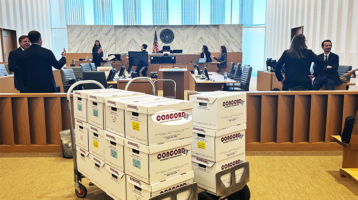
This is particularly valuable when timing is tight. A late-produced paper file may need immediate scanning, coding, review, and incorporation into an exhibit set. In Southern California litigation, that can also mean delivering trial exhibit binders overnight to Stanley Mosk, First Street Federal, or a Superior Court location. The operational details are not secondary. They determine whether the legal team has what it needs when it needs it.
Questions to Ask Before Engaging a Provider
The right provider is not always the one with the lowest per-gigabyte price. General counsel should assess whether the provider can execute under pressure while protecting confidential information and maintaining a clear record of its work. Four questions are especially useful:
- Can the provider collect from the actual sources at issue, including iPhones, email, cloud applications, endpoints, and paper records?
- What security, confidentiality, insurance, and chain-of-custody practices govern sensitive data?
- Who will manage the matter day to day, and how quickly can that team respond outside normal business hours?
- Can the provider support the full workflow, from preservation and processing through attorney review, production, and trial exhibits?
The answers reveal whether a vendor is selling a narrow technical service or functioning as an operational legal support partner. They also help procurement compare proposals on total matter risk rather than unit pricing alone.
Service Capacity Is a Litigation Risk Issue
A provider’s capacity becomes visible when the schedule changes. A regulator advances a deadline. A custodian leaves the company. Opposing counsel demands a supplemental production. Trial counsel identifies a new exhibit category two days before a hearing.
General counsel needs confidence that the provider can scale collection, processing, review support, digital printing, and delivery without sacrificing accuracy. That includes access to qualified personnel, documented quality checks, secure facilities, and production capability that does not disappear after business hours.
Concord Document Technologies supports these connected workflows with eDiscovery, forensic data collection, RelativityOne review support, scanning, legal copying, and trial exhibit production. For organizations managing high-stakes matters, a coordinated service model can simplify accountability and reduce the friction caused by multiple vendors handling the same evidence.
Build the Workflow Before the Next Matter
The strongest eDiscovery programs are not invented after a complaint arrives. General counsel can work with litigation support, IT, privacy, records management, and outside counsel to identify key data sources, define escalation paths, establish approved collection procedures, and clarify who can authorize spend or preservation decisions.
A short readiness exercise can expose real gaps: an untested mobile-device process, an unclear retention setting, an unknown repository owner, or a vendor relationship that does not cover after-hours work. Addressing those issues early gives legal departments more options when time is limited.
The goal is not to create a perfect process for every possible dispute. It is to create a disciplined starting point that preserves choice, protects the record, and gives counsel room to focus on the merits of the case. When the next urgent request arrives, execution should already be in place.