A misplaced custodian file, an inconsistent Bates range, or a scanned exhibit that cannot be searched can cost a litigation team far more than production time. The best document indexing methods for litigation create a defensible path from collection through review, production, and trial. They allow attorneys to find the right record quickly while preserving the context, provenance, and control needed in high-stakes matters.
Indexing is not a clerical afterthought. It is a litigation workflow that determines whether a document population can be searched, sorted, reviewed, produced, and presented with confidence. The right approach depends on the source material, the forum, the case schedule, and whether the matter includes paper records, electronically stored information, or both.
What Litigation Document Indexing Must Accomplish
A useful index does more than assign a document number. It connects each item to reliable metadata: what it is, where it came from, who controlled it, when it was created or received, how it relates to a family of documents, and where it sits in the production record. That information supports retrieval, privilege review, deposition preparation, exhibit selection, and motion practice.
For paper-heavy matters, the index must also bridge the physical file and its digital counterpart. A scanned contract, medical chart, personnel file, or agency record should be traceable to its box, folder, custodian, scan batch, and Bates range. When originals may be needed later, physical chain-of-custody controls are as important as searchable text.
The objective is not to apply every possible field to every document. Over-indexing creates cost and inconsistency without improving legal judgment. The objective is to use standardized fields that answer the questions the case team will actually ask.
Best Document Indexing Methods for Litigation Workflows
Metadata-driven indexing for electronically stored information
For email, cloud content, office files, and other ESI, metadata-driven indexing is generally the foundation. Native files contain valuable information that manual data entry cannot reproduce reliably, including custodian, author, recipients, sent date, file path, hash value, attachment relationship, and modified date.
A defensible workflow preserves source metadata during collection, processes the data with documented settings, and loads the resulting fields into the review platform. In RelativityOne and similar environments, structured fields make it possible to search by custodian, date range, communication participants, file type, or production status without relying solely on document text.
This method is fast and scalable, but it has limits. Metadata can be incomplete, altered before collection, or unavailable in certain exports. It should be validated against the collection source and supplemented with context fields where necessary. A message date, for example, is not always the same as the date a record was retained, reviewed, or produced.
OCR and full-text indexing for scanned paper records
When a case turns on legacy paper files, incoming mail, handwritten notes, or hard-copy exhibits, optical character recognition is essential. OCR converts image-only scans into searchable text, allowing the team to locate names, dates, contract terms, account numbers, and key phrases across large volumes of material.
OCR alone is not an index. Scan batches should be separated and labeled logically, then associated with a controlled set of fields such as source location, custodian, document type, date range, confidentiality designation, and Bates number. Quality control should confirm that pages are complete, oriented correctly, and legible enough for OCR to be useful.
Handwriting, faded copies, stamps, and poor originals reduce OCR accuracy. For critical documents, teams should not assume a failed search means the term is absent. Image review and targeted manual indexing remain necessary where text quality is low or the record has particular evidentiary importance.
Folder-level and document-level indexing for physical collections
Physical records often arrive in a state that reflects office habits rather than litigation needs. A box may contain mixed files, duplicates, handwritten annotations, and documents that should remain together. In those situations, folder-level indexing can provide a practical early inventory while preserving original order.
Folder-level indexing records the box number, folder title, apparent custodian or department, date span, and general contents. It is efficient for assessment, collection tracking, and prioritizing scanning. Document-level indexing adds a record for each discrete item and is better suited to productions, exhibit databases, and matters where individual documents must be retrieved quickly.
The trade-off is cost and time. Not every archive requires document-level indexing at intake. A staged approach often works best: create a reliable box and folder inventory first, then apply detailed indexing to responsive, high-value, or trial-bound materials.
Issue, entity, and event indexing for case strategy
Litigation teams do not search only for documents. They search for people, transactions, events, claims, defenses, and disputed facts. Issue coding adds strategic value by associating documents with case-specific categories, such as notice, reliance, damages, discrimination, regulatory reporting, contract performance, or spoliation.
Entity indexing captures normalized names for people, organizations, projects, properties, and account numbers. Event indexing ties documents to dates or sequences that matter to the case, such as an internal investigation, termination decision, product launch, or government inquiry. These fields help teams build chronologies and prepare witnesses without repeatedly re-reading the same records.
This method requires disciplined case-team input. Broad or poorly defined issue tags become unreliable quickly. Establish clear coding definitions, examples, and an owner who can resolve questions. Use issue coding where it serves a known litigation purpose, not as a substitute for attorney analysis.
Production and exhibit indexing
A production index should let the receiving party and the producing party understand what was delivered. At minimum, it should reconcile production volume, Bates ranges, document counts, confidentiality designations, load file fields, and exceptions. When documents are withheld, redacted, or produced natively, the index and related logs must accurately reflect that treatment.
For trial preparation, exhibit indexing becomes more exacting. Each proposed exhibit should be connected to its Bates range, source file, exhibit number, description, sponsoring witness when known, authentication status, objection status, and courtroom-ready version. This avoids the common problem of maintaining separate and conflicting lists for discovery, motions, depositions, and trial.
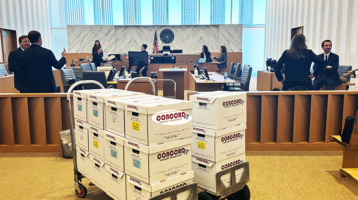
In compressed trial schedules, teams benefit from a production partner that can manage scanning, Bates labeling, digital printing, exhibit binders, and electronic files under a single documented workflow. Concord Document Technologies supports these workflows with 24/7 production capacity for document-intensive litigation matters.
Build a Defensible Indexing Protocol Before Processing Begins
The strongest indexing method can fail if the rules change midstream. Before scanning, processing, or review begins, establish a written protocol that identifies required fields, field definitions, naming conventions, date formats, document family rules, and quality-control thresholds.
The protocol should also address how the team will handle duplicates, near-duplicates, nonresponsive material, attachments, oversized records, color documents, and privileged content. If a collection includes mobile data, exported email, or shared drives, identify the source-specific metadata that must be retained and the expected format for review.
Four controls deserve particular attention:
- Assign unique identifiers that reconcile physical records, digital images, and Bates numbering.
- Preserve source information and chain-of-custody records for every collected or scanned batch.
- Use controlled vocabulary for document types, custodians, and issue tags to prevent inconsistent coding.
- Audit samples throughout the project, not only at the end, for missing pages, duplicate identifiers, OCR failures, and incorrect metadata.
These controls are especially important when work is divided among outside counsel, in-house teams, forensic collectors, scanning vendors, and review providers. A consistent protocol makes handoffs visible and exceptions manageable.
How to Choose the Right Level of Indexing
There is no single answer for every case. A fast-moving regulatory response may need an immediate folder inventory, targeted OCR, and custodian-level metadata before deeper review. A commercial dispute approaching trial may justify document-level coding, detailed issue fields, and exhibit-specific indexing. A large investigation may rely first on automated metadata extraction and analytics, then reserve manual indexing for key evidence.
Consider the volume, source types, likely discovery requests, anticipated privilege burden, trial risk, and time available. Also consider who must use the index. A litigation support professional may need technical fields and load-file validation. A trial lawyer needs a dependable route to the record, its key facts, and its exhibit status.
The most effective indexing plan gives each group what it needs without forcing unnecessary manual work across the entire collection. When the index is designed around real legal decisions, the document set becomes easier to defend, easier to review, and far more useful when the case reaches its most demanding moments.