A text thread projected on a courtroom screen can be powerful. So can an email, a cellphone video, a spreadsheet, a social media post, or a native-file report. But are digital exhibits admissible evidence? Usually, they can be – if the party offering them can establish what the material is, why it matters, and that it has been handled and presented reliably.
For litigation teams, the practical issue is not whether electronic evidence is somehow separate from “real” evidence. It is whether the exhibit satisfies the same evidentiary foundation required of any other proof, while avoiding the distinct problems that digital files create: altered copies, incomplete context, missing metadata, inaccessible formats, and weak chain-of-custody records.
Are Digital Exhibits Admissible Evidence Under the Rules?
Digital exhibits are not categorically excluded simply because they originate on a phone, computer, cloud account, or business system. Federal and state courts routinely admit electronically stored information when the proponent meets the applicable evidentiary requirements. The precise rules vary by jurisdiction and judge, but the core questions are consistent.
First, the exhibit must be relevant. It must make a material fact more or less likely than it would be without the evidence. A long email chain, for example, may contain one critical admission, but the party offering it should be prepared to explain the connection between that statement and an issue in the case.
Second, the exhibit must be authenticated. Under Federal Rule of Evidence 901, the proponent must offer evidence sufficient to support a finding that the item is what the proponent claims it is. That does not always require a forensic expert or the original device. A witness with personal knowledge, a records custodian, distinctive characteristics, system evidence, metadata, testimony about collection, or a combination of those proof points may be enough.
Third, the exhibit must survive objections based on hearsay, unfair prejudice, incompleteness, privilege, or a defective foundation. Authentication answers the question, “Is this what counsel says it is?” It does not automatically answer whether the contents are admissible for their truth.
Authentication Is the Pressure Point
Most disputes over digital exhibits turn on authentication. Opposing counsel may argue that a screenshot was manipulated, a message was sent by someone else using the account, a video is incomplete, or an email was forwarded without its original transmission data.
The strength of the foundation should match the risk. A simple demonstrative image used only to illustrate witness testimony requires a different level of proof than a disputed text exchange central to liability, intent, or damages. When the source is contested, stronger evidence is prudent: a preserved original file, collection documentation, cryptographic hash values, device or account records, corroborating testimony, and production history.
What supports a reliable foundation?
A witness may authenticate an email because they received it, recognized the sender’s address and writing style, and acted on it in the ordinary course of business. A corporate representative may authenticate system-generated records by explaining how the business system captures and retains them. A forensic examiner may explain how a phone image was collected, preserved, and processed without altering source data.
For social media and messaging evidence, account ownership alone may not resolve the issue. The better foundation often combines account information with content known to the alleged sender, surrounding communications, device evidence, location information, or testimony from a recipient or investigator. The question is not whether every theoretical possibility of fabrication has been eliminated. It is whether there is sufficient evidence for the court to find the exhibit authentic.
Original Files, Copies, and the Best Evidence Rule
The so-called best evidence rule is another frequent concern. Under the federal rules, an original writing, recording, or photograph is generally required to prove its content, but duplicates are generally admissible unless a genuine question is raised about the original’s authenticity or admitting the duplicate would be unfair.
For digital evidence, the definition of an original is more practical than many teams expect. An accurately printed output or other readable output that reflects data accurately can qualify as an original. That means a properly generated PDF, printout, or courtroom display may be admissible even when the underlying data resides in a database, mobile device, or cloud platform.
Still, format choices matter. A screenshot may be enough for a straightforward issue, but it may omit metadata, timestamps, participants, attachments, hidden columns, or surrounding context. A native spreadsheet may preserve formulas and embedded data that a PDF does not. A video clip may be easier to present, while the complete file and its provenance remain essential to rebut claims of selective editing.
The right question is not simply, “Can we print it?” It is, “What information must remain available for the witness, opposing counsel, and court to evaluate it fairly?”
Hearsay Does Not Disappear Because the Exhibit Is Digital
An authenticated digital exhibit can still be hearsay. A text message offered to prove that its author made a factual assertion is commonly an out-of-court statement. The party offering it needs a non-hearsay purpose, an exclusion, or a recognized exception.
Some digital material is not hearsay at all. A statement offered to show notice, effect on the listener, or the declarant’s state of mind may not be offered for its truth. Statements by an opposing party can often be used against that party. Business records may be admissible when the required foundation is established, although litigation-created spreadsheets and selective exports deserve close scrutiny.
Machine-generated data raises a different issue. A server log or automated timestamp may not be hearsay if it contains no human assertion. But counsel should still be ready to explain the system, the accuracy of its process, and whether a person entered or altered the relevant information.
Metadata and Chain of Custody Matter Most When Facts Are Contested
Metadata is not automatically required for admissibility, and not every matter justifies a forensic-level collection. Yet it can be decisive where timing, authorship, alteration, or source is disputed. Created dates, modified dates, message identifiers, file paths, application data, and hash values can corroborate – or undermine – the story presented through a document image.
Chain of custody is similar. Courts do not demand a perfect, gap-free chronology in every case. They do expect reasonable assurance that evidence has not been materially changed. A defensible workflow documents who collected the source, when collection occurred, how it was transferred, where it was stored, what processing was performed, and which version was produced or marked for trial.
That record becomes especially important with mobile devices, shared drives, ephemeral messaging, surveillance video, and data collected from third parties. Casual handling can turn a manageable evidentiary issue into a costly motion practice problem.
Build Trial Exhibits for Use, Not Just Production
A discovery production and a courtroom exhibit serve different purposes. Discovery may require broad collection, searchable load files, metadata fields, family relationships, and defensible processing. Trial presentation requires legibility, stable exhibit numbering, complete context, compatible media, and a clear path from the admitted item to the version displayed to the fact finder.
Before trial, confirm that the exhibit is readable on courtroom equipment, that redactions are baked in where appropriate, that confidential material is segregated, and that native files have a reliable presentation plan. Check page and document references against deposition designations, motions in limine, witness outlines, and the final exhibit list. A last-minute change to an image or PDF can create discrepancies that invite unnecessary objections.
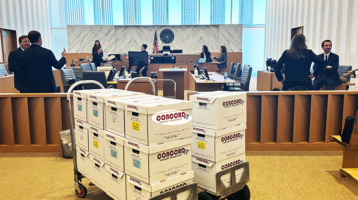
For high-volume matters, litigation teams should maintain a controlled master set and a clear versioning protocol. The admitted exhibit, demonstrative, witness copy, and court copy should not become competing versions of the same evidence. Physical exhibit binders remain valuable when the court, witness, or jury needs a stable paper reference, while digital trial sets provide speed, searchability, and presentation flexibility.
Concord Document Technologies supports this transition from defensible document and data handling to organized trial exhibit production, including high-priority court deliveries when timing leaves no margin for error.
A Practical Pretrial Check
Before designating a digital item as a trial exhibit, ask whether the team can answer five questions: What is it? Who created or transmitted it? How was it collected and preserved? What makes it relevant? What evidentiary path permits the court to consider its contents?
If those answers depend on a witness, secure the testimony. If they depend on system information, preserve the records and identify the appropriate custodian. If they depend on metadata or forensic proof, do not wait until the eve of trial to locate the source material.
Digital evidence is often admissible, but admissibility is earned through preparation. The strongest exhibit is not merely persuasive on a screen. It is traceable to its source, complete enough to be fair, and ready to withstand the objection that matters most.