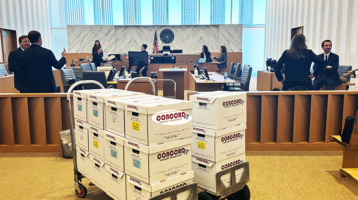
At 4:40 p.m., trial counsel learns that the court wants a revised exhibit set in the courtroom the following morning. Several exhibits have changed, witness binders must match the revised list, and opposing counsel needs a compliant service copy. This emergency courtroom production case study examines the operating discipline required when a deadline is measured in hours, not business days.
The facts below represent a typical high-stakes litigation workflow rather than a description of a single client matter. The purpose is practical: to show what separates a controlled overnight production from a rushed print job that creates avoidable risk in court.
The Production Problem Was Not Just Printing
The legal team had a late-stage evidentiary issue. New source documents had been identified, several demonstratives required revision, and a subset of previously numbered exhibits had to be removed from the trial set. The court appearance was scheduled for the next morning at a downtown Los Angeles courthouse.
At first glance, the request sounded straightforward: produce binders overnight. In practice, the request involved a series of connected decisions. Which exhibit list controlled? Were the revised PDFs final? Did the documents carry correct Bates ranges and exhibit stickers? Which materials belonged in the judge’s set, counsel sets, witness binders, and internal working copies? Could confidential documents be included in every set, or did access restrictions apply?
A courtroom production failure rarely happens because a printer stops running. It happens when version control, instructions, quality assurance, packaging, and delivery are treated as separate tasks. Under an emergency deadline, they must operate as one controlled workflow.
Emergency Courtroom Production Case Study: The First Hour
The first hour determined whether the remaining work could be completed reliably. Rather than accepting files through scattered email threads, the production team established one designated point of contact and one instruction set. Counsel confirmed the controlling exhibit list, the required number of sets, color requirements, binder format, tabs, and the exact delivery destination.
The team also identified the materials that required heightened handling. Documents containing personal information, sealed material, privileged content, or sensitive business records cannot simply be reproduced and dispatched with the rest of the production. Each category may require distinct labeling, packaging, and recipient instructions.
This intake stage is where experienced litigation support matters. A production provider should ask direct questions that reduce ambiguity before work starts. For example: Is the exhibit numbering consecutive after the removals? Are replacement pages permitted, or must entire binders be rebuilt? Does the courtroom require a specific number of bench copies? Does the filing or service copy need different assembly instructions?
The answer can change the production plan. Replacing three pages is faster and less expensive than rebuilding 20 binders, but only if every recipient can reliably insert the same replacement pages and the court will accept that approach. When clarity is lacking, a full rebuild may be the safer decision.
Building a Controlled Exhibit Set
Once final files and instructions were confirmed, the production team created a production manifest. This served as the control record for the job: document name, exhibit number, Bates range, page count, color or black-and-white designation, tab language, copy count, and destination.
The manifest matters because legal exhibit production is not a commodity copy order. A binder can look polished and still be wrong. One omitted page, an outdated demonstrative, a mismatched tab, or a confidential attachment placed in the wrong set can distract counsel and create a preventable courtroom issue.
Files were then checked against the controlling list before release to production. The team reviewed page counts, exhibit labels, orientation, legibility, and the consistency of bookmarks or printed tabs. If scanned records were part of the set, image quality required particular attention. Poorly captured handwriting, cut-off footer text, skewed pages, and unreadable color-coded annotations can become significant when a witness is being questioned from the exhibit.
Physical assembly followed the approved specifications. Depending on the matter, this may include durable binders, index tabs, exhibit stickers, slip sheets, divider pages, color inserts, and confidential legends. The right format depends on courtroom preferences, the volume of material, and how counsel expects to use the documents. A compact witness binder may need a different design from a full court set intended for reference throughout a multi-day hearing.
Quality Control Cannot Be the Step That Gets Skipped
Emergency work changes the schedule, not the standard. Before packing, a second review compared completed binders to the manifest and confirmed that every required set was present. The review focused on the details most likely to cause immediate trouble: tab sequence, page completeness, labels, orientation, color pages, and the inclusion or exclusion of sensitive materials.
There is a trade-off here. A comprehensive page-by-page review of every copy may not be realistic when the request arrives late and requires dozens of binders by morning. But a risk-based quality-control plan is always necessary. The master set should receive a detailed review, while duplicate sets can be checked against controlled assembly standards, page counts, and spot inspections.
The same principle applies to last-minute edits. If counsel sends a revised exhibit at 10:30 p.m., the production team should not silently substitute it into an already assembled job. The change must be documented, the affected copies identified, and the version confirmed with the designated legal contact. Fast execution without change control is not reliable execution.
Chain of Custody Extends to the Courthouse
Delivery was treated as part of production, not an afterthought. Each package was labeled by recipient and destination, then logged before release. For courtroom delivery, the team confirmed the courthouse address, department or courtroom number, receiving hours, security procedures, and the name or mobile number of the authorized recipient.
This is especially important for early-morning delivery to locations such as Stanley Mosk Courthouse, First Street Federal Courthouse, or a Superior Court facility. Building access rules, security screening, clerk procedures, and courtroom availability can differ. A courier who arrives with an unlabeled box and no contact information may lose critical time even when the materials were completed on schedule.
For highly sensitive matters, the delivery plan should define who may accept the package and how receipt will be documented. The goal is clear custody from the moment files are released for production through final handoff. Bonded and insured legal support providers bring meaningful value here because the handling process is designed around legal records, not ordinary commercial delivery.
What the Legal Team Gained
By the time counsel arrived the next morning, each required binder set was organized, labeled, and delivered to the designated recipients. More importantly, the team had a documented answer to the questions that matter after an emergency production: which files were used, which instructions controlled, what changed, who approved the change, how many sets were produced, and who received them.
That record does not eliminate the pressure of trial. It does eliminate much of the uncertainty that pressure creates. Counsel can focus on argument, witnesses, and court direction instead of wondering whether the demonstrative in the witness binder matches the one at counsel table.
The broader lesson is that courtroom readiness depends on preparation before the emergency occurs. Firms handling active litigation should identify an experienced production partner before the first late-night request, establish approved contacts, and decide how files and instructions will be transmitted securely. They should also understand whether the provider can support related needs such as onsite scanning, Bates labeling, eDiscovery processing, RelativityOne review, forensic collection, legal copying, and overnight exhibit delivery.
Concord Document Technologies supports these connected workflows with 24/7 production capacity and the operational discipline required for sensitive, deadline-driven matters. When a court deadline cannot move, the right response is not simply to print faster. It is to put the right controls around every page, every binder, and every handoff.