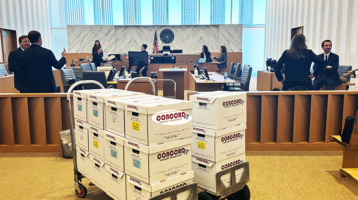
When a trial department sets a hard exhibit exchange deadline, the issue is not simply getting documents printed. Orange County Superior Court trial exhibit printing requires disciplined file control, readable output, consistent labeling, secure handling, and a delivery plan that does not leave trial counsel waiting on a courier call.
For high-stakes matters, exhibit production is part of case presentation. A binder with an incorrect tab, a clipped-off image, missing Bates numbers, or an exhibit list that no longer matches the physical set can create avoidable friction at precisely the wrong time. Legal teams need a production partner that understands the difference between a copy job and a court-ready trial package.
What Court-Ready Trial Exhibits Require
Trial exhibits must work for the people using them under pressure: attorneys at counsel table, witnesses on the stand, courtroom staff, opposing counsel, and the judge. That means every set needs to be accurate, organized, and physically durable enough to survive repeated handling.
The first requirement is source-file control. Litigation teams often receive final revisions from multiple attorneys, experts, and vendors. Before production begins, the final exhibit universe should be clearly identified, with a controlled naming convention and a confirmed exhibit list. Producing from an outdated folder is one of the most common and preventable trial-preparation failures.
Readability comes next. Pleadings, contracts, spreadsheets, photographs, medical records, native-file printouts, and demonstratives each need different production treatment. A spreadsheet may require ledger paper or a foldout. A color-coded diagram may lose its meaning in black and white. A scanned record may need image enhancement or careful reproduction to preserve legibility without altering the underlying document.
Then there is consistency. Tabs, labels, Bates ranges, exhibit stickers, indexes, divider pages, and binder spines should follow the same convention across every set. Small inconsistencies force counsel to stop and verify what they are holding. At trial, that interruption has a cost.
Orange County Superior Court Trial Exhibit Printing Under Deadline
Orange County litigation teams frequently work on compressed schedules, particularly after evidentiary rulings, late-produced records, deposition designations, or a final pretrial order changes the exhibit plan. The right production approach accounts for the fact that final documents may not truly be final until hours before a required exchange or courtroom presentation.
A capable legal print provider should be prepared to receive revised PDFs, apply approved exhibit labels, update indexes, produce replacement pages, and assemble revised binders without losing control of prior versions. This is where 24/7 production capacity matters. It provides room for the reality of trial work: late changes, urgent corrections, and non-negotiable deadlines.
Delivery planning also matters. A trial set is not complete until it reaches the intended recipient. For Orange County Superior Court matters, teams should determine early whether materials need to go to counsel, a hotel war room, a witness-preparation location, or the courthouse. Delivery instructions should identify a precise recipient, contact number, deadline, and any required security or receiving procedures.
Do not assume every courtroom or department has the same expectations. Counsel should confirm applicable local rules, standing orders, and department-specific requirements concerning exhibit exchange, courtesy copies, electronic presentation, and binder format. A production partner can execute a reliable package, but trial counsel remains responsible for the governing procedural requirements.
Build the Exhibit Package Before the Final Hour
The strongest trial-production workflow begins before the final print request. Once the exhibit list is developing, the legal team should decide how many sets are needed and who will receive them. The answer depends on the case, but it may include the court, opposing counsel, each trial attorney, witnesses, a paralegal or trial technician, and a clean archival set for the file.
That planning affects cost, timing, and assembly. A small evidentiary set may be more efficient in tabbed binders. A large document-heavy case may call for several volumes organized by exhibit range, witness, or subject matter. Oversized boards, deposition clips, and electronic demonstratives should be managed as related but separate production streams.
The exhibit index should be treated as a controlled document, not an afterthought. It should identify the exhibit number or letter, a useful description, relevant Bates range if applicable, and the corresponding binder or volume. If exhibits are withdrawn, substituted, or renumbered, the index and physical package need to be updated together.
Color decisions deserve similar attention. Color can be essential where the evidence relies on highlighted communications, redlines, charts, site photographs, maps, or medical imaging. Yet color production is not automatically necessary for every page. A mixed approach can control cost while preserving the evidentiary value of documents that require color. The decision should be deliberate and documented in the production instructions.
Quality Control Is a Litigation Safeguard
Legal exhibit production requires a quality-control process that checks more than page count. The production team should verify that the correct source files were received, the approved naming and numbering sequence is used, labels are placed consistently, tabs align with the index, and duplex or single-sided settings match instructions.
For large sets, a page-level comparison or image review may be appropriate, especially where documents include confidential information, foreign-language records, photographs, or difficult scans. If Bates labels are added during production, the placement must avoid obscuring text, signatures, or exhibit markings. When existing Bates numbers must remain visible, the team should establish the hierarchy of labels before any output begins.
Confidential and sensitive records require additional discipline. Materials may include protected health information, personnel files, trade secrets, law-enforcement records, financial information, or privileged content that has not been fully segregated. Secure transfer, controlled access, documented handling, and careful packaging protect the client and the litigation team. Convenience is not a substitute for chain-of-custody awareness.
A practical quality-control checkpoint is to inspect a complete sample volume before full assembly begins. That review can catch an incorrect tab stock, binder capacity issue, image-scaling problem, or index mismatch while there is still time to correct it. For rush matters, the checkpoint may be brief, but it should not disappear.
Physical Binders and Digital Trial Materials Must Match
Many trial teams use electronic presentation tools while still relying on paper exhibits. This hybrid approach is effective only when the paper and digital versions remain aligned. The exhibit number displayed on screen should match the tab in counsel’s binder, the PDF file name, and the index provided to the court.
That alignment is especially important for impeachment materials, deposition excerpts, and demonstratives. A witness may be shown a cropped excerpt electronically while the court needs access to the complete underlying exhibit. The team should know exactly where the full document sits in the physical set and whether the electronic presentation accurately reflects it.
Electronic files also need a production standard. PDFs should be searchable when possible, correctly oriented, and named in a way that supports rapid retrieval. Large files, video exhibits, audio files, and native spreadsheets should be tested on the equipment that will be used at trial. A beautifully assembled binder cannot solve a media file that will not play in the courtroom.
Choose a Provider Built for Legal Production
General commercial printers can produce pages. Trial exhibit work calls for a legal support provider with experience in time-sensitive litigation workflows, confidential records, complex file sets, and courthouse delivery coordination.
The right partner should be able to handle digital printing, color and black-and-white production, Bates labeling, scanning, document copying, tabbed binders, oversized materials, replacement pages, and secure overnight shipping when needed. It also helps when the same provider can support the larger matter through eDiscovery, forensic data collection, document review, and trial preparation. Fewer handoffs mean fewer opportunities for version confusion.
Concord Document Technologies supports legal teams that need this level of operational control, from high-volume document production through court-ready trial exhibit binders. Experienced production staff, secure handling practices, and around-the-clock capacity are designed for matters where accuracy and timing are inseparable.
Before sending files for production, designate one person to approve final instructions and one version of the exhibit list as controlling. That simple discipline gives the production team a reliable target and gives trial counsel more time to focus on the argument that matters.