A scanned contract, medical chart, personnel file, or handwritten note may be central to a case, yet the scan alone does not prove what it is, where it came from, or whether it was altered. Can scanned documents be authenticated? Yes, in many cases. The real question is whether the party offering the record can present sufficient evidence that it is what the party claims it to be.
For legal teams, authentication should begin long before a hearing or trial. A defensible scanning process, documented custody, reliable production controls, and a witness who can explain the workflow can turn a paper-heavy collection into usable evidence. A weak process can create avoidable motion practice, delay, and credibility issues at exactly the wrong time.
Can Scanned Documents Be Authenticated Under Evidence Rules?
Generally, yes. Under Federal Rule of Evidence 901, the proponent must produce evidence sufficient to support a finding that the item is what the proponent claims. That is a threshold showing, not a final determination that the document is genuine. The opposing party may still challenge the record’s accuracy, completeness, authorship, or weight.
Authentication can come from a witness with personal knowledge, a records custodian, a person familiar with a business process, distinctive characteristics in the document, or evidence describing a reliable system or process. The proper route depends on the document and how it was acquired.
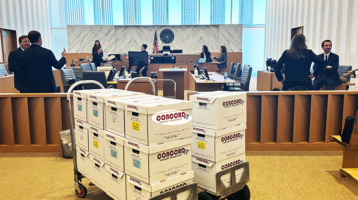
For example, a former employee may recognize a scanned memorandum they wrote. A hospital records custodian may explain that the scanned chart was created and maintained in the ordinary course of business. A litigation support professional may testify or provide a declaration describing how boxes of paper files were received, inventoried, scanned, quality-checked, and preserved.
State evidence rules and local court practice may differ. The governing rules, the assigned judge’s preferences, and the purpose for which the document is offered all matter. Authentication is also separate from hearsay, relevance, privilege, and confidentiality objections. Clearing one issue does not automatically clear the others.
Authentication Is Not the Same as the Best Evidence Rule
Legal teams often use “authenticated” to mean “admissible.” That shortcut causes problems. Authentication establishes identity. The best evidence rule addresses proving the contents of a writing, recording, or photograph when those contents are at issue.
Under the Federal Rules, a duplicate is generally admissible to the same extent as an original unless there is a genuine question about the original’s authenticity or admitting the duplicate would be unfair under the circumstances. A properly made scan may qualify as a duplicate. If an original has been lost or destroyed without bad faith, other evidence of its contents may also be permitted in appropriate circumstances.
That does not mean every PDF is automatically safe. If the dispute turns on handwritten annotations, ink color, embossing, erasures, faint marginal notes, page order, or the physical condition of the original, the paper source may carry evidentiary significance that a scan cannot fully capture. In those situations, preserve the original if possible and document the scan at a level that allows the parties and court to evaluate it.
The Foundation Starts at Collection
The strongest authentication story is operational, specific, and documented. It should answer a straightforward series of questions: Who had the records? When were they collected? Were they complete? Who handled them? How were they scanned? What happened to the originals and resulting image files?
For sensitive matters, a defensible workflow usually begins with intake controls. The receiving team identifies the source, records the date and time of receipt, counts containers or files, and assigns matter-specific tracking information. If documents are collected onsite, the process should identify the location, the custodian or authorized representative, and any transfer from the client to the scanning provider.
Preparation should be controlled as well. Removing staples, repairing torn pages, separating oversized materials, and identifying foldouts are normal production tasks, but they can affect document order and condition. The team should preserve the original sequence where it matters and flag unusual items rather than forcing them through a standard workflow.
Scanning settings should match the record. A black-and-white scan may be sufficient for routine text, while color may be essential for exhibits with highlights, colored signatures, photographs, or annotations. Resolution, file format, OCR treatment, and image enhancement settings should be selected deliberately. Aggressive cleanup can improve readability but may create questions if it removes marks or changes the appearance of the source.
What Documentation Supports a Scanned Record?
A court does not need a technical lecture for every scan. It does need a credible foundation. That foundation becomes much easier to establish when the record includes contemporaneous documentation of the workflow.
The most useful materials often include an intake log, chain-of-custody record, box or folder inventory, scanning job specifications, exception reports, quality-control logs, and a record of delivery or export. Bates numbering and production logs can further connect the scanned image to the version produced in discovery or prepared for trial.
For electronically stored scan files, technical information can help corroborate the process. File creation dates, system audit trails, access logs, hash values, and controlled storage locations may show that the image set remained stable after collection. Metadata is supporting evidence, not magic proof. File dates can change during copying, export, or processing, so they should be interpreted in the context of the full workflow.
A concise declaration is often more useful than a stack of internal logs. The declarant should have actual knowledge of the collection, scanning, records-management process, or both. Generic language stating that a file is “true and correct” may be inadequate when the opposing side raises a specific challenge. The declaration should identify the source records, explain the standard process used, and state how the offered scan was created or maintained.
Quality Control Protects Both Evidence and Case Strategy
A scan can be authentic yet still be operationally unusable. Missing backs of pages, skewed images, unreadable handwriting, omitted attachments, split oversized pages, and incorrect document breaks can distort attorney review and create production disputes.
Quality control should therefore be designed around the purpose of the collection. For a litigation production, image quality, page-level completeness, confidentiality designations, Bates sequencing, and load-file consistency may all be relevant. For a trial exhibit set, the review should also confirm that the demonstrative or exhibit matches the version disclosed to opposing counsel and the court.
Exception handling deserves particular attention. If a page cannot be scanned cleanly, if a document is damaged, or if a color feature is material, the issue should be recorded and escalated. A documented exception is usually manageable. An undisclosed omission discovered during a deposition or trial is not.
When Originals Should Be Preserved and Produced
Do not destroy originals merely because they have been scanned, especially when litigation is pending or reasonably anticipated. A legal hold, client retention obligations, regulatory requirements, and the possibility of evidentiary dispute may all require continued preservation.
Keep originals when their physical attributes may matter, when they are unique signed instruments, when the scan does not capture the relevant detail, or when the parties or court require inspection. Secure storage should maintain the same discipline used during collection: controlled access, clear labeling, tracked transfers, and a retrievable location.
There are also practical reasons to retain originals. An opposing party may request inspection, an expert may need to examine the paper, or a late-arising issue may make a high-resolution rescanning necessary. The cost of organized preservation is often far lower than the cost of reconstructing a deficient record.
Preparing Scanned Documents for Discovery and Trial
Authentication planning should be coordinated with discovery, not left to trial preparation. Identify early which witness can explain each category of records. For client business records, that may be a custodian or employee familiar with the system. For third-party records, it may require a subpoena, certification, stipulation, or testimony from the originating organization.
When a vendor performs the scanning, the vendor can support the technical and custody foundation, but it may not be able to prove the business meaning or original creation of the underlying document. That distinction matters. A scanning provider can explain that a particular image accurately reflects the paper received on a particular date. The records custodian or author may still be needed to establish how the document was created, used, and kept.
For high-volume matters, use consistent naming, Bates labels, production logs, and review-platform loading procedures so the document offered at deposition or trial can be traced back to its source collection. Concord Document Technologies supports this type of end-to-end control, from secure paper scanning and Bates labeling through document review and trial exhibit production, with the production discipline complex legal matters require.
A scanned record becomes easier to defend when the process behind it is easy to explain. Preserve the source, document each transfer, scan to the needs of the evidence, verify the output, and identify the witness who can tell that story clearly when it counts.