A trial team can have a strong brief, organized evidence, and a clear courtroom strategy, then lose valuable time over a mislabeled exhibit, missing Bates range, or binder that arrives after the clerk’s office closes. Washington DC litigation printing is not ordinary commercial printing. It is a deadline-driven legal production function where accuracy, confidentiality, and courtroom readiness have to hold up under pressure.
For matters moving through the federal courts, DC Superior Court, agencies, or arbitration, document production must account for strict filing schedules, complex exhibit sets, multiple counsel teams, and records that may contain protected or regulated information. The right litigation support provider treats every production as part of the legal workflow, not as a stack of pages to be copied.
What Washington DC Litigation Printing Must Deliver
Legal teams need more than clean copies. They need a production process that preserves the integrity of the record from source collection through review, final output, delivery, and trial presentation.
That starts with document control. A production vendor should be able to confirm the source files, apply consistent document naming, maintain Bates numbering without gaps or duplicates, and run quality control before anything leaves production. In high-volume matters, a minor sequencing error can affect deposition preparation, exhibit lists, privilege review, or the ability to locate a document quickly in court.
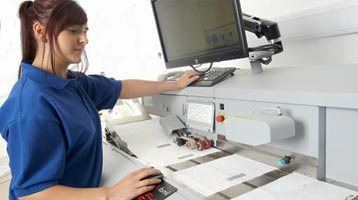
Printing quality matters as well, but it is only one part of the assignment. Courtroom exhibits may include color-coded timelines, spreadsheets, native-format printouts, photographs, engineering drawings, emails with attachments, and redacted government records. The output needs to be legible, correctly oriented, securely assembled, and produced in the format requested by counsel or the court.
Turnaround is the other constant. A late discovery issue, an overnight filing request, or a newly designated trial exhibit can change a production plan immediately. Legal teams should work with a provider that has 24/7 capacity and understands that a same-day request requires clear intake, active communication, and a documented handoff – not vague promises.
Core Services for Trial and Discovery Production
A dependable litigation printing engagement can cover the physical and electronic workstreams that often become disconnected when several vendors are involved. That reduces duplicate handling and gives the legal team a clearer chain of responsibility.
Bates Labeling and Discovery Productions
Bates labeling remains fundamental to civil litigation and regulatory matters. Whether documents originate as scanned paper, PDFs, emails, or exports from a review platform, the numbering must align with the agreed production protocol. This includes prefixes, confidentiality designations, page positioning, load files, slip sheets, and placeholders where required.
The production plan should also address redactions before printing or exporting. Redacted text, hidden metadata, and image-based documents require careful validation. A visible redaction is not enough if the underlying electronic file remains searchable or recoverable. When a matter calls for both paper and electronic production, the records should match across formats.
Trial Exhibit Binders and Courtroom Sets
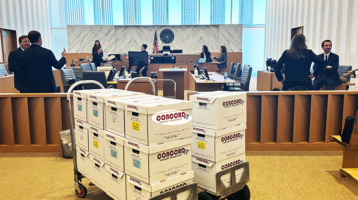
Trial binders are operational tools, not presentation pieces. Attorneys, witnesses, opposing counsel, the court, and war room staff may all need different sets. Tabs must match exhibit lists. Volumes must be divided logically. Oversized materials, color exhibits, and deposition transcripts may require separate handling.
A well-planned binder production includes a final exhibit inventory, tab confirmation, volume labels, spine labels, color requirements, and copy counts. It also accounts for replacement pages. In a fast-moving trial, a single corrected exhibit should be capable of being reproduced and delivered without forcing the team to rebuild every volume.
For Washington DC matters, delivery coordination can be as important as production itself. Security procedures, building access, receiving hours, and courthouse logistics can affect the last mile. Confirming the destination and delivery contact early helps prevent a finished job from becoming a missed deadline.
Scanning, Copying, and Document Conversion
Legacy paper files remain a reality in investigations, government matters, and long-running disputes. Boxes of correspondence, handwritten notes, personnel records, transaction files, or archived case materials need more than high-speed scanning. They need a controlled conversion process.
That process can include document preparation, removal of staples and clips, scan resolution selection, optical character recognition, file naming, coding, duplicate detection, and searchable PDF creation. For sensitive originals, chain-of-custody documentation and secure storage are essential. The question is not simply how quickly paper can be scanned. It is whether the resulting files can be found, reviewed, produced, and defended later.
Why One Provider for Print and eDiscovery Helps
Litigation printing often intersects with electronically stored information. A discovery set may begin with forensic collection from an iPhone, Microsoft 365 account, or email archive; move into attorney review; then become a produced PDF set, a deposition exhibit package, or a trial binder.
Using separate providers for each stage can work for a limited matter. It can also create handoff risk. File versions may diverge. Instructions can be interpreted differently. A late change made in review may not reach the print team. For large or sensitive matters, a provider that can support collection, processing, online attorney review, production, scanning, and print reduces those breakpoints.
Concord Document Technologies supports that connected model, including RelativityOne-based review workflows and physical trial production. For counsel, the practical advantage is a team that can understand why a document was coded, how it was produced, and how it needs to appear in a binder or courtroom set.
This approach does not mean every matter requires a full eDiscovery platform. A short hearing may only require a carefully assembled exhibit set. A regulatory investigation or complex federal case may require forensic preservation, review, production specifications, and rolling print support. The scope should fit the matter, but the provider should have the capacity to expand when the case does.
Security Is Part of the Production Standard
Legal documents can contain privileged communications, personally identifiable information, trade secrets, health information, financial records, or law enforcement-sensitive material. Secure litigation printing requires procedures that protect records at every stage.
Ask how files are transferred, who can access them, where they are stored, how originals are tracked, and how completed work is returned or destroyed. Bonded and insured operations, controlled production environments, documented chain of custody, and trained personnel provide meaningful safeguards. So does a provider’s experience serving law firms, corporations, and public-sector agencies where confidentiality is not negotiable.
Security also affects ordinary tasks. A courier should not receive unlabeled boxes with no documented recipient. A print room should not mix one matter’s tabs or cover sheets with another’s. Digital files should not sit indefinitely on an unsecured transfer location after the job closes. Reliable providers build these controls into daily operations rather than treating them as special requests.
Preparing a Production Request That Moves Quickly
The fastest projects begin with precise instructions. Counsel or litigation support staff should identify the requested deliverable, deadline, recipient, file source, copy count, color requirements, Bates instructions, tabs, and any handling restrictions. If the work is tied to a hearing or trial date, provide the event time as well as the desired delivery time.
It is also useful to identify one person who can approve proofs and answer exceptions promptly. Questions will arise: Should an email attachment print behind the parent message? Does a color image need to remain color in every set? Is the corrected exhibit replacing every prior version? A quick decision from an authorized contact keeps production moving without assumptions.
For recurring matters, establish standard preferences in advance. Naming conventions, binder templates, preferred tab styles, confidentiality legends, and delivery contacts can all be documented before the next emergency request arrives.
When the record is large, the deadline is fixed, and the court expects a usable exhibit set, printing is not an administrative afterthought. Give the production team complete instructions early, maintain one source of truth for changes, and use a legal document partner built for the pressure of the matter.