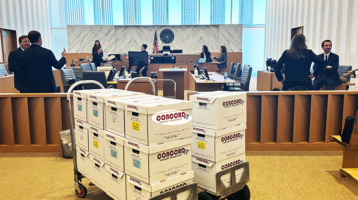
A production failure in a class action rarely begins with one bad document. It begins with inconsistent collection, unclear custodians, incomplete family handling, or a rolling production that cannot be reconciled six months later. This class action document production example shows how a defensible workflow can move from preservation through delivery while protecting privilege, confidentiality, and production deadlines.
The scenario is fictional, but the production issues are familiar to counsel handling consumer, employment, data privacy, product liability, and regulatory class actions. The governing case management order, ESI protocol, protective order, and jurisdiction-specific rules always control. The point is to establish an operational model that can withstand opposing counsel scrutiny and support the case through certification, merits discovery, expert work, and trial.
The Matter and the Production Problem
Assume a putative nationwide consumer class action alleges that a retailer used misleading subscription renewal disclosures over a four-year period. Plaintiffs seek documents concerning website design, customer communications, complaint handling, payment processing, internal testing, board reporting, and the company’s response to regulatory inquiries.
The defendant identifies 38 initial custodians across legal, marketing, product, customer care, finance, compliance, and executive leadership. Potential sources include Microsoft 365 email, Teams chats, shared drives, mobile devices, archived marketing platforms, customer-service exports, and paper files maintained by the compliance group. The case has a negotiated ESI protocol requiring TIFF images with searchable text, load files, Bates numbering, family preservation, native production of spreadsheets, and a privilege log for withheld responsive material.
This is not a simple export-and-send exercise. A defensible production requires a documented path from source to collection, processing, review, quality control, and delivery. It also requires enough production capacity to meet rolling deadlines without changing standards midstream.
Class Action Document Production Example: Workflow
1. Issue preservation and define the data map
Counsel sends a legal hold that identifies the claims, relevant period, likely data sources, and employee obligations. The hold should be acknowledged, tracked, and periodically reissued as new custodians or sources are identified. In a class action, the scope can expand quickly after initial disclosures or discovery from named plaintiffs, so the preservation process must be capable of revision.
The litigation team then creates a data map. For each custodian and source, the map records the system owner, date range, data type, estimated volume, collection method, access limitations, and chain-of-custody status. A marketing platform may contain the source of a campaign, while a shared drive may contain only exported PDFs. Treating both as interchangeable can create avoidable gaps.
For mobile data, counsel should decide early whether relevant communications may exist in text messages, iMessage, WhatsApp, Signal, or personal email. Forensically sound iPhone and email collection can preserve relevant metadata and reduce later disputes about whether material was altered, omitted, or collected too late.
2. Collect with chain-of-custody discipline
Collections are performed using documented procedures. Each transfer receives a unique identifier, and collection logs record the collector, source, date, method, hash values where applicable, and destination. Originals remain preserved while working copies move into processing.
In this example, the first collection includes 4.2 million email and Teams items, 1.1 million shared-drive files, 22 mobile-device collections, and 180 boxes of paper compliance records. The paper records are scanned at production quality, OCR processed, and coded to retain box, folder, and document-level provenance. If a paper original bears handwritten notes or color markings, the imaging specifications should preserve those features rather than reducing the record to a black-and-white image.
Collection decisions involve trade-offs. Broad collection may reduce the risk of missing relevant evidence, but it increases cost, processing time, and review volume. Narrow collection may be efficient, but it can create proportionality arguments and leave counsel unable to explain why certain sources were excluded. The defensible answer is a documented, case-specific decision made with legal and technical input.
3. Process, deduplicate, and prepare the review population
After collection, data is processed into a controlled review environment. Processing extracts metadata, expands archives, performs OCR where needed, identifies file types, captures email attachments, and flags exceptions such as encrypted files, corrupt items, or unsupported formats.
The team applies date filters, custodian filters, and negotiated search terms. Exact deduplication reduces duplicate copies across custodians, while near-duplicate analysis and email threading help reviewers work more efficiently. The production plan must state how duplicate documents will be treated. For example, the team may produce one copy of an exact duplicate while preserving all custodian information in metadata or a separate field.
The review database should also preserve family relationships. If an email is responsive, its attachment must not disappear because the attachment did not independently hit a search term. If a spreadsheet is produced natively, its placeholder image and Bates reference must accurately identify the corresponding native file.
4. Review for responsiveness, confidentiality, and privilege
Attorneys review the narrowed population using written coding instructions. The instructions define the issues, responsiveness categories, confidentiality designations, privilege calls, and escalation paths. A short reviewer training session and calibration set can prevent inconsistent coding across a large team.
For this matter, reviewers code documents as responsive, nonresponsive, privileged, or further review. Responsive documents receive a confidentiality designation where justified under the protective order. Privileged documents are withheld and captured for privilege-log preparation. Documents containing both legal and business communications require closer analysis, particularly where in-house counsel participated in operational discussions.
Quality control is not an end-stage task. Review managers should sample coded documents throughout the review, assess overturned decisions, monitor coding rates, and examine documents near search-term boundaries. Production quality improves when the team detects a misapplied issue tag during week one rather than after several productions have been served.
5. Build a rolling production set
The first rolling production contains 18,450 responsive documents. Before export, the team runs a production checklist that confirms Bates ranges, page counts, image quality, extracted text, metadata fields, confidentiality stamps, endorsement placement, native placeholders, and load-file integrity.
A typical production may include TIFF or PDF images, searchable text files, a metadata load file, an image cross-reference file, native files for spreadsheets and other agreed formats, and a production letter. The precise format depends on the ESI protocol. When a protocol calls for single-page TIFFs and the vendor produces PDFs, even otherwise responsive documents may need to be reproduced.
The production log records the Bates range, document count, page count, date served, sources included, confidentiality designation, and exceptions. Each later production uses a non-overlapping Bates range. If a correction is necessary, the team documents what changed, why it changed, and whether replacement images, text, or natives were supplied.
6. Address exceptions before they become disputes
Some documents will not process cleanly. Password-protected files, oversized drawings, embedded media, foreign-language material, corrupted files, and inaccessible legacy-system records should be identified early. The team should maintain an exceptions report and discuss material issues with counsel before the production deadline.
For instance, the retailer’s testing team has 46 password-protected spreadsheets containing A/B test results. Rather than silently excluding them, counsel determines whether passwords can be obtained, whether the files can be rendered, and whether they are responsive. That decision, and the effort taken to reach it, belongs in the project record.
What Makes This Production Defensible
A defensible production is traceable. The legal team should be able to answer where a document came from, how it was collected, what transformations occurred, who reviewed it, why it was produced or withheld, and which Bates range contains it. That capability matters when plaintiffs challenge completeness, demand supplemental discovery, or test a witness on the company’s discovery process.
It also requires continuity between electronic and paper workflows. High-stakes matters often include legacy files, physical exhibits, hearing binders, and last-minute demonstratives alongside electronically stored information. A fragmented vendor approach can create handoffs at exactly the moment when chain of custody and deadline control matter most.
Concord Document Technologies supports this type of work with forensic collection, RelativityOne-based attorney review, scanning, Bates labeling, electronic production, and trial exhibit services under one coordinated engagement. For matters with compressed deadlines, a single accountable production team can reduce avoidable rework between discovery and trial preparation.
The useful test is simple: if the case team receives a challenge on Friday afternoon, can it identify the source, retrieve the record, explain the production decision, and prepare the needed exhibit without guessing? Build the workflow so the answer is yes.