Bankruptcy printing Toppan is often used as a search term by legal teams looking for dependable support with high-volume bankruptcy notices, claims documents, creditor communications, and court-filed production. The name may point to a particular provider or a familiar category of outsourced bankruptcy print services. The operational question is broader: can the provider produce, secure, track, and deliver time-sensitive documents without creating risk for the estate, debtor, creditors, or counsel?
For bankruptcy counsel, claims agents, in-house legal departments, and restructuring teams, printing is rarely just printing. A service failure can mean missed notice deadlines, incomplete creditor packages, inconsistent versions, lost chain of custody, or a last-minute scramble before a hearing. The right production partner should understand that every mailed notice, exhibit set, barcode, and Bates range may become part of a record that requires scrutiny.
What Bankruptcy Printing Toppan Searches Usually Mean
A search for bankruptcy printing Toppan commonly reflects a need for specialized document production rather than ordinary commercial printing. Bankruptcy matters frequently involve thousands of recipients, court-controlled deadlines, confidential financial records, and a blend of physical and electronic workflows. Legal teams may need assistance with notice packages, ballots, proof-of-claim forms, solicitation materials, creditor matrices, declaration exhibits, hearing binders, and scanned case records.
The provider’s name matters less than whether its process fits the matter. A Chapter 11 solicitation with a large creditor population has different production demands than a Chapter 7 case requiring organized records for a trustee. A contested confirmation hearing may require overnight exhibit binders and courtroom-ready copies, while a claims administration project may require data-driven personalization, address hygiene, mail tracking, and documented quality control.
No single production model is right for every bankruptcy. The scope should be built around the court schedule, recipient volume, sensitivity of the information, and the degree of auditability required.
Production Requirements That Cannot Be Treated as Routine
Variable data and version control
Bankruptcy notices often require individualized fields such as creditor name, address, claim number, voting class, hearing information, objection deadline, or return instructions. That makes data intake and variable-data printing central to the assignment. Before production starts, counsel should confirm who validates the source file, how suppressed or duplicate records are handled, and how the final population count is reconciled.
Version control is equally important. A revised hearing date, amended plan, or corrected notice can affect every component of a mail package. The provider should be able to identify the approved version, lock production files, retain a record of changes, and prevent a superseded document from entering the workflow.
Mail preparation and evidentiary records
For large creditor distributions, postage is only one part of the mailing process. The work may include address standardization, presort preparation, intelligent mail barcodes, envelope insertion, returned-mail processing, and affidavits or declarations supporting service. Counsel and claims professionals should ask what reports are available and whether the output can be retained in a form useful for later filing or dispute resolution.
A production report that merely says a job was completed is not enough for a sensitive matter. The record should help establish what was produced, when it entered the mail stream, how many pieces were generated, and how exceptions were handled. If mailing data will support a certificate of service or other court submission, it should be reviewed before the deadline becomes urgent.
Confidentiality and controlled handling
Bankruptcy files can contain account information, tax records, employment data, personally identifiable information, privileged communications, and sensitive business plans. A provider should have defined access controls, trained personnel, secure staging areas, and documented destruction or return procedures. Bonded and insured status is a meaningful baseline, but the legal team should also understand the actual handling process.
This is especially relevant when hard-copy files are being scanned, copied, or transported. Boxes should be inventoried at intake, custody transfers should be documented, and exceptions should be escalated promptly. For electronic files, confirm secure transfer methods, permissions, retention periods, and the process for purging data once the engagement ends.
Courtroom and Hearing Support Still Matter
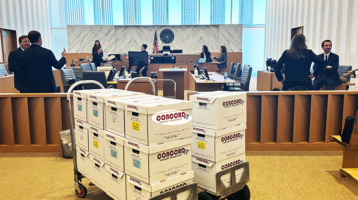
Electronic filing has not eliminated the need for physical trial and hearing materials. Bankruptcy courts, witnesses, experts, lenders, and litigation teams may still require tabbed binders, demonstratives, deposition excerpts, color exhibits, and judge or witness sets. The quality of these materials influences how easily the record can be used under pressure.
A capable legal production partner can convert a late-night revised exhibit list into organized, Bates-labeled, indexed binders with the correct number of copies and delivery instructions. The difference is not cosmetic. Mislabeled tabs, missing pages, inconsistent color copies, or an exhibit set delivered to the wrong location can disrupt a hearing and consume attorney time when attention should remain on the case.
For Southern California matters, this can include coordinated delivery to locations such as Stanley Mosk Courthouse, First Street Federal Courthouse, and other Superior Court facilities. For matters outside the region, the provider should be prepared to package and ship court-ready materials overnight with reliable tracking.
Integrating Paper Production With EDiscovery
A bankruptcy engagement often begins with boxes of records or an urgent request for notices, then expands into investigation, adversary proceedings, regulatory inquiries, or a contested hearing. That is why a disconnected print vendor can become an operational problem. Teams benefit when scanning, OCR, coding, Bates labeling, electronic discovery processing, online attorney review, and physical production can be coordinated through a single accountable workflow.
For example, a debtor’s historical paper files may need onsite scanning and searchable text before counsel can assess key issues. Email, mobile-device data, or cloud content may then require forensic preservation and processing. Once reviewed, selected records may need to be produced electronically, printed for deposition use, or assembled into hearing exhibits. Each handoff creates potential delay and risk if vendors use incompatible processes or lack litigation support experience.
Concord Document Technologies supports this type of blended workflow with legal copying, secure scanning, forensic data collection, RelativityOne-based review support, digital printing, and trial exhibit production. For teams handling sensitive matters, the practical value is accountability across the document lifecycle rather than a series of disconnected service orders.
Questions to Ask Before Engaging a Provider
The fastest way to assess a bankruptcy production provider is to ask operational questions before the first file or box changes hands. Four areas deserve direct answers:
- Capacity: Can the provider absorb peak volumes, perform quality checks, and meet court or service deadlines with 24/7 production capability when necessary?
- Data controls: How are source lists validated, duplicates resolved, variable fields tested, and approval records retained?
- Security: Who can access case data, how are physical files tracked, and what procedures govern secure transfer, storage, return, and destruction?
- Proof of completion: What reports, mailing documentation, production logs, and exception records will counsel receive?
It is also reasonable to request a test file or proof for a complex notice package. A pre-production proof can reveal field-mapping errors, envelope-window issues, pagination problems, or missing inserts before they become thousands of defective mail pieces. On a large matter, that small checkpoint can protect both the schedule and the record.
Choose the Workflow, Not Just the Printer
When evaluating bankruptcy printing support, price per page or price per mail piece is only one part of the decision. A lower unit cost can become expensive if it requires manual correction, lacks service documentation, or forces legal staff to manage multiple vendors during a court-imposed deadline. Conversely, a full-service provider may not be necessary for a small, static document run with no sensitive data or service requirements.
The right choice depends on the consequences of failure. High-volume notices, rapidly changing pleadings, confidential records, and hearing-driven timelines call for a provider with disciplined production controls and legal experience. Ask for a process that your team can defend, not simply a print quote that looks attractive on a spreadsheet.
A reliable bankruptcy document partner should leave counsel with organized records, verified output, and one less deadline to worry about when the case demands full attention.