A production deadline can turn a stack of records into a litigation risk quickly. When pleadings, medical files, business records, discovery productions, and trial exhibits must be reproduced accurately and delivered on time, legal copying is not an administrative afterthought. It is a controlled legal support function with consequences for privilege, confidentiality, court compliance, and trial readiness.
For law firms, corporate legal departments, and government agencies, the right copying partner does more than make pages. The provider must preserve document integrity, follow instructions precisely, maintain chain of custody, and scale without introducing uncertainty at the point when a matter is moving fastest.
What Legal Copying Must Deliver
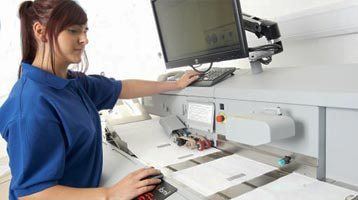
Legal copying is the secure reproduction and production of case-related paper and electronic records. Depending on the matter, the work may include high-volume copying, scanning, document indexing, OCR, Bates labeling, color reproduction, oversized exhibits, native-file handling, load-file preparation, and delivery to counsel, experts, opposing parties, or the court.
The distinction between ordinary commercial copying and litigation support is operational discipline. A legal production may be subject to discovery agreements, protective orders, subpoena requirements, local court rules, or internal records policies. A missing page, incorrect Bates range, unreadable scan, or misdirected delivery can require costly rework and may create avoidable disputes.
Accuracy is therefore more than image quality. It includes confirming the complete source set, preserving original order where required, applying the correct identifiers, separating privileged or confidential materials, and verifying that the final package matches production instructions. The work must be repeatable and documented, particularly when records are sensitive or likely to be scrutinized later.
The Risks Hidden in “Just Make Copies”
Many copying failures begin with a reasonable-sounding request: duplicate these files, scan this archive, prepare these exhibits. The risk appears when the request lacks production specifications or when the provider does not ask the questions that litigation support teams expect.
Consider a medical-record production with handwritten notes, tabs, color-coded pages, and mixed paper sizes. A low-resolution black-and-white scan may technically capture every page while eliminating information counsel needs to evaluate. Or consider a large document set that requires Bates numbers beginning at a specific range. If labels are applied before duplicate pages and family groups are identified, the resulting sequence can become difficult to defend and expensive to correct.
Confidentiality is equally important. Client records, personnel files, trade secrets, law-enforcement material, and regulated data should not move through an informal workflow. The provider needs clear intake procedures, restricted handling, secure storage, trained personnel, and a documented chain of custody. Bonded and insured status matters, but it is not a substitute for disciplined production procedures.
Turnaround presents its own trade-off. Same-day and overnight service can be essential before a hearing, deposition, or filing deadline. Speed should never mean skipping page counts, visual quality control, or delivery confirmation. A capable legal support provider builds quality checks into the production schedule rather than treating them as an optional final step.
A Defensible Workflow for Paper Records
Paper remains central to many disputes, especially in older matters, public-records requests, medical cases, construction litigation, employment files, and trial preparation. A defensible paper workflow starts at intake.
The team should document what was received, from whom, when, and in what condition. Box counts, file labels, special instructions, and delivery requirements should be captured before production begins. If originals must be returned, that requirement should be established at the start, not after scanning is complete.
Preparation follows. Staples, bindings, sticky notes, folders, and damaged pages may need careful handling so every page can be captured without losing context. This stage often requires judgment. Some tabs or notes are substantive and should be imaged; others are temporary handling materials. The correct decision depends on counsel’s instructions and the purpose of the production.
After copying or scanning, quality control should assess completeness, legibility, page orientation, color requirements, and image consistency. OCR can make a document set searchable, but it should be understood for what it is: a useful text layer, not proof that every character was interpreted perfectly. Poor originals, handwriting, stamps, and unusual formatting can reduce OCR accuracy.
Bates labeling should be applied only after the production structure is confirmed. The label format, prefix, starting number, location, font size, and treatment of attachments must align with the governing protocol. When multiple document sets are involved, a production log helps litigation teams identify what was produced, when, and under which Bates range.
When Copying and eDiscovery Need to Work Together
A modern matter rarely stays entirely on paper. The same case may include custodial email, text messages, cloud documents, mobile-device data, spreadsheets, scanned archives, and physical exhibits. Treating each source as a separate vendor project can create handoff delays, inconsistent identifiers, and unnecessary coordination work for the legal team.
The stronger approach is to plan paper and electronic workflows together. Scanned paper can be processed for search and review alongside electronically stored information. Collections from email or iPhones may require forensic preservation before data is filtered, processed, and reviewed. Responsive materials can then be produced in the requested format with consistent naming, Bates numbering, confidentiality designations, and production records.
That does not mean every matter needs a full eDiscovery platform. A focused subpoena response may require secure scanning, indexing, and delivery only. A major regulatory investigation may require forensic collection, processing, hosted review in RelativityOne, privilege review support, and rolling productions. The right scope depends on the volume, data types, deadline, governing agreement, and level of risk.
For legal teams, the practical advantage is control. One coordinated provider can reduce the chance that scanned paper, electronic records, and trial demonstratives are managed under conflicting instructions. It also gives counsel a clearer escalation path when a production changes late in the process.
Trial Exhibit Production Requires Different Discipline
Trial exhibits place unique pressure on legal copying operations. The documents must be correct, organized, labeled, and physically usable in court. Counsel may need chamber copies, witness binders, exhibit lists, demonstratives, deposition designations, and last-minute replacement pages. A digital file alone is not always enough.
Production teams should confirm the court’s requirements, the number of sets, binder configuration, tab style, color needs, and delivery timing before assembling materials. Oversized drawings, photographs, and color-coded records often demand specialized printing and finishing. For remote or hybrid proceedings, electronic exhibit sets may need corresponding secure files with clear naming conventions.
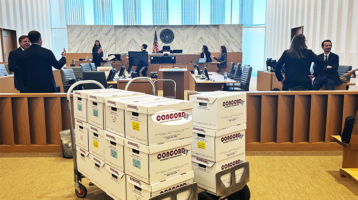
In Los Angeles, the value of a local, experienced production team is most visible when trial schedules shift. Overnight delivery of completed exhibit binders to Stanley Mosk Courthouse, First Street Federal Courthouse, or other Superior Court locations can protect preparation time that cannot be recovered on the morning of a hearing. The goal is not merely fast delivery. It is ensuring that every set arrives complete, correctly assembled, and ready for use.
Questions to Ask a Legal Copying Provider
Before releasing sensitive records, legal teams should determine whether the provider can describe its process in specific terms. General assurances are not enough when the assignment involves confidential information, large volumes, or a court deadline.
Ask how originals are logged and secured; who handles scanning, labeling, and quality control; and how discrepancies are reported. Confirm whether the provider can produce color, oversized, and high-volume materials without outsourcing key steps. If electronic data is involved, ask how forensic collections, processing, review, and production connect to the paper workflow.
It is also reasonable to ask about after-hours capacity. Litigation deadlines do not consistently arrive during business hours, and a vendor’s response after 5 p.m. can matter as much as its pricing proposal. The best partner will identify production risks early, explain available options clearly, and document the final instructions before work begins.
Concord Document Technologies supports these interconnected requirements with 24/7 legal production capacity, secure document handling, digital printing, scanning, eDiscovery workflows, and trial exhibit services. For matters involving sensitive records or compressed timelines, operational depth is not a luxury. It is part of the case strategy.
When the record must be accurate, usable, and where it needs to be by a fixed deadline, treat copying as a controlled production process from the first box or data source to the final delivery confirmation.