A trial team can spend months building a record and still lose valuable time if counsel cannot locate the right exhibit at counsel table. The search phrase trail notebook printing is often used when legal professionals mean trial notebook printing: the controlled production of organized, court-ready binders for hearings, arbitrations, depositions, and trial. The distinction matters less than the outcome. Every volume must be accurate, legible, complete, and available when the court calls the matter.
For high-stakes litigation, printing is not a final administrative task. It is a production workflow that requires document control, clear specifications, quality assurance, secure handling, and dependable delivery. A misplaced divider, an omitted page, or a mismatch between a witness binder and the admitted exhibit set can create avoidable pressure in the courtroom.
What Trail Notebook Printing Must Accomplish
A trial notebook is a working tool for attorneys, paralegals, witnesses, and litigation support teams. It may contain pleadings, witness outlines, exhibit lists, demonstratives, deposition designations, jury instructions, legal authorities, or a final exhibit set. The contents vary by matter, but the operational standard does not: users must be able to find the correct document immediately and trust that the printed version matches the approved source.
Effective production begins with a defined binder plan. Legal teams should determine who will receive each set, whether each recipient needs identical content, which documents require color, and whether confidential material needs separate treatment. A judge’s courtesy copy, a witness binder, and counsel’s working notebook may share core exhibits while requiring different tabs, annotations, or document sequences.
The right production partner asks these questions before print files reach the press. That early review helps identify missing pages, inconsistent pagination, oversized exhibits, unreadable scans, and files that may not reproduce correctly. It is faster and less expensive to resolve those issues before a final set is assembled.
Build the Binder Around Courtroom Use
A notebook that looks polished but is difficult to navigate does not serve the trial team. Organization should follow the way documents will be used in the proceeding, not merely the order in which they were collected.
Establish one approved source set
The litigation team should designate a final source folder or production set before printing begins. This protects against a common deadline problem: multiple versions of the same exhibit circulating among attorneys, paralegals, and vendors. The approved source should identify the controlling file, exhibit number, intended order, and any special production instructions.
When a late exhibit is added, the team should document the change and determine which volumes require replacement pages. A controlled update process is particularly important when several attorneys are working from separate binders or when materials are being shipped to multiple locations.
Use consistent tabs, labels, and numbering
Tabs should reflect how counsel refers to documents in the room. Exhibit numbers, witness names, motion categories, or deposition designations are generally more useful than vague labels. Printed spines should identify the case, volume, and date or version where appropriate, allowing staff to retrieve the right binder without opening it.
Bates numbers and trial exhibit numbers serve different purposes, and both may appear in a notebook. Before production, confirm which identifier controls the index and whether exhibit stickers must be applied. If an exhibit spans multiple pages, verify that labels, stamps, and page references do not obscure material content.
Match the print format to the evidence
Standard black-and-white printing is appropriate for many pleadings and text-heavy records. It is not always appropriate for photographs, spreadsheets, emails with color-coded content, maps, medical images, or demonstratives. A grayscale reproduction can change the usefulness of the evidence, even when every page technically prints.
Paper size also requires planning. Oversized drawings, native spreadsheets, and large charts may need foldouts, enlarged reproduction, or separate boards. These choices involve trade-offs. A compact binder is easier to carry, while a larger format may be necessary for readability. The correct choice depends on how the document will be presented and whether the court has established format requirements.
Quality Control Is the Core of Trial Notebook Printing
The most reliable trial notebook printing process includes review at several points, not just a final glance at the finished binder. Production teams should confirm that files are complete, pages are oriented correctly, tabs match the index, and each volume contains the proper sequence.
A useful proofing process checks the title page, table of contents, divider language, page counts, and first and last pages of every exhibit. For sensitive documents, the review should also confirm redactions are properly applied in the final printable file. A redaction that appears correct in one application but is not flattened in the production PDF can create serious risk.
Physical assembly needs its own controls. Binder capacity must match the page volume so pages turn freely without tearing or pulling from the rings. Hole punching, inserts, foldouts, and mounted tabs should be checked for alignment. If volumes are numbered, the numbering should be reconciled before packing to ensure no set is incomplete.
For matters with frequent changes, consider producing a controlled master set first. Once the legal team approves the master, identical copies can be generated with greater confidence. This is often more efficient than discovering a tab or pagination error after every binder has been assembled.
Security and Chain of Custody Cannot Be an Afterthought
Trial materials routinely include confidential business records, personally identifiable information, protected health information, sealed filings, and attorney work product. The production provider must treat files and finished materials as sensitive legal records from receipt through delivery.
That means using secure file-transfer procedures, limiting access to authorized personnel, maintaining clear instructions for handling confidential material, and controlling the movement of physical binders. A production team should know whether a set is for internal attorney use, a court filing, opposing counsel, or a witness. Those destinations can require different labeling, packaging, and approval procedures.
When a matter involves a rush deadline, security should not be traded for speed. The right provider can operate urgently while preserving accountability for files, proofs, prints, and final delivery. Bonded and insured operations with established legal production experience provide an additional level of assurance when the record is sensitive or irreplaceable.
Plan for the Deadline You Actually Have
Trial schedules change. A ruling may require new briefing, an exhibit may be admitted late, or counsel may need replacement sets after travel. The practical question is not whether last-minute changes will occur. It is whether the production workflow can absorb them without compromising accuracy.
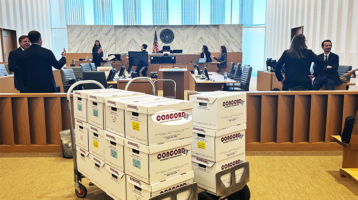
Provide the printer with the hearing date, delivery location, quantity, anticipated update cadence, and any hard cutoff set by the court. If binders are needed at Stanley Mosk Courthouse, First Street Federal Courthouse, or another Southern California venue, local delivery planning can reduce uncertainty on the morning of trial. For out-of-area matters, overnight shipment should include enough time for receipt, confirmation, and contingency planning.
Legal teams should also order with realistic volume needs in mind. Counsel table sets, witness sets, court copies, client copies, and backup volumes can add up quickly. Printing too few may force a rushed second run. Printing too many can create unnecessary cost and additional confidentiality exposure. The right quantity depends on the courtroom, case team, and presentation plan.
Choose a Provider That Understands the Record
A general print shop may produce attractive binders, but legal trial notebooks require more than commercial printing capability. The provider should understand Bates labeling, exhibit preparation, document scanning, indexing, color exceptions, sealed material, version control, and courtroom deadlines. It should also have the capacity to coordinate electronic files and physical production without creating handoffs that introduce error.
Concord Document Technologies supports these workflows with legal document production experience, 24/7 capacity, secure handling practices, and trial exhibit binder delivery for demanding matters. For teams managing both eDiscovery and paper trial materials, working with one accountable provider can reduce friction between the reviewed record and the final printed set.
When the hearing date is fixed and the record is moving, the best next step is to confirm the source set, production specifications, and delivery plan early. That preparation gives the trial team something essential at counsel table: a binder they can rely on without hesitation.