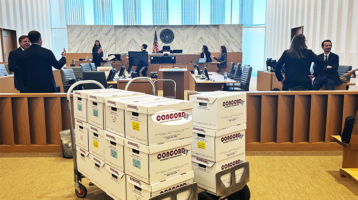
A missed box, a broken Bates sequence, or a scan set that cannot be searched can create avoidable pressure days before a deposition or filing deadline. A thorough legal scanning vendor review is not a purchasing exercise focused on per-page pricing. It is a risk assessment of the vendor that will receive, process, protect, and return case-critical evidence.
For litigation teams, corporate legal departments, and government agencies, the right provider must do more than convert paper into PDFs. The vendor must preserve chain of custody, meet demanding production schedules, produce usable searchable files, and understand how scanned records move into attorney review, discovery production, hearings, and trial.
A Legal Scanning Vendor Review Starts at Intake
The most consequential part of a scanning engagement often happens before the first page is scanned. Ask a prospective vendor how it receives documents, inventories boxes and folders, identifies exceptions, and records transfers between locations or personnel. General assurances are not enough. The provider should be able to describe a documented intake procedure that creates accountability from pickup through final return or approved disposition.
This is especially significant when records include medical files, personnel materials, financial documents, law enforcement records, privileged communications, or evidence collected under a preservation obligation. A vendor should know whether original order must be maintained, whether documents require unitization, and how staples, oversized pages, photographs, tabs, and fragile records are handled without losing context.
A reliable process also distinguishes between a routine back-file conversion and a litigation-ready project. Litigation records may require instructions on confidentiality designations, separator handling, duplicate identification, document-level naming, and Bates numbering before scanning begins. If the vendor waits to clarify these decisions after production is underway, the schedule and budget can move quickly.
Verify Chain of Custody and Document Security
Security is operational, not promotional. During a vendor review, request a clear explanation of who can access physical records, where scanning takes place, how materials are stored outside production hours, and how completed images are delivered. The answers should cover both physical and electronic controls.
A dependable provider will be prepared to address bonded and insured operations, controlled production areas, trained personnel, documented handling procedures, and secure transfer methods. For sensitive matters, confirm whether scanning can be performed onsite at a law office, agency, corporate location, or secure records facility. Onsite service can reduce transport exposure and keep custodians or case teams close to the source materials, though it may not always provide the same production scale as a dedicated scanning center.
Chain of custody should remain intact when work expands beyond paper. If a matter includes mobile-device collection, email preservation, hard-copy records, and electronic discovery, determine whether the provider can coordinate these workstreams under consistent project management. Multiple vendors can be appropriate when specialized expertise is required, but every handoff adds opportunities for confusion, delay, and inconsistent reporting.
Test Capacity Against the Actual Deadline
A vendor that performs well on a small archival project may not be equipped for a compressed litigation schedule. Capacity means more than having high-speed scanners. It includes staffing, quality-control coverage, equipment redundancy, shift availability, pickup and delivery logistics, and the ability to absorb late changes without placing the matter behind other jobs.
Ask direct questions: Can the provider support 24/7 production when a court deadline requires it? What happens if document volume is materially higher than the initial estimate? Is there a defined escalation contact after business hours? Can the vendor produce trial exhibit binders, hearing materials, and replacement sets on short notice?
In Los Angeles litigation, where matters may require overnight exhibit delivery to courthouses such as Stanley Mosk or First Street Federal, logistics can be as important as image quality. The same principle applies in every jurisdiction: a legal support vendor should understand that a trial team cannot pause because a shipment, reprint, or corrected exhibit set is delayed.
Capacity also has a financial dimension. A responsible vendor provides a realistic estimate while identifying variables that can affect cost, such as document preparation, color scanning, oversized materials, OCR, coding, hosting, rush work, and delivery. The lowest stated page rate can become expensive when required litigation services are treated as unexpected add-ons.
Measure Image Quality and OCR Usability
A scanned file is only valuable if legal professionals can use it. Review sample work before committing a major matter. Look beyond whether the pages appear on screen. Confirm that images are legible, complete, properly oriented, consistently sized, and free of missing pages, clipped margins, bleed-through, or duplicate scans.
OCR deserves particular attention. Searchable text helps attorneys, paralegals, and reviewers find key language across large paper collections, but OCR accuracy varies with source quality. Faxes, handwriting, carbon copies, poor photocopies, unusual fonts, and marked-up records may produce unreliable text. A qualified vendor will explain those limitations rather than promise perfect searchability.
Discuss what the final deliverable should include. Depending on the matter, that may mean searchable PDFs, single-page TIFFs with load files, document-level PDFs, extracted text, fielded data, native files, or a combination of formats. The output must be compatible with the receiving review platform and production protocol. A technically correct scan set in the wrong structure still creates expensive rework.
Review Quality Control, Not Just Quality Claims
Every high-volume project has exceptions. The meaningful question is how the vendor finds and resolves them. Ask whether quality control occurs during preparation, image capture, OCR, and final export. Determine whether the process checks for page counts, legibility, orientation, document breaks, Bates continuity, and export integrity.
The review should also establish how exceptions are communicated. A vendor should flag illegible originals, missing attachments, unusual media, handwritten annotations, and ambiguous folder structures promptly. Silent assumptions can alter evidence context. Clear exception reporting allows counsel to make informed decisions while there is still time to correct the record.
For production work, verify that the vendor can provide sample batches and obtain approval before processing the full collection. This step is particularly useful when a protocol includes custom endorsements, confidentiality legends, redactions, slip sheets, or unique naming conventions. It may add a small amount of time at the front end, but it prevents much larger downstream corrections.
Consider Whether the Vendor Connects Paper to Review and Trial
Paper scanning rarely remains an isolated task in complex matters. Once records are digitized, they may need to be loaded into an attorney review environment, compared with electronically stored information, produced to another party, printed for a witness examination, or organized into trial exhibits.
A single-provider model can reduce friction when the provider has real capability across scanning, legal copying, eDiscovery processing, managed review support, digital printing, and exhibit production. The trade-off is that buyers should still test depth in each required service. Do not assume a company that offers eDiscovery understands courtroom production, or that a print provider can manage defensible data collection.
Concord Document Technologies is built for matters where physical records and electronic workflows meet, including document scanning, forensic collection, RelativityOne-based review support, legal copying, and trial exhibit production. For teams managing sensitive, document-intensive cases, that service breadth can reduce handoffs while keeping project responsibility clear.
How to Conduct a Practical Legal Scanning Vendor Review
Before selecting a provider, give each finalist the same project scenario. Include estimated volume, material types, security requirements, desired output, deadline, delivery location, and anticipated downstream use. A standardized scenario makes proposals comparable and exposes whether a vendor asks the operational questions that matter.
Evaluate the response across five areas: intake and chain of custody; physical and electronic security; production capacity and escalation; image, OCR, and export quality; and integration with review, production, and trial workflows. Require each vendor to identify assumptions and exclusions in writing. A precise proposal is often a sign of disciplined execution.
If the matter is high stakes, begin with a pilot batch. Use difficult documents rather than clean, uniform pages. Include handwritten notes, mixed sizes, tabs, low-quality copies, and any records likely to create production exceptions. Review the output with the litigation support team before releasing the full collection.
The provider you choose will handle more than paper. They will handle evidence, privilege, deadlines, and the working record your legal team depends on. Select the vendor whose process remains clear when the volume rises, the instructions change, and the deadline becomes nonnegotiable.