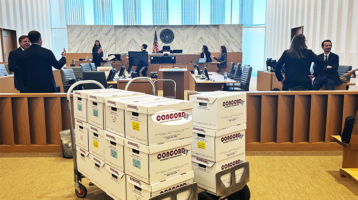
A trial exhibit binder that reaches counsel, the witness, or the courtroom with a missing page, duplicate label, or incorrect version can interrupt a carefully built case in minutes. Preparing trial exhibit binders for federal court is therefore not a finishing task delegated at the end of trial preparation. It is a controlled production process that connects the case team’s evidence decisions with the court’s rules, the judge’s procedures, and the practical demands of using documents under pressure.
Federal practice is not uniform from one district or courtroom to another. The Federal Rules of Civil Procedure provide the framework, but local rules, standing orders, and the individual judge’s trial procedures often determine how exhibit lists, premarked exhibits, courtesy copies, electronic displays, and binder delivery must be handled. The binder must serve the actual trial plan, not a generic production template.
Start With the Court’s Exhibit Requirements
Before documents are printed, verify the governing requirements for the assigned judge and division. Review the scheduling order, pretrial order, local civil rules, standing orders, and any instructions issued at the final pretrial conference. Confirm deadlines for exchanging exhibits, filing exhibit lists, lodging sets with the courtroom deputy, and providing copies to opposing counsel.
The details matter. One court may require consecutively numbered plaintiff and defense exhibits; another may assign numbering conventions by party, use letters for demonstratives, or require a joint exhibit list. Some judges prefer electronic exhibit sets with a limited paper courtesy binder. Others expect hard-copy binders for the court, witnesses, and counsel. Do not assume that a procedure used in state court, or even another federal courtroom in the same district, applies to the current matter.
The exhibit list and the binder must match exactly. Each listed identifier should lead to one complete, clearly identifiable document. If an exhibit is withdrawn, substituted, or revised, the change should be reflected across the list, binder index, electronic repository, and trial presentation system. A late change that updates only one of these places creates avoidable confusion at the moment evidence is offered.
Build a Controlled Exhibit Inventory
A reliable binder begins with a master exhibit inventory, not a stack of print-ready PDFs. The inventory should identify the exhibit number, short description, source or custodian, Bates range, proposed sponsoring witness, authentication status, objection status, and final production location. For high-volume matters, add fields for confidentiality designation, native-file availability, demonstrative status, and the person responsible for final approval.
This inventory becomes the source of truth. It allows the litigation team to distinguish between documents that were produced in discovery, documents selected for the trial set, and documents actually expected to be offered into evidence. Those are not always the same population.
Version control deserves particular attention. A contract may exist as an executed PDF, a scanned copy, a redlined draft, and a document with trial annotations. An email chain may appear in multiple productions with different family relationships or attachments. The correct exhibit is the version the trial team intends to use and can authenticate. Labeling a document as “final” without a documented review path is not enough.
Confirm what belongs in the binder
A practical final-pass review should confirm at least five points:
- The document is complete, readable, and in the correct order.
- The exhibit label matches the master list and any court-assigned numbering.
- Bates numbers, page references, and cited excerpts are consistent with briefs and witness outlines.
- Redactions are complete and do not obscure required context or exhibit identifiers.
- The file is the approved trial version, including all intended attachments and attachments to attachments.
This review is especially valuable for email families, spreadsheets, photographs, text-message exports, and records collected from mobile devices. These formats can lose context when converted, printed, or separated from metadata. If the original format has evidentiary value, preserve it and coordinate the paper binder with the electronic version that may be needed at trial.
Organize the Binder for Use at Counsel Table
A courtroom binder must be usable at speed. The person examining a witness should be able to locate an exhibit without searching through loose pages, unclear tabs, or an index that uses descriptions no one recognizes. Organize exhibits in the same sequence used on the final exhibit list unless the court directs otherwise.
Use durable, clearly printed divider tabs that show the exhibit number and a concise description. Include a table of contents at the front of each volume. When a set spans multiple binders, label the spine and cover with the case name, party, volume number, exhibit range, and production date. A volume containing Exhibits 1 through 25 should never be indistinguishable from a volume containing Exhibits 26 through 50.
Pagination should be stable and easy to cite. Existing Bates numbers usually provide the best common reference point, but they do not replace an exhibit number. If a document has no Bates label, determine whether court procedure or the trial team’s protocol calls for a separate page numbering convention. Avoid adding labels or stamps that obscure material text, signatures, or metadata printed on the page.
Physical construction matters as much as indexing. Overfilled binders split at the rings and make page turns difficult. Thin paper can show text from the reverse side, while poorly aligned tabs can cover document margins. Use appropriate binder capacities, reinforced tabs, quality paper, and consistent duplex or single-sided printing based on the court’s requirements and counsel’s preference. For exhibits that will be handled repeatedly by witnesses, a separate witness set may be more practical than relying on the court’s binder.
Plan for Objections, Admissibility, and Demonstratives
A binder is not a ruling on admissibility. It should, however, make the trial team’s evidentiary decisions visible and manageable. Track objections and anticipated foundations separately from the publicly used binder. Internal work-product notes should not appear in any copy that may be handed to a witness, opposing counsel, or the court.
For each exhibit, counsel should know the expected sponsoring witness, authentication method, hearsay response, and whether a limiting instruction may be needed. Original-versus-duplicate issues, completeness concerns, and the treatment of summaries under Federal Rule of Evidence 1006 should be resolved before the witness takes the stand whenever possible. A summary chart may be useful at trial, but it should be clearly identified as a demonstrative or summary and supported by underlying materials that are available for examination as required.
Demonstratives require their own control process. They may be numbered differently from admitted exhibits, subject to advance disclosure, or prohibited from going to the jury room. Keep demonstratives separate from admitted or proposed evidentiary exhibits unless the judge’s procedures direct otherwise. A polished timeline or damages chart can become a problem if it is inserted into the exhibit binder without a clear designation.
Produce the Right Sets and Protect the Record
The required number of sets depends on the courtroom. Common recipients may include the judge, courtroom deputy, witness, opposing counsel, the jury if authorized, and each trial attorney. Confirm whether the court wants original binders, copies, electronic media, or a combination. Also determine whether documents should be delivered in advance, brought to the final pretrial conference, or lodged on the first day of trial.
Every set must be identical unless its purpose requires otherwise. A witness copy may need a limited selection of exhibits, while the court set may need the entire proposed exhibit package. Maintain a production log showing who received each set, when it was delivered, the exhibit range included, and the version date. This is a simple but meaningful chain-of-custody discipline for sensitive records and last-minute corrections.
For confidential, sealed, or personally identifiable information, use secure handling from production through delivery. Verify that public binder sets contain only approved redacted versions. Use sealed packaging, controlled access, and documented handoffs where appropriate. Do not leave trial materials with protected data in an unsecured reception area, hotel business center, or courier drop location.
Pair Paper Binders With a Trial-Ready Digital Set
Paper remains useful in federal court, but it should not be the only source of trial evidence. Build a synchronized digital exhibit set with the same exhibit numbers, filenames, and document order. The electronic set should be tested in the presentation environment before trial. A file that opens correctly on a paralegal’s desktop may display differently on courtroom equipment, particularly large spreadsheets, color-coded charts, video files, and documents with embedded links or comments.
A dependable digital protocol includes a final PDF review, searchable text where appropriate, verified exhibit naming, and a backup copy held by authorized trial staff. Native files, audiovisual evidence, and forensic exports should be preserved in their original forms even when a PDF printout appears in the binder. The paper version is a courtroom tool; it is not always the complete evidentiary record.
For matters with compressed schedules, high exhibit volume, or delivery requirements near federal courthouses, experienced litigation support production can reduce risk. Concord Document Technologies supports controlled trial exhibit production, legal copying, Bates labeling, scanning, and overnight delivery for complex matters, including service to Los Angeles federal court locations. The value is not merely fast printing. It is having a documented process capable of maintaining accuracy when the exhibit list changes late.
Conduct a Final Trial-Eve Audit
The last audit should occur after the final exhibit list is approved, not before. Compare each physical binder and digital folder against the master inventory page by page. Confirm tab order, cover labels, table of contents, exhibit stickers, redactions, and volume ranges. Then have someone who did not assemble the set attempt to locate several exhibits using only the index. If that person hesitates, counsel will hesitate too.
Keep a small, controlled reserve of replacement pages, labels, tabs, and empty binders available for authorized corrections. Do not casually substitute pages after sets have been distributed. Record every change, identify the affected recipients, and make sure all versions are brought back into alignment.
A well-prepared exhibit binder gives the trial team something rare during a fast-moving hearing or examination: confidence that the document in hand is complete, correctly identified, and ready to be used when the court calls for it.