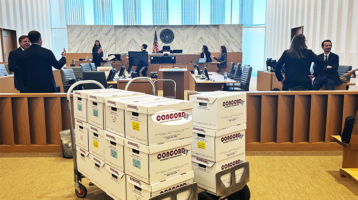
A Santa Ana courthouse exhibit binder is often treated as a last-mile production task. It is not. A binder that is missing a page, uses inconsistent exhibit labels, arrives at the wrong department, or does not match counsel’s working set can create avoidable pressure immediately before a hearing or trial. For high-stakes matters, the binder should be managed as a controlled litigation deliverable with a documented production process.
The correct format depends on the assigned judicial officer, the type of proceeding, applicable local rules, and any case-specific order. Counsel should always confirm current department requirements before production. The objective is straightforward: every person handling the exhibits should be able to locate the same document, on the same page, under the same exhibit designation without delay.
Overnight Printing & Delivery.
CALL CONCORD TODAY (213) 745-3175
or email: cs@concorddt.com
What a Santa Ana Courthouse Exhibit Binder Must Accomplish
An effective exhibit binder does more than hold documents. It creates a reliable presentation system for the court, opposing counsel, witnesses, and the trial team. The binder must be easy to navigate under pressure, physically durable, accurately indexed, and consistent with the exhibit list and electronic source files.
For a hearing, the court may require a smaller set of lodged or courtesy materials. For trial, the production may involve multiple volumes, exhibit sets for the bench and parties, witness binders, demonstratives, and replacement pages. These are different workflows. Producing a hearing binder as though it were a trial set can waste time and budget, while treating a trial production as a simple courtesy copy invites confusion.
Before printing begins, identify the intended recipient and purpose of every set. A bench copy, an original for filing or lodging, an opposing-counsel set, and an internal attorney set may have different labeling, assembly, and delivery instructions. Do not assume that a document delivered to the courthouse is accepted for filing, lodged with the clerk, or provided to the judicial officer. Those are separate procedural questions.
Start With a Controlled Exhibit Record
The exhibit list is the production control document. It should be finalized, or at minimum frozen for a defined production window, before tabs are cut and pages are printed. Each exhibit should have a unique identifier, a clear description, a page count, and a source-file reference. If the matter uses Bates numbering, confirm that every printed page matches the approved Bates range.
Version control matters most when the team is working from a mixture of native files, produced PDFs, deposition attachments, and late-added materials. One revised email chain can change pagination for an entire tab and affect the table of contents. A disciplined workflow identifies the final source version, converts it consistently, applies required Bates labels or footer treatment, and performs page-level quality control before assembly.
Confirm exhibit designations before tabs are produced
Exhibit labels should match the designations counsel will use in court. That may mean numerical exhibits, alphabetical exhibits, plaintiff and defense designations, or a format required by a pretrial order. Avoid informal labels such as “Exhibit 12 revised” unless counsel has expressly approved the designation and the exhibit list reflects it.
Tab production should follow the same approved list. If a tab reads “Exhibit 24” but the index identifies the underlying document as “Exhibit 24A,” the court and trial team lose time resolving a problem that should have been caught in production. For lengthy records, use clear, legible tabs and volume labels that remain visible when binders are stacked.
Build the Binder for Actual Courtroom Use
A professional binder needs enough capacity to turn pages easily without tearing holes or stressing the binding. Overfilled three-ring binders create page damage and make a clean courtroom presentation harder. When volume size becomes impractical, divide the set logically by exhibit range, subject matter, witness, or chronology, depending on how counsel expects to use it.
Every volume should carry a consistent spine label showing the case short title, exhibit set type, volume number, and exhibit range. A cover page can include fuller case information, hearing or trial date, department if confirmed, and a confidentiality notation when appropriate. Do not place protected personal information on an exterior label unless it is necessary and authorized.
The index should be placed at the front of the first volume and, when useful, repeated in each volume with the relevant range clearly marked. It should identify the exhibit number, a concise description, and the starting page or tab. In a large case, a master index is valuable, but it should not replace a usable volume-level index.
Document legibility deserves its own review. Color exhibits, photographs, spreadsheets, maps, text-message captures, and small-font emails can lose meaning in standard black-and-white output. Print settings should be selected for evidentiary usability, not merely speed. A color original may require color reproduction; a spreadsheet may need landscape orientation, a larger sheet size, or an approved excerpting strategy. The right choice depends on the exhibit and the court’s direction.
Quality Control Is More Than a Page Count
A page count confirms quantity. Quality control confirms reliability. The final review should compare each assembled binder to the approved exhibit list and inspect the actual physical product. This is where production teams identify missing pages, duplicate pages, tab misalignment, upside-down inserts, unreadable images, incorrect Bates ranges, and failed hole punches.
For sensitive matters, track custody from receipt through delivery. The production record should identify who released the source files, who approved the final set, the number and type of binders produced, the time of completion, and the designated recipient or courier. This discipline is especially valuable for sealed, confidential, regulated, or personally identifiable information.
A practical final check includes these controls:
- Confirm every tab against the final exhibit list and volume range.
- Compare the first and last page of each exhibit to the approved PDF or source set.
- Review color-dependent, oversized, and image-heavy exhibits for legibility.
- Verify covers, spines, confidentiality markings, and recipient labels.
- Photograph or document completed sets before sealed delivery when appropriate.
Plan Delivery Around the Hearing, Not the Deadline
Same-day courthouse delivery can be necessary, but it should not be the plan for a production that requires revision cycles, multiple sets, or special finishing. Build backward from the hearing time and account for attorney approval, printing, quality control, assembly, traffic, security screening, courier handoff, and confirmation of delivery instructions.
Santa Ana matters can involve Orange County Superior Court locations and departments with different practical expectations. Confirm the precise courthouse location, department, recipient name, delivery window, and whether the set must go to a clerk, courtroom, litigation team member, or another authorized recipient. A courier arriving at the correct courthouse but without the right recipient instructions has not completed the job.
Keep an attorney-ready reserve set whenever the matter justifies it. Last-minute substitutions happen. A reserve copy, replacement exhibit packet, or supplemental volume can prevent a revised document from disrupting the primary courtroom set. For especially large productions, keep a searchable electronic version aligned to the same exhibit numbering so the legal team can verify content quickly.
When Outsourced Production Is the Safer Choice
Internal teams can handle straightforward, low-volume binders when the source set is stable and staff have time for careful review. The calculation changes when a matter requires overnight turnaround, complex Bates treatment, color-critical evidence, multiple recipient sets, confidential handling, or coordinated courthouse delivery. In those situations, the risk is not simply a printing error. It is losing control of a litigation deliverable at the moment it matters most.
Concord Document Technologies supports trial exhibit production, legal copying, digital printing, Bates labeling, scanning, and controlled delivery for legal teams managing time-sensitive matters. With 24/7 production capacity and experience supporting complex litigation workflows, the focus remains on accurate, courtroom-ready materials and accountable handling from source file through delivery.
A binder should leave production only when counsel can rely on it without opening every tab again. That standard protects the legal team’s time, supports a credible courtroom presentation, and gives the case the operational discipline it deserves.
CALL CONCORD TODAY (213) 745-3175
or email: cs@concorddt.com
https://concorddt.com/trial-exhibit-binders/
https://www.occourts.org/
https://www.occourts.org/location/civil-complex-center