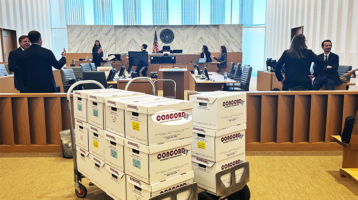
A hearing date can change without warning. A witness outline can be revised after business hours. An exhibit list can grow by hundreds of pages the day before counsel needs to be at the courthouse. First Street federal exhibit binders must be accurate, courtroom-ready, and delivered on a schedule that leaves no room for production errors.
For high-stakes federal matters, a binder is not simply a stack of copied documents. It is a working litigation tool used by attorneys, witnesses, courtroom staff, and trial teams under pressure. Tabs must lead to the right material. Bates ranges must match the record. Confidential material must be handled correctly. Every volume must be complete, legible, and easy to navigate when time is limited.
What First Street Federal Exhibit Binders Need to Accomplish
Exhibit binders prepared for federal proceedings at the First Street courthouse in Los Angeles should support the way the case will actually be handled in court. That begins with a clear understanding of the intended recipient. A judge’s chambers set, opposing counsel set, witness binder, attorney working set, and demonstrative binder may all require different labeling, tab structures, and production specifications.
The operational standard is simple: counsel should be able to open any volume, locate an exhibit immediately, and trust that the material matches the approved exhibit list. Achieving that result requires careful coordination between the legal team and the production provider before printing begins.
A reliable production workflow accounts for exhibit numbering, chronology, volume breaks, document orientation, color requirements, and any protective-order designations. It also accounts for the practical realities of courtroom use. Oversized spreadsheets, photographs, maps, native-format printouts, and deposition excerpts may need special handling so they remain readable and durable.
Accuracy Starts Before the First Page Prints
Most binder problems originate upstream. An outdated exhibit list, duplicate document, incorrect PDF version, or inconsistent Bates range can move through production quickly if no one is checking the source files against the instructions.
Before production, the litigation team should confirm the final exhibit list, identify any documents to be excluded or replaced, and establish a single point of contact for approvals. If documents have been pulled from an eDiscovery review platform, the export should be checked for document integrity, endorsements, redactions, and correct page order. When late substitutions are expected, a production plan should allow for replacement pages or revised volumes without disrupting the entire set.
This is where experienced legal document support matters. The goal is not merely to print a clean PDF. The goal is to create a defensible, usable physical record that reflects counsel’s final litigation strategy.
Production Decisions That Affect Courtroom Use
Binder construction should be based on the material, not on a one-size-fits-all template. A compact motion hearing set may require only a few indexed volumes. A lengthy evidentiary hearing or trial may require multiple coordinated sets with sequential volume labels and duplicate copies for several users.
Three-ring binders remain useful when teams expect to add or remove pages during preparation. Perfect-bound or wire-bound books can be a better fit for fixed materials that need a clean, controlled presentation. The right choice depends on whether the contents are final, how often the materials will be handled, and whether courtroom rules or counsel preferences call for a particular format.
Tabs are equally important. Numbered exhibit tabs are often appropriate when the court and parties are working from a stipulated exhibit list. Descriptive tabs can be more useful for internal attorney or witness binders, where quick subject-matter access is the priority. For large productions, a master index with exhibit number, description, Bates range, and volume reference reduces confusion across the team.
Color reproduction should be deliberate. Color-coded correspondence, marked-up plans, medical imaging, charts, and photographs can lose evidentiary value when reproduced in black and white. At the same time, printing every page in color can add cost and create unnecessary production time. A targeted color plan preserves what matters while keeping the job efficient.
Legibility Is a Litigation Requirement
Documents that are technically included but difficult to read do not serve the trial team. This is especially true for spreadsheets, emails with attachments, engineering drawings, financial reports, and image-heavy records.
Production staff should review page scaling and orientation rather than forcing every document onto letter-size pages. Larger documents may need foldouts, legal-size inserts, or oversized reproduction. Native spreadsheets often require landscape formatting and adjusted print settings so formulas, headers, and column values remain visible. When the source material is poor, enhancement, scanning cleanup, or a higher-resolution reproduction may be necessary.
The binder should also withstand use. Reinforced holes, durable tabs, consistent volume labeling, and secure packing help prevent avoidable disruptions after delivery. These details are easy to overlook until a volume is being passed between counsel tables during a hearing.
Secure Handling Is Part of the Deliverable
Federal exhibit materials frequently include confidential business records, personally identifiable information, medical records, financial information, or documents subject to a protective order. Production and delivery procedures should reflect that sensitivity from intake through final handoff.
A controlled workflow includes secure file transfer, restricted access to project files, documented instructions, quality control, and an accountable delivery process. Sensitive matter files should not be left in an unsecured location or handed to an unidentified recipient. For time-sensitive courthouse delivery, clear recipient information and delivery confirmation are essential.
Chain-of-custody discipline is particularly valuable when the binder set includes originals, uniquely marked documents, or materials received from a client, custodian, or expert. The legal team should know what was received, what was reproduced, how many sets were produced, and where each set was delivered.
Concord Document Technologies supports sensitive litigation production with bonded and insured operations, 24/7 capacity, and experience serving law firms, corporations, and government agencies. For teams managing both paper exhibits and electronically stored information, that operational continuity can reduce the risk created by moving files among multiple vendors.
Overnight Delivery Requires a Real Cutoff Plan
Overnight delivery is valuable only when production is complete, quality-checked, and routed to the correct destination. A request made late in the day can still be manageable, but it requires decisive instructions and prompt approvals from the legal team.
For urgent First Street federal exhibit binders, the most useful information to provide at intake includes the required delivery time, number of sets, recipient names, exhibit list, source files, binding preference, color instructions, and any special handling requirements. If the material is still changing, identify which documents are final and which are pending. That allows production to begin on stable portions of the set while revisions are managed separately.
There is a trade-off between speed and flexibility. A fully assembled, tabbed, and bound set is efficient for final materials, but late changes can require reprinting affected pages or rebuilding a volume. If counsel expects substantial revisions, using loose-leaf binders with planned replacement sections may be more practical. The right approach depends on the stage of the matter and the likelihood of last-minute evidentiary changes.
Quality Control Before Courier Handoff
The final review should verify more than page count. Production staff should check volume labels, tab order, index accuracy, Bates continuity, color pages, document orientation, blank-page instructions, and the completeness of each requested set. Delivery labels should match the recipient and courthouse instructions, with separate packing for distinct recipients when necessary.
For especially critical matters, counsel may request a digital companion set, such as a searchable PDF or load-ready files, alongside the physical binders. That can help the team verify content remotely and maintain access if a document needs to be referenced outside the courtroom. Physical and digital sets must be version-controlled so the team does not work from conflicting exhibit collections.
Plan for the Binder After the Hearing
A well-produced exhibit binder retains value after the immediate appearance. It can support witness preparation, post-hearing briefing, trial preparation, internal case review, settlement discussions, and the preservation of a clean matter record.
That is why production choices should consider the full lifecycle of the case. Maintain the final exhibit list and source PDFs, record the production specifications, and preserve a clear record of version changes. If the matter returns to court weeks or months later, the team can reproduce the same controlled set without reconstructing it from scattered emails and local drives.
When the deadline is tight, the most dependable approach is to treat exhibit binders as part of the litigation operation, not as an administrative afterthought. Clear instructions, disciplined quality control, secure handling, and an experienced production partner give counsel one less uncertainty to manage when the court date arrives.