A case can be won or lost long before a witness takes the stand. It happens when a litigation team cannot locate the controlling version of a contract, when mobile data is collected too late, or when a production deadline exposes gaps in Bates ranges, privilege review, or chain of custody. Document intensive matter management is the operational discipline that keeps those failures from becoming case risks.
For law firms, corporate legal departments, and government agencies, the challenge is rarely just volume. A high-stakes matter may involve paper archives, scanned records, email, cloud files, text messages, iPhones, third-party data, and physical trial exhibits at the same time. Each source requires a process that is secure, traceable, and fast enough to meet the court’s schedule.
What Document Intensive Matter Management Requires
Document-intensive matters demand more than storage space or a review platform. They require coordinated control over the document lifecycle, from initial preservation through final production and trial presentation. The most effective workflows connect physical and electronic evidence rather than treating them as separate projects.
That begins with matter intake. Counsel should identify what exists, where it resides, who controls it, and how quickly it must be preserved. A box of legacy personnel files may need same-day scanning and indexing. A departing employee’s iPhone may require forensic collection before data changes. A regulatory response may require thousands of records to be copied, redacted, quality checked, and produced within days.
The right process depends on the matter. A small internal investigation may need targeted collection and early case assessment. A large commercial dispute may require enterprise-scale processing, RelativityOne-based attorney review, rolling productions, and trial exhibit preparation. What does not change is the need for documented procedures and a provider that can handle the handoffs without losing control of the evidence.
Start With Defensible Intake and Preservation
The first hours of a matter set the standard for everything that follows. Intake should establish a written record of custodians, data sources, collection instructions, deadlines, confidentiality requirements, and production specifications. It should also identify whether records contain regulated information, trade secrets, protected health information, or personally identifiable information.
Forensic collection is especially sensitive. Email, mobile devices, and cloud-based data can change quickly. A defensible collection process preserves relevant information while documenting the device, custodian, method, date, and transfer history. That documentation matters when opposing counsel, regulators, or the court asks how the data was obtained and whether it remained intact.
Paper presents a different but related problem. Originals may be fragile, oversized, bound, handwritten, or stored offsite. Onsite scanning can be the right choice where records cannot leave a secure facility. Offsite scanning may be more efficient when the volume is substantial and the records can be transported under controlled chain-of-custody procedures. In either setting, image quality, indexing, OCR, and physical document tracking should be defined before production begins.
Build One Workflow for Paper and ESI
Separate vendors often create separate risks. When scanning, data collection, processing, copying, review, and trial production are divided among multiple providers, the legal team becomes responsible for reconciling file formats, naming conventions, status reports, invoices, and custody records. That is manageable in a routine matter. It becomes a serious burden when discovery is moving quickly.
A unified workflow makes the evidence easier to manage. Scanned paper can be OCR’d, coded, Bates labeled, and loaded alongside electronically stored information. Native files can be processed, deduplicated, searched, reviewed, and produced according to agreed specifications. Physical records can be copied or printed for depositions, hearings, and trial while the corresponding electronic record remains available to the review team.
This does not mean every document should be digitized immediately. Large-scale scanning has cost and timing implications. Teams should prioritize documents that are likely to be responsive, needed for upcoming depositions, or necessary for early case assessment. The key is to make that decision deliberately, with a workflow that can scale when the scope expands.
Establish Controls Before Volume Arrives
Strong matter management relies on a few operational controls that are easy to describe but difficult to maintain under pressure:
- Clear chain-of-custody records for physical files, devices, and transferred data.
- Consistent naming, matter numbering, folder structures, and Bates conventions.
- Access controls that limit sensitive records to authorized personnel.
- Quality control at scanning, processing, review, redaction, and production stages.
- Written escalation paths for missing data, corrupted files, deadline changes, and production exceptions.
These controls create accountability. They also reduce avoidable rework, such as rescanning incomplete files, correcting production slips, or rebuilding exhibit lists after documents have been renamed inconsistently.
Make Review Proportional to the Matter
Attorney review is often the most expensive phase of a document-intensive matter. The objective is not simply to move documents through a platform. It is to give reviewers a defensible, efficient path to identify responsive material, assess privilege, apply issue tags, and prepare accurate productions.
Review design should match the facts. Early case assessment can help counsel understand data volume, key custodians, date ranges, and likely themes before committing to a full review. Search terms, analytics, email threading, near-duplicate identification, and prioritization tools can reduce the number of documents requiring first-pass review. Those tools require oversight, however. Technology can focus attorney time, but counsel remains responsible for the decisions that determine responsiveness and privilege.
A well-managed RelativityOne review environment should reflect the review protocol, not force the protocol to fit the software. Fields, layouts, coding choices, batch sizes, reporting, and permissions should support the legal team’s actual assignments. Daily production metrics are useful, but quality metrics matter just as much. A fast review that produces inconsistent privilege calls creates more risk than it removes.
Treat Production as a Controlled Legal Deliverable
Production is not the end of a technical workflow. It is a legal deliverable that must be accurate, complete, readable, and compliant with the governing order or party agreement. Before release, teams should confirm the requested format, metadata fields, image specifications, confidentiality designations, load files, native-file handling, redactions, and Bates numbering.
Quality control should include more than a spot check. It should verify that redactions are applied correctly, document families are handled as intended, produced files open properly, OCR is usable where required, and the production log matches the actual delivery. If a rolling production is planned, the team should also preserve a clear record of what was delivered, when, and under which Bates range.
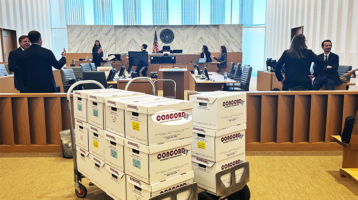
Physical productions still matter. Government agencies, local courts, arbitrations, depositions, and trial teams may require paper copies, tabs, binders, boards, or demonstratives. When those materials are prepared close to a hearing, production capacity and delivery discipline become as important as document accuracy. A perfectly prepared exhibit binder that arrives after the hearing begins does not serve the case.
Prepare Trial Materials Before the Final Week
Trial preparation often reveals the cost of weak document management. Exhibits may be spread across review databases, shared drives, email attachments, war rooms, and banker boxes. Witness binders may contain obsolete copies. Demonstratives may cite documents that were never admitted or may not match the final exhibit list.
The better approach is to begin trial-readiness work while discovery is still active. Maintain an exhibit index, track source and Bates information, identify documents needing clean copies or color printing, and establish a process for version control. As the court date approaches, the legal team can move from organizing evidence to preparing deposition binders, witness folders, courtroom sets, and presentation materials without restarting the document search.
For matters in Southern California, overnight delivery of trial exhibit binders to Stanley Mosk Courthouse, First Street Federal Courthouse, and Superior Court locations can be critical when schedules change without warning. The same urgency applies anywhere a trial team needs accurate materials delivered to a courtroom, hotel war room, or client office.
Choose Capacity, Security, and Accountability
A document services partner should be evaluated on more than price per page or per gigabyte. Ask whether the provider can support forensic collection, scanning, legal copying, eDiscovery processing, hosted review, printing, and trial production under one accountable engagement. Ask about staffing depth, 24/7 production capability, security practices, insurance, handling of sensitive records, and the ability to work onsite when records cannot be moved.
Concord Document Technologies supports these connected workflows for law firms, corporations, and public-sector agencies handling sensitive, deadline-driven matters. The advantage is practical: fewer handoffs, clearer accountability, and experienced support when a discovery issue turns into a production emergency.
The best time to establish document controls is before the volume becomes unmanageable. Treat every intake, collection, scan job, review decision, and production as part of the same evidentiary record. When the deadline arrives, your team should be preparing the argument, not searching for the documents.