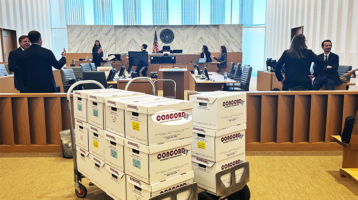
When a case team cannot let files leave the office, records room, agency site, or hospital archive, onsite legal scanning becomes the practical answer. It keeps sensitive material under direct control while converting paper into usable litigation data fast enough to support review, production, deposition prep, and trial deadlines.
For legal departments and law firms handling active matters, the question is rarely whether paper should be digitized. The real question is where the work should happen, who should handle it, and how the chain of custody will be documented from first box to final load file. That is where onsite service makes a measurable difference.
CONCORD has been handling on-site scanning for over 30 years. We handle as small as a stack of documents to over 1,000 boxes (D.O.J. investigation) scanned on-site. Call today at (213) 745-3175
What onsite legal scanning actually solves
Offsite scanning has its place. If records are already cleared for transport and the matter is mainly about volume, moving bankers boxes to a production center can be efficient. But many legal matters do not start in that condition.
Some files are tied to protective orders, internal investigations, regulated records, or government retention requirements. Some are mixed with privileged material that has not yet been sorted. Some sit inside facilities where transport creates delay, risk, or internal approval issues. In those cases, onsite legal scanning allows the legal team to capture the documents where they are, under controlled procedures, without adding another transfer event.
That can matter for several reasons. First, it reduces handling risk. Second, it shortens the time between paper collection and attorney review. Third, it creates a cleaner audit trail for buyers who need to answer to general counsel, procurement, records management, or agency oversight.
Why legal teams choose onsite over offsite
The strongest case for onsite work is control. If the documents never leave the premises, the client keeps visibility over access, staging, and return to storage. For sensitive employment files, medical records, internal investigation binders, board materials, or legacy case files, that level of control is often worth more than the marginal convenience of shipment.
Speed is another factor, but it depends on the matter. Onsite scanning can accelerate a case when documents are needed immediately for issue analysis, early case assessment, or rolling review. A trained team can begin imaging, indexing, and Bates labeling in parallel with legal decision-making instead of waiting for pickup, transit, intake, and queue time.
There are trade-offs. Onsite work requires space, power, access coordination, and realistic planning around the condition of the records. If files are poorly organized, stapled heavily, or spread across multiple departments, production may move slower than an offsite run in a dedicated facility. The right choice depends on urgency, sensitivity, and volume.
How onsite legal scanning fits into litigation workflows
For most legal buyers, scanning is not the end product. It is one step in a broader workflow. The images may need OCR, unitization, file naming, folder-level indexing, confidentiality coding, Bates stamping, slip sheets, or export into a review platform. If the provider treats scanning as an isolated copy shop task, the legal team often ends up rebuilding the workflow later.
A legal-focused scanning operation should understand downstream use from the start. That includes preparing output that supports attorney review, production specifications, and exhibit preparation. It also means recognizing when paper records are part of a mixed evidence environment alongside email, mobile data, and electronically stored information.
In a stronger engagement, the paper capture process aligns with the rest of the matter. Scanned files can be organized for hosted review, produced with consistent numbering, and coordinated with related discovery collections. That is especially useful when deadlines are tight and the case team cannot afford friction between physical document handling and digital review.
Chain of custody is not a formality
In legal support, chain of custody is operational discipline. It starts before the first page is scanned. Boxes, file drawers, binders, and loose records should be inventoried and staged with clear identifiers. Access should be limited to authorized personnel. Movement between rooms or departments should be documented. If scanning is performed after hours or in controlled facilities, entry and exit protocols should be clear.
This is one reason experienced legal vendors are different from general business scanning providers. A legal matter may require documented handling standards, confidentiality controls, secure media practices, and defensible production records. Those expectations are not optional when the documents involve active litigation, internal investigations, public-sector records, or regulated information.
A serious onsite team should be prepared to answer practical questions before work starts. Who is touching the documents. How are exceptions logged. How are rescans handled. What happens to notes, separator sheets, and temporary working files. How are images validated before delivery. If those answers are vague, the risk is being pushed back onto the client.
What to expect from a professional onsite operation
A capable onsite legal scanning project usually begins with a scoping conversation, not a generic quote. The provider needs to understand the document types, estimated volume, indexing requirements, privilege concerns, facility restrictions, and final deliverables. A records room with standard letter-size files is one thing. Oversize plans, medical charts, redwelds, exhibit binders, and mixed media are another.
The next step is deployment planning. That may include equipment selection, operator count, scheduling windows, workspace setup, and a production sequence that does not interrupt the client’s staff. For many law firms and agencies, after-hours or weekend work is preferable. For some corporations, onsite teams need escorts, badging, or department-by-department coordination.
Then comes image capture and quality control. Legal scanning is not just about creating a readable PDF. The work should support accurate pagination, clean OCR, legible image output, and consistent document boundaries. If files are headed toward review, indexing and naming conventions must be established in advance. If they are headed toward production, Bates application and confidentiality legends need to be handled correctly.
The best providers also build in exception management. There are always damaged pages, odd-size inserts, handwritten tabs, photographs, or files that arrive out of order. A mature operation knows how to escalate those issues without stalling the entire project.
Security, compliance, and sensitive records
Not every onsite scanning matter carries the same risk profile. A dormant archive project may be mostly logistical. An active white-collar investigation or healthcare dispute is different. In those environments, the provider should be equipped to work under stricter controls and to coordinate with legal, compliance, and records stakeholders.
Bonded and insured staffing matters. Experience with government and regulated environments matters. So does the ability to integrate scanning with broader litigation support services if the matter expands. A provider that can move from onsite paper capture to hosted review, legal copying, digital printing, trial exhibits, and related discovery support gives legal teams more room to adapt when the case changes direction.
That is one reason institutional buyers often prefer a partner built for legal workflows rather than a commodity scanning vendor. The service may begin with paper, but the matter does not stay simple for long.
When onsite legal scanning is the better call
Onsite service tends to be the better fit when records are highly sensitive, when transport is restricted, when review must begin immediately, or when files are still being actively used by the client. It is also well suited for matters where the legal team needs direct visibility over the project as it happens.
Offsite may still be appropriate for lower-risk archives, very large backfile conversions, or projects where transportation and intake can be managed without pressure. There is no one right model for every job. The right model is the one that protects the records, supports the case timeline, and reduces avoidable rework.
For law firms, corporate legal departments, and government agencies, that decision should be made with the end use in mind. If the documents need to become evidence-ready, review-ready, and production-ready, the scanning process has to be designed that way from day one.
Concord Document Technologies has worked in that reality since 1996, supporting high-stakes legal and regulatory matters where speed, confidentiality, and production accuracy are not negotiable.
When paper records are standing between your team and the next litigation deadline, onsite legal scanning is not just a convenience. It is a controlled way to move the matter forward without losing custody, time, or confidence in the record.