A production deadline rarely fails because a legal team lacks options. It fails because the vendor handling the data, documents, or exhibits cannot respond with the urgency the matter requires. When legal teams ask why use Concord over national companies like Lighthouse and Epiq, the useful answer is not that every national provider is unsuitable. It is that high-stakes matters often require a level of direct accountability, physical production capability, and case-specific responsiveness that a large national service model may not consistently provide.
For litigation support teams, the decision is not simply about selecting an eDiscovery platform or a document vendor. It is about selecting an operating partner that can preserve an iPhone, collect email, scan a warehouse of records, load data for attorney review, apply Bates labels, and deliver trial binders to the courthouse without passing the work through separate departments or vendors.
Why Use Concord Over National Companies Like Lighthouse and Epiq?
National legal services companies can be a practical fit for matters requiring broad geographic coverage, established enterprise procurement channels, or highly standardized workflows across many offices. For some organizations, that scale is the priority.
But scale can also introduce distance between the legal team and the people making production decisions. A case manager may need to navigate layered intake procedures, centralized service queues, or separate teams for forensic collection, data processing, printing, and trial support. That structure can work well for predictable work. It becomes less attractive when a partner needs to make informed decisions quickly at 8 p.m. before a hearing, when opposing counsel changes an exhibit list, or when a device must be preserved before data is lost.
Concord is built for the point where document-intensive litigation becomes operationally demanding. Since 1996, the company has supported law firms, corporations, and public-sector agencies with physical and electronic legal workflows under one roof. The advantage is not merely convenience. It is continuity of responsibility from collection through presentation.
Direct access matters when the request is not routine
A large provider may offer extensive resources, but the service experience can depend on account structure, location, and the complexity of the request. Legal teams should ask who will actually assess the job, authorize adjustments, monitor chain of custody, and resolve an issue when the matter is moving quickly.
With Concord, clients work with a team experienced in the practical realities of litigation support. That means understanding that a request for “copies by morning” may involve confidential source files, precise Bates ranges, deposition designations, color tabs, court-specific binder requirements, and a delivery window that cannot move. It also means recognizing when a collection request requires forensic discipline rather than a basic file transfer.
This is especially valuable for litigation support managers and paralegals who cannot spend hours translating legal requirements between multiple vendors. One accountable provider reduces handoffs, clarifies ownership, and gives the legal team a clearer escalation path.
One Provider for Paper, Data, Review, and Trial
The distinction between paper discovery and electronic discovery has narrowed in practice. A single matter may involve banker boxes, legacy personnel files, Microsoft 365 data, mobile-device messages, hard-copy exhibits, and a RelativityOne review workspace. Managing each component separately creates avoidable risk.
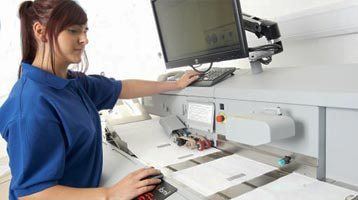
Concord combines document services with modern legal technology workflows. The same engagement can include onsite or offsite scanning, OCR, coding, legal copying, digital printing, Bates labeling, eDiscovery processing, RelativityOne-based attorney review, and trial exhibit production. For legal teams, that integrated model helps preserve context across the lifecycle of the matter.
Consider a regulatory response involving both archived paper records and current email. A fragmented workflow may require one provider to scan the files, another to process the email, a third to host review, and a fourth to prepare hearing exhibits. Every transfer creates another opportunity for file naming errors, incomplete production sets, inconsistent confidentiality treatment, or uncertainty about which version is final.
A single legal support partner does not eliminate the need for legal oversight. It does reduce the operational friction that consumes time during discovery and trial preparation. The team handling the source materials can understand how those materials will be reviewed, produced, and ultimately presented.
Forensic collection requires more than fast access
Mobile-device and email collection are often time-sensitive, sensitive in content, and consequential in discovery. A casual approach to collecting an iPhone or preserving email can raise questions about completeness, metadata, authentication, and chain of custody.
Concord supports forensic data collection for iPhones and email with the discipline required for legal matters. The objective is not simply to obtain files. It is to preserve potentially relevant information in a defensible manner, document handling, and move the resulting data into an appropriate review and production workflow.
National providers may also offer forensic capabilities, so the key comparison is execution. Ask whether the provider can coordinate collection with the discovery team, explain the preservation approach in plain legal-operational terms, and respond quickly when the custodian, device, or data source is local and the timeline is tight.
Trial Deadlines Favor Production Strength
Trial support is where service gaps become visible. A review database can be technically sound and still fail to solve the immediate problem of preparing hearing binders, witness folders, enlarged demonstratives, deposition clips, or replacement exhibit sets on short notice.
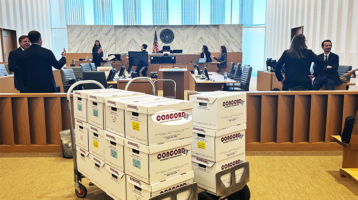
Concord maintains 24/7 production capacity for matters that do not follow business-hour schedules. For Southern California legal teams, that includes overnight delivery of trial exhibit binders to Stanley Mosk Courthouse, First Street Federal Courthouse, and many Superior Courthouses, as well as overnight FedEx shipment when the matter is elsewhere in the United States.
This is not a minor convenience. Court calendars, meet-and-confer deadlines, and late evidentiary rulings can alter a trial team’s needs with little warning. A provider that understands both the electronic source set and the physical final product can act faster than a vendor receiving instructions from a separate eDiscovery provider.
The question to ask is simple: if the exhibit list changes tonight, can the provider produce, quality-check, organize, and deliver the revised set tomorrow? If the answer is uncertain, the apparent savings or national scale may not justify the risk.
Security, Confidentiality, and Institutional Confidence
High-volume legal support is not only a production issue. It is a trust issue. Matters involving employment records, financial data, privileged communications, government files, health information, trade secrets, or internal investigations require controlled handling at every stage.
Concord is bonded and insured, with long-standing experience supporting sensitive and regulated records. Its work with AMLAW 200 firms and government agencies reflects the level of operational confidence institutional clients require. Legal teams should still confirm matter-specific security requirements, access controls, retention expectations, and delivery procedures. No vendor should be selected on credentials alone.
The practical difference is familiarity with the obligations behind the request. A legal support provider should understand that a secure production is not just a completed job ticket. It is a documented process involving controlled access, accurate reproduction, reliable tracking, and careful handling of materials that may later be examined by opposing counsel or the court.
Choose the Service Model That Fits the Matter
There is no universal rule that a regional or specialized provider is always better than a national company. A nationwide portfolio matter with standardized volumes and dispersed offices may benefit from the infrastructure of a large provider. A legal department with a deeply embedded enterprise relationship may also have sound reasons to continue using an incumbent.
The better question is whether the provider’s operating model fits the risk profile of the work. If the matter demands fast local collection, hands-on scanning, physical exhibit production, direct communication, and experienced escalation, a provider with integrated capabilities and immediate production access may be the stronger choice.
For cases where every handoff creates delay and every deadline has consequences, choose the team prepared to own the work from first collection through final delivery.