When a matter turns urgent, the problem is rarely just volume. It is volume under deadline, under scrutiny, and often under a preservation obligation. That is where litigation support services matter most – not as a generic vendor category, but as the operational backbone that keeps a case moving without creating new risk.
For law firms, corporate legal departments, and government teams, the standard is higher than basic copying or file hosting. You need a provider that can handle physical documents, electronically stored information, chain-of-custody discipline, attorney review workflows, and trial preparation without handing work off across three or four separate vendors. In high-stakes matters, fragmentation costs time. It also creates avoidable mistakes.
What litigation support services actually include
The term gets used broadly, sometimes too broadly. In practice, litigation support services should cover the full lifecycle of case-related data and documents, from collection through production and courtroom readiness.
That starts with intake and preservation. A reliable provider should be able to receive banker boxes, hard drives, mobile devices, email sources, and cloud exports in a controlled way. If the matter involves sensitive evidence, forensic handling is not optional. The first question is not how fast data can be processed. It is whether the collection will stand up later if challenged.
From there, the work usually branches into physical and digital streams. On the physical side, services often include legal copying, scanning, OCR, unitization, document coding, Bates labeling, and oversized or color reproduction. On the digital side, the scope may include forensic data collection, eDiscovery processing, hosted review, analytics, productions, and load file delivery.
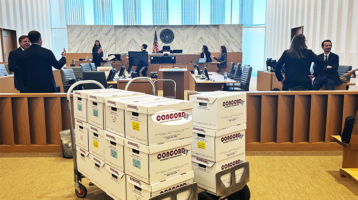
Trial support sits at the far end of the same pipeline. Exhibit preparation, exhibit binders, digital printing, deposition designations, and overnight courtroom delivery are all part of litigation support when timing is tight and errors are costly. A provider that can move from collection to courtroom with one chain of responsibility gives legal teams a real operational advantage.
Why one-provider litigation support services reduce risk
Legal teams often inherit a patchwork process. One vendor scans, another collects email, another hosts review, and someone else handles trial boards at the end. That model can work on smaller matters, but it becomes fragile when deadlines compress or the record grows messy.
Every handoff creates an exposure point. Metadata can be altered, naming conventions can drift, instructions can be misunderstood, and responsibility can become unclear. If a production issue surfaces two weeks before a hearing, it helps to have one accountable partner rather than a string of subcontracted explanations.
This is especially true in matters involving regulated records, confidential personnel files, government data, or executive communications. Security and confidentiality are not just selling points. They shape how work is staffed, where data is handled, how access is logged, and whether onsite support is available when materials should not leave a facility.
That is why experienced litigation teams often prefer a provider that can perform onsite scanning, secure offsite processing, forensic collection of iPhones and email, hosted review, and final production under a single operating model. It simplifies communication and preserves control.
The core capabilities that matter most
Not every case needs the same stack of services. A trade secret matter with mobile data collection has different demands than a document-heavy commercial dispute built around legacy paper records. Still, there are a few capabilities that separate true litigation support from basic document work.
Forensic collection and preservation
If a case may involve spoliation arguments or authenticity challenges, defensible collection matters from day one. Email, mobile devices, laptops, external media, and cloud-based records each require different handling. The right provider should understand chain of custody, targeted collections, and how to preserve usable evidence without overcollecting everything in sight.
There is a trade-off here. Broad collections may feel safer at first, but they increase processing cost, review volume, and privacy exposure. Narrow collections save money, yet they must be carefully scoped so key evidence is not missed. Experienced support teams help legal counsel make that call with the facts and timeline in mind.
Scanning, coding, and paper-to-digital conversion
Paper is still a major factor in many matters, especially in healthcare, real estate, public sector, employment, and long-running business disputes. Good scanning is not just about image quality. It is about document organization, OCR accuracy, unitization, indexing, and Bates consistency.
When these foundations are weak, review becomes slower and productions become harder to defend. When they are done correctly, paper records enter the same workflow as native digital files and can be reviewed, searched, and produced with less friction.
eDiscovery processing and attorney review
Processing converts raw data into a usable review set. That includes deduplication, metadata extraction, text generation, exception reporting, and preparation for hosted review platforms such as RelativityOne. Small processing mistakes can have large consequences later, especially when privilege review or production specifications become contested.
Hosted review should also be practical for the legal team actually using it. The platform matters, but workflow design matters just as much. Foldering, issue tags, batching, privilege workflows, redactions, and quality control all affect speed and cost. A provider should not just host data. It should help the review proceed efficiently.
Production and trial readiness
Productions are where execution gets tested. Opposing counsel and courts do not care how complicated your internal workflow was. They care whether the production is complete, readable, correctly numbered, and delivered in the required format.
The same discipline carries into trial prep. Exhibits need to be organized, printed correctly, and available where and when they are needed. In Southern California, that can mean overnight exhibit binders delivered to Stanley Mosk, First Street Federal, or local Superior Courthouses. In other matters, it means coordinated shipping, remote trial support, and digital exhibit sets that hold up under pressure.
How to evaluate litigation support services before you engage
The safest time to vet a provider is before the emergency call. Once a TRO, second request, subpoena response, or trial deadline is in play, your options narrow fast.
Start with production capacity. Can the provider scale quickly if a project jumps from a few thousand pages to several million records? Ask whether work can be handled 24/7, whether onsite and offsite services are both available, and whether the team is accustomed to enterprise or public-sector workflows.
Next, ask about security and controls. Bonded and insured status, access restrictions, logging procedures, secure transfer methods, and handling protocols for sensitive records are not administrative details. They are part of the service itself.
Then look at range. A vendor that can only do one segment of the workflow may still be useful, but if your matters routinely involve both paper and ESI, service breadth becomes a real advantage. The more your provider can do well under one roof, the fewer operational breaks your team has to manage.
Finally, evaluate credibility. Longevity matters in this field because repetition builds process discipline. A provider trusted by AMLAW 200 firms, corporations, and government agencies has likely already worked through the types of timing, confidentiality, and formatting problems that derail less experienced shops. That does not guarantee fit for every matter, but it is a meaningful signal.
When specialized support is worth the cost
Some teams hesitate to bring in full-service support early because they are trying to control spend. That instinct is understandable. But the cheaper path on paper is not always the lower-cost decision.
If your internal staff is spending nights labeling exhibits, troubleshooting OCR failures, coordinating data from multiple custodians, and chasing down production inconsistencies, the hidden cost is already there. It shows up in attorney time, burnout, missed deadlines, and preventable rework.
Specialized litigation support services are worth it when the case is large, time-sensitive, technically complex, or exposed to challenge. They are also worth it when your team simply needs certainty. In many matters, that certainty is the real value – a partner that can collect, process, produce, print, scan, and deliver without drama.
Concord Document Technologies has built its reputation on exactly that kind of execution for law firms, corporations, and government agencies that cannot afford mistakes.
The right support partner should make your case operations quieter, faster, and easier to trust. When the stakes are high, that is not an extra service. It is part of being ready.