When trial is approaching, disorganization gets expensive fast. A missing exhibit, a mislabeled tab, or a witness outline filed in the wrong section can slow a team down at exactly the wrong moment. Trial notebook preparation services exist to prevent that kind of failure by turning a high-volume case file into a controlled, courtroom-ready set of materials.
For law firms, in-house legal departments, and government teams handling complex matters, the notebook is not just a binder. It is a working command center. It has to support attorneys at counsel table, paralegals managing exhibits, and litigation support staff tracking what has been marked, admitted, or challenged. That is why trial preparation demands more than copying and tabbing. It requires document discipline, production capacity, and a provider that understands how trial teams actually work under pressure.
What trial notebook preparation services actually cover
The phrase trial notebook preparation services can mean very different things depending on the case, venue, and trial team. In a smaller matter, it may involve compiling pleadings, motions in limine, witness materials, exhibit lists, and deposition excerpts into a few clean binders. In a larger commercial case or regulatory hearing, it may mean coordinating dozens of notebooks across multiple tracks, with attorney sets, witness sets, court sets, and internal working copies produced on a compressed schedule.
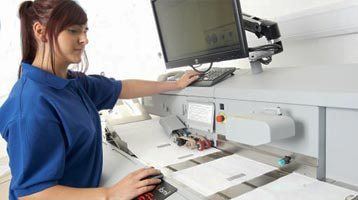
A serious provider should be able to manage exhibit printing, binder assembly, custom tabs, slip sheets, Bates continuity, color coding, and last-minute replacement pages without losing control of the file set. Many matters also require coordinated digital support, where the physical notebook mirrors an electronic folder structure used by the trial team for remote access or presentation prep.
That combined physical and digital workflow matters. Trial teams rarely work from paper alone anymore, but they still rely on paper when speed and certainty matter most. A well-prepared notebook bridges both environments.
Why legal teams outsource trial notebook preparation services
The issue is not whether a firm can assemble binders internally. Many can. The real question is whether internal staff should be spending critical pretrial hours on print production, tab sequencing, and overnight delivery coordination instead of witness prep, exhibit objections, and trial strategy.
Outsourcing becomes especially valuable when the record is large, revisions are constant, or the case includes sensitive material that has to be handled under a documented process. In those situations, the provider is not just producing binders. The provider is extending the litigation team’s operational capacity.
That has practical value in several common scenarios. One is the late-stage rush, when exhibit lists change repeatedly and teams need revised sections turned around overnight. Another is venue-specific delivery, where materials must arrive at a courthouse, hearing room, war room, or hotel on schedule and intact. A third is matters involving high confidentiality, where chain of custody and restricted handling are not optional.
The trade-off is straightforward. If the notebook is simple and stable, internal preparation may be sufficient. If the case is document-heavy, time-sensitive, or procedurally demanding, dedicated trial notebook support usually reduces risk.
The difference between basic binder assembly and courtroom-ready execution
Not every vendor offering printing or copying is equipped for trial. Courtroom-ready notebook preparation requires legal workflow knowledge, not just equipment.
That starts with file integrity. Sections need to match the latest approved set of documents. Exhibit numbering must stay consistent with the team’s master list. Replacement pages cannot create silent discrepancies between attorney copies and court copies. If there are sealed materials, restricted exhibits, or confidential witness documents, those items need separate handling and clear controls.
It also includes production judgment. A provider should know when to recommend heavier stock for divider tabs, when color blowbacks improve usability, when oversized trial graphics need separate handling, and when a binder should be split to avoid failure at counsel table. These decisions sound minor until trial day. Then they are operationally significant.
An experienced legal document partner also understands timing. Trial notebooks are rarely final when production starts. Teams need a process that can absorb rolling updates without rebuilding everything from scratch.
What to look for in trial notebook preparation services
Reliability matters more than marketing language. Legal buyers should evaluate trial notebook preparation services based on executional factors that affect trial readiness.
First, look for a provider with documented production capacity. If your matter requires overnight exhibit binders, duplicate attorney sets, or same-day revisions, capacity is not a luxury. It determines whether deadlines are met without quality slipping.
Second, assess whether the provider understands both paper and electronic records. Modern trial preparation often starts with scanned files, reviewed productions, or data collected from email and mobile devices. If the notebook vendor cannot work cleanly from those sources, the process gets fragmented.
Third, ask about handling of privileged, confidential, and regulated materials. Bonded and insured status, secure workflows, and experience with institutional clients are meaningful signals. For corporate and public-sector matters, those controls are often part of the purchasing decision.
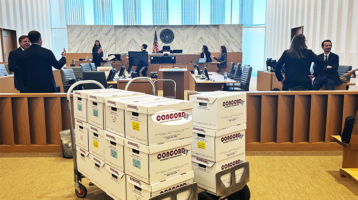
Fourth, consider delivery discipline. Trial materials are not ordinary office shipments. They may need direct delivery to court, a litigation war room, or a secured client site. In Southern California, for example, proximity to major courthouses can materially improve turnaround on urgent exhibit binder production.
Finally, make sure the provider can support revision-heavy jobs. Trials change. Witness orders move. Motions are decided. Exhibits are pulled, added, and renumbered. A vendor built for static print jobs will struggle. A legal services provider with 24/7 production capability is far better positioned for that reality.
How these services fit into a broader litigation workflow
The best notebook preparation is not isolated from the rest of the case. It should connect to scanning, legal copying, Bates labeling, review exports, deposition designations, and exhibit production.
That integration reduces rework. If documents have already been scanned and organized under a defensible naming structure, notebook assembly becomes faster and more accurate. If the same provider is handling review platform exports or print-ready exhibit sets, there is less risk of mismatched versions. If forensic data collection or email preservation has been part of the matter, continuity across vendors becomes even more important.
This is where a full-service litigation support partner has an advantage. Instead of moving files between disconnected vendors, the legal team can coordinate the transition from collection to review to production to trial prep in one managed workflow. That does not eliminate every issue, but it usually reduces handoff errors and compressed-timeline confusion.
For institutional clients handling sensitive matters, that continuity also supports accountability. When one provider manages the chain from source collection through courtroom materials, there are fewer gaps to explain later.
Common mistakes that create trial notebook problems
Most notebook failures are not dramatic. They are cumulative. Teams wait too long to lock a production plan. They underestimate the number of sets required. They allow inconsistent naming between digital folders and printed tabs. They treat delivery as an afterthought.
Another frequent problem is assuming all copies should be identical. In practice, attorney notebooks, witness notebooks, and court copies often serve different purposes. The content overlap may be high, but the arrangement, tabbing, and restrictions may differ. A provider that understands these distinctions can prevent confusion and unnecessary cost.
There is also the issue of overproduction. Not every case needs hundreds of pages printed into multiple duplicate sets. Some matters are best served by hybrid preparation, with a core printed notebook supported by digital access to secondary materials. The right approach depends on courtroom conditions, team preferences, and how dynamic the exhibit record is expected to be.
That is why trial prep should be scoped strategically, not just ordered reactively.
When timing is tight, process matters more than promises
Any vendor can say they handle urgent jobs. What matters is whether their process supports urgency without compromising control.
A credible workflow includes intake procedures, version checks, clear section instructions, proofing, production staging, and final delivery confirmation. It also includes communication with people who understand litigation deadlines, not just general print scheduling.
Concord Document Technologies has built its reputation in exactly this kind of environment – supporting legal teams with document-intensive, deadline-driven work that demands both precision and speed. For firms and agencies that need trial exhibit binders, court delivery, and coordinated litigation support under one roof, that operational depth is what makes the difference when trial gets close.
The strongest trial notebook preparation services do not simply produce binders. They give legal teams a controlled way to move from document volume to courtroom readiness. When the stakes are high, that kind of preparation is not overhead. It is part of the case strategy.