A superior court los angeles trial binder notebook is not simply a stack of pleadings placed behind tabs. It is the working record counsel, witnesses, and the trial team rely on when the court asks for a document immediately. If the exhibit copy is incomplete, the tab sequence is wrong, or the final set is not at Stanley Mosk before the courtroom opens, even strong trial preparation can become an avoidable operational problem.
For matters moving through Los Angeles County Superior Court, binder production should be treated as a controlled litigation workflow. That means confirming the current exhibit list, applying consistent labeling, separating confidential materials where appropriate, and producing every requested set from a single approved source file. The goal is simple: trial materials that are accurate, usable, and available when counsel needs them.
What a Trial Binder Notebook Must Accomplish
A well-built trial notebook gives the legal team a dependable path to the record. It should make it easy to move from the witness outline to the supporting exhibit, from the exhibit to the relevant deposition designation, and from the courtroom copy to the admitted-exhibit record.
The binder’s physical construction matters because trial work is physical as well as electronic. Pages are handled quickly, transported between war rooms and courtrooms, marked by witnesses, and reviewed under time pressure. Oversized documents, color demonstratives, native-format printouts, and heavily redacted records all need a production plan that preserves legibility and keeps the sequence intact.
The contents vary by matter and by counsel’s trial plan. A typical notebook may include a table of contents, witness materials, key pleadings and orders, exhibit lists, exhibit copies, deposition excerpts, jury instructions, verdict forms, and legal authority. Not every item belongs in every binder. A concise attorney notebook can be more effective than a comprehensive file if it reflects how that attorney will actually use it in court.
Start With the Approved Source Set
The most common binder failures begin before printing. Teams often pull exhibits from email attachments, shared folders, prior productions, or draft case folders without confirming which version is final. That creates opportunities for duplicate exhibits, missing pages, inconsistent redactions, and different copies of the same document in counsel’s and the court’s sets.
Establish one approved source set before production begins. The set should identify the final exhibit number, document description, Bates range if applicable, confidentiality treatment, printing specifications, and required quantity. If an exhibit is being replaced, withdrawn, or reserved, that status should be visible in the production instructions rather than left to verbal communication.
This process is especially valuable when materials originate in eDiscovery platforms or across multiple custodians. Documents reviewed and coded electronically should be exported with the correct endorsements, redactions, and metadata-derived identifiers before they become printed trial exhibits. A final quality-control review should compare the produced pages against the exhibit list, not merely verify that the binder looks complete.
Confirm Courtroom Requirements Before Final Assembly
Los Angeles Superior Court practice can differ by courthouse, judicial officer, department, and case type. Counsel should confirm applicable standing orders and department-specific instructions regarding exhibit exchanges, electronic presentation, courtesy copies, and the number of sets required. A trial binder should support those instructions, not assume that a prior matter’s protocol will apply.
There is also a practical distinction between a trial notebook for the legal team and a formal exhibit binder intended for the court, opposing counsel, or witnesses. The attorney’s version may include notes, outlines, or work product that should not be reproduced in a shared set. Witness binders may require a more limited selection of documents. Court copies generally demand a cleaner, more standardized presentation.
When a matter includes sealed, protected, personally identifying, or otherwise sensitive materials, production instructions should address access and handling from the outset. Restrictive legends, segregated volumes, controlled delivery, and documented chain of custody may be necessary. Convenience cannot override confidentiality obligations.
Build a Binder That Works Under Trial Pressure
A functional superior court los angeles trial binder notebook uses a navigation system that a first-time reviewer can understand immediately. Tabs should align with the final exhibit list. Volume numbers should be visible on the spine and cover. A table of contents should identify the beginning page or tab for each section. If the binder contains multiple volumes, the numbering convention needs to continue logically from one volume to the next.
Exhibit tabs deserve particular attention. Tabs that are too small, too lightly printed, or crowded by bulky documents slow down retrieval. For large sets, an exhibit-number range on each binder spine helps the team pull the correct volume without opening every cover. Where letters, numbers, or subparts are used, they should exactly match the current exhibit list.
Paper, binding, and reproduction choices should fit the record. Standard black-and-white copying may be appropriate for routine pleadings and correspondence. Color reproduction is often essential for photographs, spreadsheets with color-coded fields, maps, medical imaging references, charts, and demonstratives. Large-format documents may need foldouts or separate boards. The correct choice depends on whether color or scale carries evidentiary meaning, not on a preference for a more polished-looking binder.
Do not bind documents so tightly that pages cannot be turned or annotated. At the same time, oversized binders become difficult to carry, store, and use at counsel table. Splitting a large exhibit set into numbered volumes usually improves courtroom utility and reduces the risk of damaged pages or failed binding.
Quality Control Is a Trial Task, Not a Print Task
Before delivery, the production team should inspect the finished binders against the approved specifications. This review should confirm that every volume is present, all tabs are in sequence, page orientation is correct, color pages reproduce correctly, and no pages are clipped, duplicated, blank, or missing.
Bates numbers and exhibit labels should remain readable after printing, punching, and binding. Redacted documents deserve special scrutiny. A redaction that appears correct in a digital review platform can be compromised by an incorrect export setting, an old file version, or an unflattened annotation layer. Sensitive records should be reviewed using the actual final output, not solely the source PDF.
The last checkpoint is quantity and destination. Trial teams often need separate sets for lead counsel, co-counsel, witnesses, the court, opposing counsel, and the war room. A delivery list should identify exactly what goes where, who receives it, and when it must arrive. This is particularly important when last-minute supplements are produced after the primary binders have already left the production facility.
Plan Delivery Around the Court Calendar
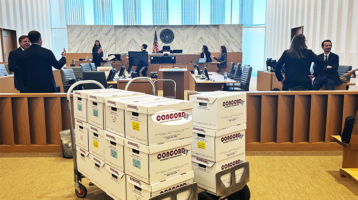
A completed binder sitting in an office after the courthouse closes has little value. Delivery planning should account for filing and courtroom schedules, security screening, traffic, receiving procedures, and the possibility that a department changes location. For urgent Los Angeles matters, teams should confirm the courthouse destination, contact information, volume count, and delivery deadline before dispatch.
Overnight shipping can be appropriate when the recipient is outside Los Angeles or when the trial team has a dependable receiving location. Local courier delivery is often the better choice for time-sensitive sets headed to Stanley Mosk or another Superior Court courthouse. The right method depends on the deadline, the number of volumes, the sensitivity of the contents, and whether proof of delivery is required.
A dependable litigation support provider should be able to handle both the production and the logistics without forcing the trial team to coordinate several vendors at the last moment. Concord Document Technologies supports trial exhibit production, Bates labeling, scanning, digital printing, and time-sensitive courthouse delivery with the same discipline applied to larger document-intensive matters.
Keep the Digital Record Aligned With the Paper Set
Paper binders remain useful in trial, but they should not become disconnected from the electronic case record. The final printed exhibit set should be traceable to the reviewed and approved digital files. When a late exhibit is added, revised, or excluded, the team needs a clear record of what changed and which physical sets were affected.
This alignment is critical in cases involving forensic collections, mobile-device data, email evidence, or large-scale document review. The trial team may need to verify a printed excerpt against its source, locate a native file, or confirm that a demonstrative reflects admitted evidence. Organized electronic source materials make those checks faster and more defensible.
Trial preparation rarely follows a clean, predictable timeline. Witness order changes, rulings arrive late, and a document that seemed peripheral can become central overnight. The practical answer is not to overproduce every possible paper set. It is to maintain an approved source record, use disciplined production controls, and work with a provider capable of turning accurate changes quickly. That preparation gives counsel room to focus on the argument when the courtroom clock is running.