A trial binder is not simply a stack of printed papers with tabs. It is a working courtroom tool that must let counsel, witnesses, the clerk, and the bench find the same record without hesitation. For teams facing a hearing or trial date, Santa Monica courthouse exhibit binder printing requires disciplined source-file control, accurate numbering, durable assembly, and a delivery plan that respects the court’s schedule.
A misplaced page, a tab that does not match the exhibit list, or an incomplete duplicate set can interrupt an examination at exactly the wrong moment. Litigation teams need a production partner that treats exhibit preparation as part of case execution, not ordinary commercial printing.
What Court-Ready Exhibit Binders Require
The starting point is a final, controlled exhibit universe. Before printing begins, counsel should identify which documents are admitted, lodged, offered, demonstrative, or reserved for impeachment. Those categories may require separate treatment. Combining them into one binder for convenience can create confusion during a hearing and make last-minute substitutions harder to track.
Every set should be built from a single approved production file or clearly identified source folder. That file should be checked for page orientation, complete attachments, readable scans, color accuracy where color carries evidentiary value, and consistent Bates ranges. A document that looked acceptable on a monitor may be difficult to read after printing, especially when a spreadsheet, photograph, text message image, or email chain has been reduced to letter size.
Binder architecture matters as much as print quality. Exhibit numbers or letters must correspond precisely to the exhibit list and tab labels. Tabs should be durable, legible, and positioned so they remain usable once the binder is opened and handled repeatedly. Dividers, slip sheets, covers, spine labels, and indexes should make the set easy to navigate without obscuring the documents themselves.
For many matters, the right specification also includes double-sided printing, reinforced holes, high-capacity rings, and a logical approach to oversized material. It depends on the record. A compact evidentiary hearing binder may be best in one or two volumes, while a document-heavy trial may require sequential volumes to prevent overfilled binders and damaged pages.
Santa Monica Courthouse Exhibit Binder Printing Starts With File Control
Last-minute exhibit production often fails before it reaches the print room. The problem is usually version control. A paralegal receives revised PDFs from multiple attorneys, someone updates the exhibit list without updating the tabs, and a late-produced email is inserted into only one set. By the time the discrepancy is noticed, the matter is already on calendar.
A defensible workflow separates working documents from print-ready documents. The litigation team should designate one person to approve the final source files, index, tab sequence, and quantity. That person should communicate changes through a single instruction set rather than scattered email threads. When changes are necessary, the production team needs the revised file, the exact pages or exhibits affected, the replacement quantity, and whether all existing sets must be updated.
Bates numbering should be verified before final assembly. If documents require exhibit stamps, confidential designations, attorney work-product labels, or custom footer treatment, those instructions should be confirmed in writing before output begins. These details are operational, but they directly affect courtroom usability and the integrity of the record.
Sensitive records deserve the same attention. Medical files, personnel records, trade-secret material, financial information, and protected discovery should move through a controlled process with restricted access and clear handling instructions. For high-stakes matters, the chain of custody for source media and produced binders is not an afterthought.
Build the Exhibit List and Tabs Together
The exhibit list should not be treated as a document that gets reconciled after printing. It is the map for the binder. Producing tabs from the current exhibit list reduces the risk that Exhibit 24 points to the wrong document or that a withdrawn exhibit remains in the set.
Before production, compare the list against the source PDFs for exhibit designation, title, date, Bates range, and page count. If a single exhibit contains multiple documents, decide whether it will be treated as one tabbed unit or broken into separately designated exhibits. The correct choice depends on counsel’s trial plan and the governing order, but the decision should be made before tabs are cut and binders are assembled.
Plan Quantities Around the Actual Hearing
The required number of binder sets is not always obvious. Counsel may need sets for the court, opposing counsel, witnesses, the client team, and their own examination table. Some departments request electronic courtesy copies or have particular procedures for lodged exhibits. Court and department practices can change, so teams should confirm current requirements directly rather than relying on a prior matter.
Production quantities should include a controlled reserve. A spare set can solve a practical problem quickly when a witness needs a clean copy, a late addition must be served, or a binder is damaged in transit. The reserve does not need the same finish in every case, but it should be complete enough to be useful.
Color also requires a deliberate decision. A mostly black-and-white record may still contain photographs, maps, charts, annotated contracts, or email highlights that lose meaning in grayscale. Printing everything in color can increase cost and production time. Selective color output is often the more disciplined choice when the record allows it.
Do Not Overlook Physical Usability
A binder that is technically complete can still be difficult to use in court. Overstuffed rings cause pages to tear. Thin tabs disappear between large document sections. Oversized pages fold awkwardly and can distract from testimony. Weak covers and poorly secured hole punches do not hold up through repeated handling.
A professional production review looks at these physical conditions before delivery. It checks that pages turn freely, tabs align, volume labels are accurate, and all copies match. For filings or hearing sets under real time pressure, this quality-control step is where preventable errors are caught.
Coordinate Delivery Before the Deadline Becomes Critical
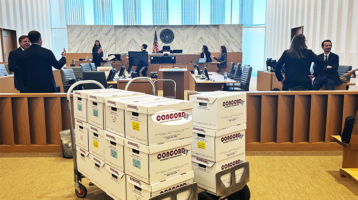
Courthouse delivery is a coordination task, not just a courier request. The delivery instructions should identify the recipient, law firm, department where applicable, delivery window, contact phone number, number of boxes or binders, and any instructions for calling upon arrival. Counsel should know who is receiving the materials and where they will be stored until needed.
Build in time for security screening, traffic, parking limitations, and the possibility that the recipient is in court when the delivery arrives. If binders must be brought directly to counsel, label them clearly by volume and set. If they are going to a courtroom or clerk location, verify the current acceptance procedure beforehand. A carefully produced set has little value if it arrives at the wrong place or cannot be located minutes before the hearing.
For urgent matters, 24/7 production capability and a direct escalation path matter. The vendor should be able to confirm what has been received, what is in production, what remains to be approved, and when completed materials leave the facility. General status language is not enough when the next morning’s calendar depends on the set.
Use One Litigation Support Workflow When the Record Is Complex
Exhibit binders are frequently the final physical output of a much larger information workflow. Source documents may come from scanned paper files, exported emails, mobile-device collections, cloud data, deposition exhibits, or documents reviewed in an eDiscovery platform. Disconnected vendors increase handoffs and create opportunities for version drift.
A unified legal support provider can move the matter from forensic collection and scanning through document processing, attorney review, Bates labeling, and trial exhibit production. That model is particularly useful when late evidence must be incorporated without losing control of the original record. It also gives the case team a single accountable production contact rather than separate printers, scanning vendors, and data providers.
Concord Document Technologies supports this type of end-to-end legal workflow for law firms, corporations, and government agencies, including deadline-driven trial exhibit production and secure document handling. The value is not merely speed. It is having experienced personnel who understand that a binder is tied to the case record, the exhibit list, and the next event on the calendar.
A dependable exhibit set gives the legal team one less variable to manage when the courtroom doors open. Confirm the specifications early, control the final files tightly, and treat delivery as part of production – because on a hearing date, the binder must work the first time it is opened.