A redaction failure can turn a routine production into a privilege waiver, privacy incident, sanctions issue, or emergency motion. Redacting legal documents is not simply covering text on a page. It is a controlled legal production process that must protect sensitive information while preserving the document’s meaning, format, and evidentiary integrity.
For litigation teams, the standard is not whether a redaction looked correct on a reviewer’s screen. The question is whether the protected information remains inaccessible in every delivered format, whether the redaction is justified, and whether the production can withstand scrutiny from opposing counsel, the court, regulators, or a client.
Why Redacting Legal Documents Requires a Defensible Process
Legal documents may contain privileged attorney-client communications, attorney work product, personally identifiable information, protected health information, financial account data, trade secrets, confidential business terms, and information restricted by a protective order. Each category can require a different treatment, and the governing standard may come from a court order, statute, agency rule, contract, or internal policy.
That is why ad hoc redaction creates risk. A reviewer may correctly identify a name or account number but apply the wrong redaction reason. A production specialist may burn in a visual box without removing underlying text. A PDF may appear clean while its metadata, comments, hidden layers, bookmarks, or searchable text still disclose the information. The visible page is only one part of the production.
A defensible workflow creates repeatable decisions. It documents what must be withheld, who approved the decision, how the redaction was applied, how it was checked, and what was ultimately produced. This discipline matters as much on a small subpoena response as it does in a high-volume regulatory investigation.
Start With the Legal Basis, Not the Redaction Tool
Before review begins, identify the governing production requirements. Review the operative discovery requests, protective order, confidentiality agreement, applicable court rules, agency guidance, and any negotiated ESI protocol. These materials establish whether information should be withheld, redacted, logged, designated confidential, or produced in a particular format.
Privilege is a common example. A document that contains legal advice may be withheld in full, redacted in part, or produced with a privilege log entry, depending on the document and the agreed protocol. A partial redaction should not become a shortcut for avoiding a careful privilege analysis. If the document is responsive and nonprivileged except for a discrete passage, a targeted redaction may be appropriate. If the communication is privileged throughout, withholding may be the better course.
Privacy redactions require equal precision. Dates of birth, Social Security numbers, driver’s license numbers, bank account information, medical details, minor names, and home addresses may be governed by specific rules. The appropriate scope depends on the jurisdiction and matter. For example, redacting an entire page because it contains one personal identifier may remove context unnecessarily, while leaving the identifier visible can create a reportable exposure.
Create a written redaction protocol before the production deadline becomes urgent. It should define the categories to be redacted, approved redaction labels, escalation procedures for close calls, and the quality-control standard. When the matter involves multiple review teams, a short protocol is often the difference between consistent production and inconsistent judgment calls.
Preserve the Source and Chain of Custody
A sound process begins with preservation. Keep the original native files, paper originals, source PDFs, and collected data separate from the redacted production set. The original record must remain available for legal review, challenge analysis, or later correction.
For physical records, that means tracking receipt, scanning, preparation, Bates labeling, redaction, and final production. For electronically stored information, it means maintaining collection records, file hashes where appropriate, processing history, and production specifications. High-stakes matters benefit from a clear chain of custody from the moment material is collected through final delivery.
This separation also protects against an avoidable operational error: overwriting the only usable copy. Redacted files should be derivative work product, not replacements for the source evidence. If a court later requests in camera review or counsel needs to revisit a redaction decision, the unaltered source must be identifiable and secure.
Apply True Redactions, Not Visual Obscuring
A black rectangle placed over text is not necessarily a redaction. If the underlying content remains selectable, searchable, recoverable by copying and pasting, visible through layers, or available in document properties, the information has not been reliably removed.
Use software and production workflows designed to apply permanent redactions. The process should remove the underlying content from the delivered file and account for text, images, annotations, headers, footers, embedded objects, linked files, and metadata. Native formats deserve particular caution because hidden revisions, comments, speaker notes, formulae, and tracked changes can retain sensitive information outside the visible page.
Image-based productions present a different set of considerations. A properly rendered TIFF or PDF can limit hidden-content risk, but the production must still be checked for readable redacted text, OCR treatment, page integrity, and correct Bates ranges. If searchable text is supplied separately, that text must be generated from the redacted version, not from the unredacted source.
The right format depends on the production agreement and the nature of the evidence. A production that must preserve spreadsheets or native functionality may require more planning than a conventional image production. There is no universal technical setting that resolves every redaction issue.
Use Review Controls That Match the Matter’s Risk
For a modest, low-risk document set, a trained attorney review with independent quality control may be sufficient. For a large litigation or investigation, the workflow should include standardized coding fields, redaction reason tags, sampling rules, exception reports, and documented escalation paths.
Review platforms can help organize these decisions at scale. In a RelativityOne-based workflow, for example, reviewers can identify responsive content, privilege, confidentiality designations, and redaction instructions within a controlled review environment. The benefit is not automation alone. It is consistency, auditability, and the ability to validate decisions across families, duplicates, and related communications.
Automation can assist with known patterns such as Social Security numbers, account numbers, email addresses, or dates of birth. It should not replace judgment. Pattern matching can miss formatting variations, capture irrelevant numbers, or fail to recognize context. A docket number may resemble a financial identifier. A public executive email address may not require the same treatment as a personal address. Human review remains necessary where relevance, privilege, confidentiality, or proportionality is at issue.
Quality Control Must Test What the Recipient Will Receive
Quality control should occur after redactions are applied and again after the production is assembled. A reviewer should inspect the final rendered documents, not merely the source file or review-platform image. Confirm that redacted areas cannot be selected or searched, that redaction labels are correct, and that surrounding text and page layout remain readable.
A practical QC review also checks production mechanics: Bates numbers, confidentiality legends, parent-child relationships, page counts, load files, document breaks, and naming conventions. These details affect whether the receiving party can use the production and whether counsel can defend it later.
For larger productions, use both targeted and sampled checks. Targeted checks focus on documents with redactions, documents containing known sensitive categories, family groups, exceptions, and documents near production boundaries. Sampling can identify systemic problems, such as a redaction setting that failed across a batch or OCR text that was created from the wrong version.
When an error is found, stop and assess scope before sending a correction. Determine whether it affects one document, a document family, a custodian set, a batch, or the entire export. Preserve the facts of the incident, notify counsel promptly, and follow the applicable clawback, protective-order, or reporting procedures. Fast, disciplined response can limit harm, but it does not substitute for careful QC.
Plan for Paper, Scanned Records, and Trial Use
Many sensitive records still begin as paper files, legacy binders, handwritten notes, medical charts, or scanned PDFs. These materials create added challenges because handwriting, stamps, marginal notes, and poor image quality can conceal information that keyword searching will not reliably find.
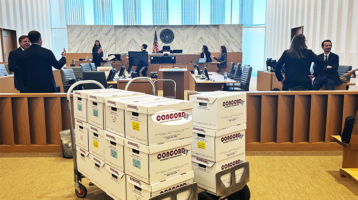
The scanning stage matters. Records should be scanned at a quality that supports accurate review, OCR, and exhibit use. Pages must be kept in order, attachments maintained with their parent documents, and Bates labels applied according to the production plan. If redacted documents will later be used as trial exhibits, the trial team should know which version is cleared for courtroom display and which unredacted version is restricted.
Concord Document Technologies supports these connected workflows, from secure scanning and legal copying through electronic review, redaction support, Bates labeling, and trial exhibit production. For matters moving quickly through Southern California courts or across multiple production formats, having one accountable document-services partner can reduce handoffs and prevent version confusion.
Treat Redaction as a Production Decision
The strongest redaction process is built before documents are exported. It brings legal judgment, review operations, document technology, and production controls into the same plan. That approach takes more discipline than drawing black boxes at the end of a case, but it protects the client, preserves credibility with the court, and gives the legal team a production it can stand behind.
When the deadline is tight and the record is sensitive, call the experts early enough to build the safeguards into the workflow rather than trying to repair them after disclosure.