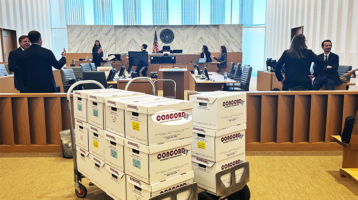
A litigation team can have 300 boxes of records in a secure client facility, a production deadline in two weeks, and no practical way to remove original files without creating risk. In another matter, the same volume may be sitting in a records warehouse, ready for pickup and high-speed conversion. The decision between onsite scanning versus offsite scanning is not simply a question of where paper is scanned. It affects chain of custody, cost, production speed, access to originals, review readiness, and the defensibility of the overall workflow.
For law firms, corporate legal departments, and government agencies, the right answer depends on the records, the matter, and the controls required from intake through production. A qualified legal document services provider should be able to support either model – and explain the operational trade-offs before boxes begin moving.
Onsite Scanning Versus Offsite Scanning: The Core Difference
Onsite scanning places trained scanning personnel and equipment at the client’s office, records center, agency location, or other controlled facility. Documents remain on the premises while they are prepared, scanned, quality checked, indexed, and returned to their designated location. Depending on the scope, the digital files may be securely transferred to a review platform, encrypted storage location, or litigation support team as scanning proceeds.
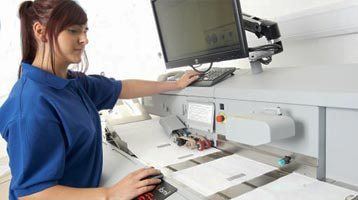
Offsite scanning moves physical records to a secure production facility. There, the documents are logged, prepared, scanned on production equipment, subjected to quality control, and returned, stored, or handled under agreed disposition instructions. Offsite work is often the stronger fit for large, standardized collections that benefit from dedicated staffing and industrial-scale scanning capacity.
Neither approach is automatically more secure or more efficient. The decision should follow the facts of the matter, not a default procurement preference.
When Onsite Scanning Is the Better Choice
Onsite scanning is often selected when the documents cannot leave the facility, whether for legal, regulatory, contractual, or practical reasons. This is common with active personnel files, medical records, government records, privileged case files, highly confidential corporate records, and collections subject to strict internal access rules.
The immediate advantage is control. Custodians and legal teams can maintain direct visibility over the source documents, limit who enters the work area, and establish a scanning workspace within an already secured environment. If an original document must remain available for ongoing business use, onsite staff can scan it and return it to the file without sending the entire collection elsewhere.
Onsite work is also valuable when the condition of a collection is unknown. A team may find mixed files, handwritten notes, oversized drawings, fragile documents, binders with embedded exhibits, or material that requires attorney direction before it is separated or scanned. Having decision-makers nearby can reduce delays. Questions about document order, duplicate materials, nonresponsive sections, and handling instructions can be resolved in real time.
For sensitive investigations and expedited matters, onsite scanning can begin quickly and deliver images in rolling batches. That permits counsel to start reviewing priority records before the complete collection is finished. However, speed depends on the available workspace, site access, equipment setup, security clearance requirements, network restrictions, and the volume that can realistically be processed at the location.
Onsite Scanning Requires a Real Production Plan
The phrase “onsite scanning” can create the impression that a scanner and one technician are enough. For a legal matter, that is rarely sufficient. A defensible onsite operation needs documented intake, box and file tracking, preparation procedures, image quality standards, exception handling, secure file transfer, and daily reporting.
The site itself matters. The provider may need a secured room, controlled access, sufficient electrical capacity, workspace for staging, and a process for locking down documents at the end of each shift. If the project includes Bates numbering, OCR, coding, or delivery into an attorney review environment, those requirements should be defined before scanning starts.
When Offsite Scanning Delivers Better Value
Offsite scanning is often the practical choice for high-volume paper collections with predictable handling requirements. A dedicated document production center can assign multiple scanners, preparation staff, quality control personnel, and project management resources to the job without being constrained by the client’s floor space or business hours.
This model is especially effective for records that are boxed, stable, and ready to process, such as closed case files, archived business records, discovery collections, insurance files, or warehouse-held materials. With appropriate chain-of-custody controls, documents can be picked up, inventoried, transported in secured vehicles, and processed under a documented workflow.
Production capacity is the primary advantage. At an offsite facility, a provider can scale staffing across shifts, run large batches efficiently, and handle specialized requirements such as color scanning, large-format documents, OCR, TIFF or searchable PDF output, unitization, metadata capture, and Bates labeling. That capacity can shorten the calendar time required for a large conversion project.
Offsite scanning may also reduce total cost when the collection is substantial. Mobilizing equipment and personnel to a client location can be necessary, but it introduces setup time and site-specific limitations. A production facility spreads fixed operating resources across the work and generally provides greater throughput for standard document types.
Chain of Custody Cannot Be Assumed
The concern most often raised about offsite scanning is document security. That concern is valid, but moving records is not inherently unsafe when the provider uses disciplined controls. The issue is whether every transfer is documented and whether access is limited throughout the process.
A sound offsite workflow should include a pickup manifest, box-level identifiers, receipt confirmation, controlled transportation, secure facility access, documented internal tracking, and clear instructions for return, storage, or certified destruction. For particularly sensitive records, legal teams may require sealed containers, scheduled handoffs, designated personnel, or additional audit reporting.
Ask how exceptions are handled. If a box is missing a label, a folder contains a potentially privileged document, or an original must be pulled for counsel, the provider should have an established escalation process. Security is not just a statement that a facility is locked. It is the ability to account for the collection at every stage.
Compare the Workflows Before Choosing
The most useful comparison starts with the collection itself. Consider volume, document condition, confidentiality level, access restrictions, deadline, need for originals, and the intended downstream use of the scanned files. A small but highly sensitive collection may warrant onsite work even if the cost per page is higher. A large archive with uniform files may be far more economical and faster offsite.
The following questions help legal teams make the decision:
- Can the records legally or operationally leave their current location?
- Does counsel need immediate access to originals while scanning is underway?
- Is the collection large enough to benefit from dedicated production-center capacity?
- Are there irregular, fragile, oversized, or mixed-format documents requiring frequent client decisions?
- What is the required turnaround for review, production, deposition preparation, or trial?
- Will the images need OCR, Bates labels, coding, load files, or delivery to a platform such as RelativityOne?
The final question is frequently overlooked. Scanning is not the end of the legal workflow. If files are headed to attorney review, the image specifications, naming conventions, confidentiality designations, document breaks, and load-file requirements should be established at the outset. Reworking an improperly structured scan set is costly and can place a deadline at risk.
A Hybrid Model Often Solves the Hardest Matters
Some matters do not require a single choice. A hybrid approach can keep the most sensitive or active records onsite while transferring routine, high-volume materials to an offsite production center. It can also use onsite personnel for collection assessment, priority scanning, and exception handling, followed by offsite processing for the bulk of the archive.
This approach is useful when a legal department needs fast visibility into key files but also needs to control the cost and schedule of a larger conversion. It lets counsel identify priority custodians, date ranges, or document categories for immediate treatment while the remaining materials move through a scalable production workflow.
For complex matters, the vendor should function as a coordinated legal support partner, not just a scanning shop. That means connecting physical records handling to electronic discovery, forensic collection, attorney review, legal copying, and trial exhibit production when the matter demands it. Concord Document Technologies supports these connected workflows with experienced personnel, documented handling procedures, and 24/7 production capability for deadline-driven engagements.
Set the Scope Before the First Box Moves
A successful scanning project begins with a written scope that identifies the source materials, custody requirements, image format, resolution, color treatment, OCR needs, Bates numbering, indexing fields, delivery method, quality-control standards, and disposition of originals. It should also state who can make decisions when the team encounters damaged records, duplicates, personal information, privileged material, or documents outside the agreed scope.
Do not wait until production is underway to define acceptance criteria. Counsel should know whether every page will receive OCR, how blank pages are handled, whether attachments remain grouped with parent documents, and how errors are reported and corrected. These details determine whether a scanned collection is genuinely usable in review and production.
The best choice is the one that protects the record while moving the matter forward. When the collection cannot leave the premises, onsite scanning can preserve control and provide rapid access. When scale, throughput, and standardized processing drive the assignment, offsite scanning can deliver greater efficiency. A careful assessment at intake gives the legal team something more valuable than a stack of images: a reliable, review-ready record when the deadline arrives.