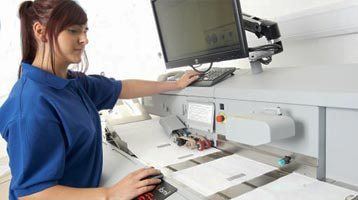
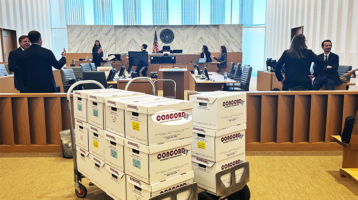
A file room can become a litigation risk the moment documents must move. Boxes may contain privileged correspondence, personnel records, regulated data, original agreements, or evidence that cannot be casually transported to an offsite facility. Onsite scanning gives legal teams a controlled way to convert those records into searchable, review-ready digital files while keeping the source documents where they belong.
For counsel managing a tight production deadline, an internal investigation, a regulatory response, or trial preparation, the question is rarely whether paper must be digitized. The question is whether the process will preserve confidentiality, chain of custody, document integrity, and the ability to locate a critical page when it matters most.
Why Onsite Scanning Is Different From Routine Scanning
Routine scanning is a convenience service. Legal onsite scanning is a controlled production operation. It begins with a defined scope, documented handling procedures, and a clear understanding of how the resulting files will be used in discovery, review, production, or trial.
The primary advantage is control. Rather than releasing sensitive records for transport, a trained scanning team works within the client’s office, records center, government facility, or other approved location. This can reduce handling points, preserve established records controls, and allow designated client personnel to oversee access to particularly sensitive materials.
That distinction matters when the collection includes employee files, medical information, financial records, investigative materials, trade secrets, or documents subject to protective-order restrictions. It also matters when originals must remain available for business operations or when organizational policy prohibits records from leaving the premises.
Onsite work is not automatically the right answer for every project. A well-organized, lower-risk archive may be more efficiently processed at a secure production center. But where transport, access restrictions, volume uncertainty, or evidentiary concerns create exposure, scanning at the source is often the more defensible operational choice.
What a Defensible Onsite Scanning Workflow Requires
A reliable project does not begin by feeding pages into equipment. It begins by determining what is being collected, who controls it, how it will be tracked, and what the finished deliverable must support. The scanning process should be built around the legal matter, not around a generic imaging checklist.
Inventory and document control
Before production starts, the scanning team should identify the source locations, box counts, file categories, and any known exceptions. Each container or file grouping needs a unique tracking method that records its movement from intake through imaging, quality control, and return.
For legal matters, the inventory should capture enough detail to reconcile the physical collection with the digital output. If a box is identified as HR-047 or Investigation Binder 12, the corresponding electronic files should preserve that association. This helps counsel answer practical questions later: What was scanned? From which source? Was every folder returned? Can this image be traced back to the original record set?
Preparation without losing context
Paper preparation may involve removing staples, repairing torn pages, unfolding oversized materials, and separating sticky notes or inserts. That work must be done carefully. A handwritten note attached to a contract, a tab divider in an investigative binder, or the order of documents in a file can carry meaning.
The goal is not to make every page look identical. The goal is to capture the record accurately while retaining its useful context. When documents have unusual characteristics, the team should establish how those items will be imaged and labeled before volume production begins.
Imaging, indexing, and OCR
Legal files commonly require more than a basic PDF. Depending on the engagement, the deliverable may include TIFF or PDF images, searchable text generated through OCR, document-level naming, folder-level indexing, metadata fields, or load files for a review platform.
OCR quality deserves close attention. Searchable text can accelerate issue spotting, support early case assessment, and reduce the time attorneys spend opening irrelevant documents. Yet poor source quality, handwriting, faint carbon copies, and skewed pages can limit OCR accuracy. The appropriate standard depends on the collection and the intended use. A historic archive may need preservation-grade imaging, while a litigation review set may require a more detailed document-level structure and production-ready specifications.
Quality control and exception handling
Quality control should confirm that pages are legible, correctly oriented, complete, and associated with the proper document or file grouping. It should also identify exceptions such as oversized exhibits, fragile records, photographs, color-coded materials, or pages that require rescanning.
A credible provider does not treat exceptions as an afterthought. Exceptions are where legal support teams prove their value. A damaged exhibit, an accordion file, or a binder with mixed document sizes can affect both completeness and usability if handled without a documented process.
Planning the Project Before Equipment Arrives
The fastest onsite scanning projects are planned before the first box is opened. Legal teams should provide the provider with the known volume, source locations, required completion date, access hours, security rules, and expected output format. If the files will enter attorney review, the review environment and loading specifications should be identified early.
A short pilot can be valuable for a large or inconsistent collection. It confirms scan settings, naming conventions, OCR expectations, index fields, and handling decisions for difficult material. It also gives the legal team a realistic view of throughput. Page counts alone do not determine speed. Bound volumes, fragile documents, color scanning, document-level coding, and restricted access windows all affect production capacity.
Physical space is another practical consideration. The onsite team needs a secure work area, sufficient power, controlled access, and room to stage documents without disrupting the client’s operations. For highly sensitive matters, access logs, restricted zones, and client-approved personnel protocols may be necessary.
Security and Chain of Custody Cannot Be Assumed
Confidentiality is not a statement on a proposal. It is reflected in the daily controls surrounding the project. Legal teams should understand who will access the records, how personnel are vetted, how devices and media are secured, and how completed files will be transferred.
A sound chain-of-custody process documents custody at each meaningful handoff. It should account for box or file intake, preparation, scanning, quality control, storage, and return. When digital deliverables are transferred to counsel or loaded into a review environment, the process should also establish how that transfer is recorded and verified.
The right controls vary by matter. A corporate contract archive may require strict confidentiality and accurate indexing. A government investigation or matter involving protected health information may require more restrictive site rules, segmented access, and heightened documentation. The operational plan should match the sensitivity of the records rather than applying a one-size-fits-all process.
From Paper Records to Attorney Review
Scanning delivers the most value when it fits the next stage of the legal workflow. Images can be organized for early case assessment, processed for text search, Bates labeled for production, or prepared for loading into platforms such as RelativityOne. The earlier those downstream requirements are identified, the less rework the legal team faces later.
This is especially useful in matters where paper and electronic evidence exist together. A provider that understands both physical document production and eDiscovery can help maintain consistent naming, custodial organization, and production standards across the collection. That continuity reduces avoidable gaps between a records room, litigation support team, review platform, and trial exhibit process.
Concord Document Technologies brings onsite and offsite production, legal copying, document imaging, Bates labeling, and electronic review support into one coordinated legal services engagement. For matters with compressed deadlines or sensitive source records, that operating depth can make the difference between a managed collection and a last-minute document problem.
When to Use Onsite Scanning
Onsite scanning is particularly appropriate when originals cannot leave the premises, documents are highly confidential, the collection must remain available to staff, or counsel needs direct oversight of the process. It is also a strong option when records are stored in a location where sorting and source context are best understood by the people who maintain them.
Offsite scanning may be more practical when the collection is stable, transportation is authorized, and high-volume production can be completed more efficiently in a dedicated facility. The decision should be based on risk, access, timeline, volume, and the required end product, not simply on the number of boxes in the room.
When the paper files at issue may shape a case, investigation, or regulatory response, treat scanning as part of the evidence workflow. A disciplined onsite process preserves the records, creates usable digital access, and gives counsel more control when deadlines begin to close in.