A large production order can become a case-management problem quickly. A deadline shifts, expert reports are revised, deposition designations expand, or the court requests additional copies with little notice. When that happens, choosing a Los Angeles printer for large projects is not simply a purchasing decision. It is a decision about production control, confidentiality, quality assurance, and whether the finished materials will arrive where counsel needs them.
For litigation teams, corporate legal departments, and government agencies, large-format or high-volume printing requires more than fast equipment. It requires a provider that understands document-intensive matters, can manage changing instructions, and has the capacity to produce accurately after normal business hours.
What Defines a Large Legal Printing Project?
Large projects are not defined by page count alone. A 20,000-page production with straightforward black-and-white copying has different requirements than a 3,000-page trial set containing color exhibits, oversized demonstratives, tabs, binders, confidential records, and overnight courthouse delivery.
The complexity typically comes from the combination of volume, deadlines, document types, and distribution requirements. A matter may require litigation copies, exhibit binders, courtesy copies, deposition transcripts, enlarged boards, color-coded tabs, and electronic versions for remote review. Each component must match the approved set and be assembled in the correct order.
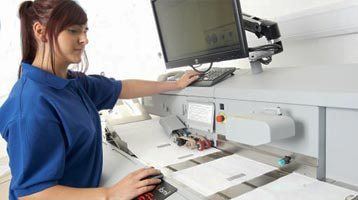
A capable provider should be prepared to handle both routine bulk production and urgent, high-consequence work. That includes scanning source records, applying Bates numbers, producing OCR-searchable PDFs, printing final sets, and maintaining controlled handling throughout the engagement.
Choosing a Los Angeles Printer for Large Projects
The right production partner should be evaluated on execution, not just a quoted per-page rate. Low unit pricing means little if a job requires rework, exhibits are mis-tabbed, a confidential set is released improperly, or delivery misses a filing deadline.
Production capacity matters when the record changes
Legal teams rarely receive final instructions weeks in advance. Late testimony, revised pleadings, supplemental productions, and settlement discussions can change the scope of a job within hours. Ask whether the printer has staffed production capacity outside standard office hours and whether it can scale when multiple matters require attention at once.
Twenty-four-hour production is particularly valuable during trial preparation. It allows counsel to approve a revised exhibit list in the evening and receive completed binders, boards, or copies before the next morning’s hearing. Capacity also means redundancy: multiple production devices, trained operators, and defined quality-control checkpoints that do not depend on a single employee or machine.
Security must extend beyond the file transfer
Sensitive legal materials should remain protected from intake through delivery. That includes confidential client data, personally identifiable information, medical records, trade secrets, and sealed filings. A professional document provider should be able to explain how it receives files, limits access, tracks physical originals, stores work in progress, and destroys or returns materials when the project closes.
For physical records, chain-of-custody discipline is essential. Boxes should be logged at receipt, work should be assigned through controlled processes, and originals should be reconciled before return. For electronic files, secure transfer procedures, restricted access, and documented retention practices reduce unnecessary exposure.
Bonded and insured status is also meaningful. It does not replace sound process, but it signals that the provider operates with the institutional safeguards expected for high-stakes work.
Quality control should be specific, not implied
“Accurate printing” is too vague for trial work. Ask what is checked before a job leaves production. Depending on the assignment, quality control may involve confirming Bates ranges, page orientation, color output, slip sheets, exhibit labels, tab sequences, binding instructions, and copy counts by recipient.
Color is a frequent source of avoidable problems. A document that appears readable in grayscale may lose key meaning when charts, redlines, maps, spreadsheets, or highlighted emails are printed without color. Conversely, printing every page in color may add unnecessary cost. An experienced legal production team can identify where color is necessary and apply it intentionally.
The same principle applies to binding. Three-ring binders are useful for materials that may change, while coil binding or secure fastening can be better for stable filings or hearing sets. The format should support how the material will be handled in court, at a witness examination, or in a war room.
Plan the Workflow Before Sending Files
Large projects move faster when the production instructions are clear at the outset. Counsel or litigation support staff should identify the source files, required output, approval contact, delivery destination, and deadline. The provider should then confirm the job specifications in writing before full production begins.
A practical production instruction should address whether the documents need Bates numbering, whether slipsheets are required, which pages print in color, the number of sets, binding and tab requirements, and where each set must go. If documents are subject to protective orders or have different confidentiality designations, that should be identified before assembly.
For matters involving paper archives, the workflow may begin with onsite or offsite scanning. Documents can be scanned, indexed, OCR processed, and prepared for online attorney review before selected records are printed as exhibits or produced to opposing counsel. This approach prevents teams from repeatedly handling the same paper files and creates a usable electronic record for later stages of the case.
When electronically stored information is involved, production printing should connect to the broader discovery workflow. Documents collected from email, mobile devices, cloud platforms, or custodians may need review and redaction before they can be printed. A provider that understands both eDiscovery and physical production can reduce handoffs between vendors and help maintain consistency from collection through trial.
Delivery Is Part of the Production Job
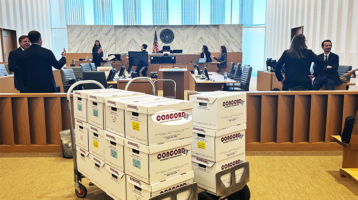
In Los Angeles legal practice, delivery timing can be as important as the finished print quality. A completed binder does not help if it is delivered to the wrong courtroom, arrives after a hearing, or lacks the final corrected exhibit. Confirm whether the provider can deliver directly to locations such as Stanley Mosk Courthouse, First Street Federal Courthouse, and other Superior Court facilities when deadlines require it.
Delivery instructions should include the recipient name, firm or department, courtroom or suite information when applicable, contact numbers, and any building access constraints. For time-sensitive shipments outside the region, overnight carrier coordination should be part of the plan, with final confirmation that the package is correctly labeled and tendered.
There is a trade-off between speed and change control. A rush request should not mean an uncontrolled request. Designate one approval contact, establish a cutoff for final revisions, and require written authorization for changes that affect content, quantity, or delivery. This prevents well-intentioned last-minute edits from producing conflicting versions in circulation.
Questions to Ask Before Awarding the Job
Before selecting a printer, ask direct operational questions. Can the team accept and process files after hours? How are confidential materials tracked? Who verifies Bates ranges and exhibit order? What happens if a source file is corrupt or a tab instruction is unclear? Can the provider coordinate courthouse delivery and overnight shipping? How will you receive status updates if the project changes overnight?
The answers should be concrete. Experienced providers describe their workflow, escalation path, and quality checks without relying on general assurances. They should also be comfortable discussing the limits of a proposed schedule. A credible partner will tell you when a same-day request is feasible, when it requires a staged delivery, and when a different production method would better protect accuracy.
Concord Document Technologies supports large legal document projects with scanning, legal copying, digital printing, trial exhibit production, eDiscovery workflows, and around-the-clock production support. For matters where paper records and electronic evidence intersect, using one accountable partner can simplify coordination and preserve control.
When the record is large and the deadline is real, provide complete instructions early, keep one decision-maker available, and choose a production team built for legal work rather than a general print counter.