A filing deadline at Stanley Mosk, a deposition exhibit set that changed overnight, or a late production of mixed paper and ESI can turn a routine copy order into a litigation risk. The right Los Angeles copy center is not simply a place to print documents. It is an extension of the litigation support team – equipped to receive sensitive records, control versions, apply production specifications, and get the correct materials to counsel or the courthouse without creating a new problem.
For law firms, corporate legal departments, and government agencies, the question is not whether a vendor can make copies. It is whether that vendor can perform under pressure while protecting confidentiality, preserving chain of custody, and understanding the practical demands of discovery, hearings, arbitrations, and trial.
What a Legal Los Angeles Copy Center Must Handle
A legal matter rarely arrives in a clean, print-ready format. Source materials may include banker boxes, oversized engineering drawings, medical records, handwritten notes, searchable PDFs, native files, email exports, mobile-device data, and prior productions with inconsistent numbering. Each category requires a different workflow, and errors can affect review, motion practice, or the trial record.
A qualified provider should begin with secure intake and clear instructions. That means identifying what must be scanned, copied, printed, coded, Bates labeled, slip-sheeted, organized, or delivered. It also means confirming whether the output is for internal case preparation, a party production, a court filing, a witness binder, or demonstratives for trial. These are not interchangeable jobs, even when the documents look similar.
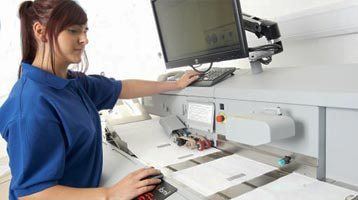
Legal copying remains essential when original paper files must be duplicated, organized, and produced accurately. High-volume copying may involve color and black-and-white segregation, removal of duplicates, chronological arrangement, confidentiality designations, document separators, tabs, and production labels. A dependable team should be able to follow a written protocol exactly and raise questions before an ambiguity becomes a costly rework.
Document scanning requires the same discipline. Image quality, orientation, blank-page treatment, file naming, OCR, color handling, and document-level separation all affect whether a scanned collection is usable. For records that later enter attorney review or are used as exhibits, poor scanning creates avoidable review time and weakens confidence in the record.
Bates Labeling Is a Production Control, Not a Final Touch
Bates numbering often appears straightforward until a production includes multiple custodians, rolling productions, privileged documents, corrected pages, confidentiality legends, or prior ranges that cannot be duplicated. The numbering plan must be established before production begins, not after files have been printed or loaded.
A litigation-focused copy center should confirm the prefix, starting number, digit count, placement, font treatment, and any accompanying designations. If documents need a footer such as “CONFIDENTIAL” or “ATTORNEYS’ EYES ONLY,” the placement must remain readable without obscuring content. When a production combines native files, images, and paper records, the vendor should coordinate the physical and electronic components so that the set is defensible and easy to navigate.
Speed Matters Only When Accuracy Holds
Los Angeles legal teams often need same-day or overnight execution. A witness needs a revised exhibit binder. Opposing counsel serves a supplemental production late in the day. A hearing is moved up. In these moments, a vendor’s stated turnaround matters less than its actual production capacity, staff availability, quality controls, and delivery coordination.
Twenty-four-hour capability is valuable because litigation does not reliably stay within business hours. Still, rush service should include a realistic conversation about scope. A 30-page pleading can be printed and delivered quickly. A 40-box scan-and-copy project with coding, redactions, Bates ranges, and several delivery destinations needs a defined production plan. The best provider will distinguish between what can be completed immediately and what requires phased delivery, rather than promising an unrealistic result.
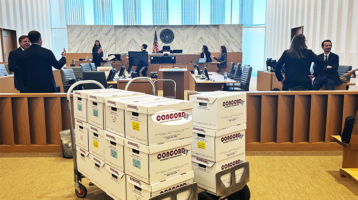
For courthouse delivery, local familiarity adds practical value. Trial exhibit binders and hearing materials may need to reach Stanley Mosk Courthouse, First Street Federal Courthouse, or a Superior Court location before a specific appearance time. The delivery team must have the correct recipient, department, contact number, labeling instructions, and contingency plan. A package that arrives at the building but cannot be located by counsel is not a successful delivery.
Trial Binders Need More Than Tabs
A trial binder is a working tool for attorneys, witnesses, and courtroom staff. It must withstand constant handling and allow the user to find the right page immediately. This calls for consistent exhibit labels, durable binding, correctly placed tabs, color copies where color is evidentiary, and page verification after assembly.
The right format depends on the assignment. A compact hearing binder may need a simple tabbed structure and a duplicate set for the court. A larger trial presentation may require multiple witness binders, exhibit lists, deposition designations, jury instructions, and replacement pages. Digital exhibit sets may be appropriate for some teams, but physical binders remain necessary in many courtroom and witness-preparation settings. The practical answer is often both: organized electronic files for the case team and carefully produced hard-copy sets for live use.
Security and Chain of Custody Cannot Be Assumed
Legal records frequently contain personal information, trade secrets, protected health information, financial data, privileged communications, or information subject to government restrictions. A low-cost print shop may be acceptable for a public marketing brochure. It is not automatically appropriate for sensitive litigation material.
Ask how documents are received, stored, tracked, accessed, transferred, and destroyed or returned. Bonded and insured operations, controlled production environments, trained personnel, documented handling procedures, and secure delivery practices provide meaningful safeguards. For forensic collections and electronically stored information, preservation procedures matter from the first handoff. A copied or exported file may be useful for working purposes, but it is not a substitute for a defensible collection when authenticity and metadata may later be challenged.
This is where a provider that understands both paper records and electronic discovery becomes more valuable. Scanned documents may need to move into an online review workflow. Email, cloud data, or mobile-device evidence may require forensic collection before processing and review. A fragmented vendor chain creates more handoffs, more instructions to repeat, and more opportunities for mismatched versions. One coordinated service team can reduce those points of failure.
Questions to Ask Before You Send the Files
Before assigning a project to a Los Angeles copy center, legal teams should establish the operational details that determine success. Confirm the required deadline and whether it is a hard court deadline or an internal target. Identify the final deliverables, number of sets, delivery addresses, and whether the work includes scanning, OCR, copying, Bates labeling, redaction, binding, or electronic load files.
Also clarify quality-control expectations. Who approves a proof? How will the team identify missing pages, misfeeds, duplicate documents, or an incorrect Bates range? What happens if an exhibit changes after binders are assembled? These questions are especially important when several attorneys, paralegals, and vendors are contributing to the same production.
Pricing should be transparent, but selecting solely on per-page cost can be misleading. A lower rate may not account for after-hours production, color imaging, OCR, document preparation, secure pickup, special handling, onsite support, or urgent courier delivery. Compare the complete scope of work and the provider’s ability to execute it without supervision from your team.
One Provider for Paper, Data, and Trial Preparation
The strongest legal document partner can support the full matter lifecycle: onsite or offsite scanning, legal copying, digital printing, document coding, Bates labeling, online attorney review, forensic data collection, production preparation, and trial exhibit services. That range is not about buying every service from one vendor. It is about having a capable resource when the matter expands beyond the original assignment.
Concord Document Technologies has supported high-stakes legal and regulatory matters since 1996, combining document production with eDiscovery and forensic collection capabilities for law firms, corporations, and public-sector agencies. For teams managing sensitive information and compressed timelines, that combination helps keep physical records and electronic evidence moving through a controlled workflow.
When the stakes are high, choose a copy center based on execution, not convenience. The provider should understand the assignment, protect the information, verify the work, and deliver materials in a form your legal team can use immediately.