A closed matter is not necessarily a disposable matter. A client may return with a dispute years later, a regulator may request historical records, or a former employee’s message may become central to a new claim. When legal teams ask, “how long should legal records be retained,” the right answer is rarely a single number. It is a defensible retention program built around record type, governing law, contractual commitments, litigation risk, and the ability to preserve and produce information when required.
For law firms, corporate legal departments, and public agencies, retention is an operational discipline as much as a policy question. It affects physical files, email, mobile-device data, review databases, financial records, deposition exhibits, trial binders, and the metadata that establishes where a document came from and how it was handled.
How Long Should Legal Records Be Retained?
There is no universal U.S. retention period for all legal records. A useful baseline for many routine business and matter records may be several years after a matter closes or a transaction ends, but that baseline cannot replace a record-by-record analysis. Tax, employment, environmental, healthcare, securities, government contracting, and financial-services requirements can impose longer periods. Bar rules, court orders, client agreements, insurance requirements, and internal policies may also control.
The key distinction is between a retention period and a litigation hold. A retention period tells the organization when a category of information may be eligible for destruction. A litigation hold suspends ordinary deletion for potentially relevant information, regardless of the normal schedule. Once a claim is reasonably anticipated, filed, investigated, or otherwise likely to lead to a dispute, routine deletion can create serious exposure.
Counsel should treat the schedule as a floor for orderly records management, not as permission to destroy relevant evidence. The more sensitive the matter, the more carefully the team should document its decisions.
Start With Record Categories, Not One Blanket Rule
A blanket rule such as “keep everything for seven years” feels safe, but it often creates more risk and cost than it prevents. Over-retention expands the volume of discoverable material, increases breach exposure, complicates data mapping, and makes later review slower and more expensive. Under-retention, on the other hand, can lead to missing evidence, sanctions risk, and difficulty defending the organization’s actions.
A practical schedule separates records into clear categories. Legal matter files may include pleadings, correspondence, attorney work product, discovery productions, expert materials, deposition transcripts, exhibits, settlement documents, and final orders. Each category can have a different trigger date, such as matter closure, expiration of an appeal period, final payment, contract termination, or completion of an audit.
Electronically stored information requires its own treatment. Email, chat messages, cloud files, shared drives, voicemail, mobile-device collections, and collaboration-platform data may contain overlapping copies of the same information. The schedule should identify the system of record where possible and account for backups, archives, legal-hold repositories, and attorney review platforms. A policy that covers only paper files is no longer a workable legal records policy.
Financial and operational records frequently intersect with legal matters. Invoices, billing support, tax records, vendor contracts, insurance files, human-resources documentation, and corporate governance records may be subject to legal, regulatory, or contractual obligations independent of a litigation file. The legal department should coordinate with finance, HR, compliance, information governance, and IT rather than maintain an isolated schedule.
Build a Defensible Retention Schedule
A defensible schedule does not need to be complicated, but it must be specific enough to operate consistently. Begin by identifying what records exist, where they live, who owns them, and what retention authority applies. This includes physical records in offices or offsite storage, as well as data stored in Microsoft 365, Google Workspace, mobile devices, file shares, case-management systems, and eDiscovery repositories.
For each category, define the retention period, the event that starts the clock, applicable exceptions, and the approved disposition method. For example, a matter file might be retained for a defined period after final closure, provided there is no active hold, audit, appeal, client instruction, or regulatory requirement extending preservation. The wording matters. A retention period without a clear trigger is difficult to administer and difficult to defend.
Assign ownership. Records managers may administer the program, but legal should approve the schedule and own hold decisions. IT should be able to suspend automated deletion in relevant systems. Matter teams need a clear process for identifying custodians, preserving paper and electronic materials, and notifying the people who manage the underlying platforms.
Retention decisions should be documented. If records are destroyed according to policy, maintain a disposition log showing the category, date range, authority, method, and approval. This record does not need to list every document individually, but it should demonstrate that disposition was routine, authorized, and not targeted at a known problem.
Litigation Holds Override Routine Deletion
The moment a dispute becomes reasonably foreseeable, the analysis changes. A demand letter, agency inquiry, accident, internal complaint, whistleblower allegation, failed negotiation, or threatened claim may trigger the need to preserve relevant information. The duty can extend beyond the named parties to custodians, departments, devices, and third parties that control relevant data.
An effective hold process identifies the issues, relevant date ranges, custodians, data sources, and preservation actions. It also tells recipients what they must not delete, including texts, personal-device communications used for business, drafts, local downloads, and files stored outside the primary system. A notice alone is not enough. Legal teams should confirm receipt, follow up with custodians, and periodically reassess the scope as the matter develops.
Forensic collection can be necessary when mobile devices, email accounts, or volatile data sources contain relevant material. The collection method should preserve metadata, document chain of custody, and avoid changing the source data. Those details become especially valuable when authenticity, completeness, or timing is challenged.
When the hold ends, release should be documented. Information that remains subject to a valid retention requirement returns to the ordinary schedule. Information eligible for disposition should not remain indefinitely just because it was once preserved for litigation.
Preserve Production-Ready Records
Retention is not simply about keeping a file somewhere. In a high-stakes matter, records must be locatable, readable, searchable, and producible. A scanned paper file without quality control, a corrupt PST, an unlabeled exhibit box, or an export that loses metadata may create substantial downstream work when deadlines tighten.
For physical documents, use consistent indexing, secure storage, image-quality review, and Bates labeling when materials move into discovery or trial preparation. Preserve original documents when their physical characteristics, annotations, or provenance may matter. For electronic records, retain native files and associated metadata when appropriate, while creating defensible review copies for counsel.
This is where production planning should begin well before trial. A matter team that can quickly locate the authoritative version of an exhibit, trace its collection history, and generate a properly labeled production set is in a stronger position than one searching legacy folders days before a hearing. For complex cases, centralizing scanning, forensic collection, document processing, attorney review, and exhibit production can reduce handoffs and preserve accountability.
Avoid the Two Common Retention Failures
The first failure is uncontrolled accumulation. Keeping every file forever may appear conservative, but it increases storage expense, cybersecurity exposure, privacy obligations, and discovery burden. It also makes it harder to find what matters. A retention schedule should support timely, routine disposition after legal and business obligations have been satisfied.
The second failure is informal deletion. Employees often clean inboxes, replace phones, purge shared drives, or discard boxes without realizing that a hold or retention requirement applies. Training should explain that records include more than formal contracts and pleadings. Informal communications, drafts, calendars, texts, photographs, and exported reports can all be relevant.
Both failures are preventable with clear ownership, automated controls where possible, regular schedule reviews, and escalation to counsel when facts change. The goal is not perfect preservation of every item ever created. The goal is a process that is reasonable, consistent, and defensible under scrutiny.
Review the Program Before a Crisis
Retention schedules should be reviewed periodically, especially after a merger, new regulatory obligation, major platform migration, cyber incident, or change in business operations. A policy written for file rooms may not address cloud collaboration, remote work, BYOD devices, or AI-generated business content. Similarly, a schedule designed for routine commercial disputes may be inadequate for government investigations or regulated records.
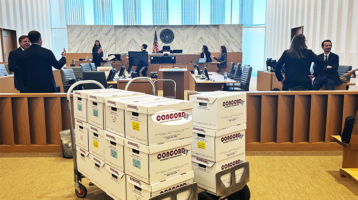
For matters involving high volumes of paper and ESI, Concord Document Technologies supports the operational side of defensible preservation and production, including secure document scanning, forensic data collection, eDiscovery processing, RelativityOne-based review, and trial exhibit preparation. The right service model depends on the matter, but chain of custody and production readiness should be built into the plan from the start.
A well-run retention program gives legal teams something more valuable than extra storage: confidence that when a record is needed, it can be found, preserved, reviewed, and produced without avoidable delay.