A subpoena can turn an ordinary records request into an immediate operational test. This guide to subpoena document production explains how legal teams can preserve responsive information, manage collection, protect privileged material, and deliver a production that is complete, usable, and defensible under deadline.
Start With the Subpoena, Not the Data
Document production failures often begin when a team starts collecting before it has translated the subpoena into an actionable scope. Read the subpoena alongside the governing rules, any accompanying notice, prior discovery agreements, protective orders, and the procedural posture of the matter. A subpoena issued in federal litigation may raise different timing, service, objection, and geographic issues than one issued in state court or an administrative proceeding.
Identify the requesting party, production date, required production format, categories of requested documents, relevant date ranges, custodians, entities, and stated definitions. Terms such as “communication,” “document,” “relating to,” and “control” can expand a request well beyond the obvious files in a records room.
The legal team should then separate three questions: what information is potentially responsive, what information is reasonably accessible, and what information should be withheld, limited, or challenged. Those questions overlap, but they are not the same. A broad request may reach a large volume of data while still presenting valid concerns about relevance, burden, confidentiality, privilege, or proportionality.
Issue a Targeted Preservation Notice
Once a subpoena may require action, preservation needs to begin before collection. A targeted legal hold should identify the matter, the categories of information at issue, the relevant time period, likely custodians, and systems that may contain responsive records. It should instruct recipients not to delete, alter, overwrite, or dispose of potentially responsive material.
For many organizations, the responsive universe is not limited to email and shared drives. It can include cloud storage, collaboration platforms, text messages, iPhone data, accounting systems, HR platforms, paper files, archived mailboxes, scanned images, and vendor-held records. A preservation plan should account for ordinary deletion practices, auto-purge settings, device replacement cycles, and any system where data can change quickly.
Preservation is not a one-time email. Track acknowledgment, follow up with nonresponsive custodians, and document decisions about systems that are outside the scope or no longer available. If a collection limitation becomes necessary, counsel should be able to explain the basis for it with a clear factual record.
Build a Defensible Collection Plan
A defensible collection plan is specific enough to be repeatable and documented enough to withstand scrutiny. It should state who will collect data, from which sources, how the data will be transferred, where it will be stored, and how chain of custody will be maintained.
For electronically stored information, collecting data in its native form can preserve metadata that may matter later, including sender and recipient fields, file paths, creation dates, modification dates, and message attachments. Screen captures, print-to-PDF exports, and manually forwarded emails may be useful for orientation, but they are not always reliable substitutes for forensic or system-level collection.
Mobile devices require particular care. Relevant text messages, attachments, call records, and application data can be lost when a user upgrades a phone, resets a device, or changes accounts. When iPhone data or other mobile evidence is implicated, use a collection method that preserves the source data and records the handling process. The right approach depends on the subpoena’s scope, the device ownership model, the applicable privacy requirements, and whether personal and business data are commingled.
Paper records should receive the same discipline. Box inventories, file-level logs, document preparation, high-resolution scanning, optical character recognition, and quality control can turn a physical archive into a searchable review set. Original files, scan batches, and Bates ranges should be tracked so that the team can trace a produced image back to its source.
Process and Review Before Production
Collection is only the beginning. Raw data commonly contains duplicates, system files, irrelevant materials, privileged communications, and personal or protected information. Processing makes the collection reviewable by extracting text, normalizing metadata, identifying duplicates, and preparing image or native-file deliverables where appropriate.
Search terms, date filters, file-type restrictions, and custodian-based targeting can reduce review volume, but each method has trade-offs. Narrow terms may miss responsive information that uses different language. Broad terms can create unnecessary review expense and increase the risk of inconsistent calls. For high-volume matters, a documented search and validation process is more defensible than an ad hoc approach built around whatever produces the fewest documents.
Review should address responsiveness, confidentiality, privilege, and production designation. Attorney-client communications, work product, common-interest materials, trade secrets, personally identifiable information, medical records, and regulated data may require withholding, redaction, a protective-order designation, or special handling. Do not treat redaction as a formatting task. Redacted documents need quality control to confirm that hidden text, metadata, comments, layers, and native-file content are not inadvertently disclosed.
A privilege log may be required depending on the forum, agreement between the parties, and basis for withholding. Early coordination with counsel on log fields and categorical logging options can prevent a late-stage scramble. When the volume is substantial, a clawback agreement or applicable nonwaiver framework may provide additional protection, but it does not replace careful review.
Prepare the Production Specification
The subpoena may ask for documents in a particular form, but parties often negotiate the technical details. Before exporting data, confirm the production specification in writing. It should address whether documents will be produced as TIFF images, searchable PDFs, native files, or a combination; how Bates numbers will appear; which metadata fields will be included; how families and attachments will be handled; and how redactions, confidentiality designations, and load files will be delivered.
Consistency matters. An email with its attachments should remain identifiable as a family. A spreadsheet that cannot be meaningfully understood as a static image may need native production with a placeholder image. Documents that contain redactions should be produced in a format that visibly reflects them. These decisions should be made deliberately, not improvised after a production has been loaded or served.
Production quality control should test both legal and technical requirements. Confirm that Bates numbers are sequential, filenames are accurate, document counts reconcile, images are legible, searchable text aligns with images, metadata fields load correctly, and withheld or redacted records have not slipped into the export. If the receiving party uses an eDiscovery platform, test the load files before delivery whenever possible.
Manage Objections, Timing, and Communication
A subpoena deadline is not always a production deadline. Counsel may object, seek clarification, negotiate a phased production, move to quash or modify, or request additional time. Those decisions are legal judgments, but they depend on accurate operational information from the people managing records and data.
Provide counsel with early estimates: likely data sources, number of custodians, approximate volume, accessibility issues, expected collection time, review burden, and anticipated production costs. A credible estimate allows the legal team to negotiate from facts rather than assumptions. It also helps distinguish a genuinely burdensome request from one that simply requires organized execution.
Maintain a written production log throughout the matter. Record the subpoena received date, preservation steps, collection sources, processing decisions, review population, privilege and redaction treatment, production volumes, Bates ranges, delivery method, and correspondence concerning scope. If questions arise months later, this record is often more valuable than anyone’s recollection.
When Production Capacity Becomes the Risk
Some subpoena productions are manageable internally. Others involve dispersed custodians, legacy paper archives, mobile-device evidence, large email populations, sensitive records, expedited court deadlines, or a need for both electronic and hard-copy trial-ready output. The deciding factor is not only volume. It is whether the team can preserve control, quality, confidentiality, and timing at the same time.
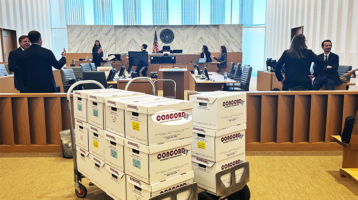
A legal support provider can coordinate forensic collection, scanning, Bates labeling, online attorney review, production exports, and physical exhibit preparation within one controlled workflow. For matters requiring fast courthouse delivery in Southern California or overnight shipment elsewhere, that operational continuity can prevent handoff errors at the point where deadlines are least forgiving. Concord Document Technologies supports these document-intensive workflows with 24/7 production capacity and experienced handling of sensitive legal records.
The most useful next step is to turn the subpoena into a written production plan before the first file is copied. Assign ownership, identify the risks, set defensible checkpoints, and give counsel timely facts they can use to protect the client while moving the production forward.