A missed preservation step can turn a manageable discovery dispute into a motion, sanctions risk, or a damaging gap in the record. That is why eDiscovery services for law firms must do more than process files. They must establish a defensible chain of custody, make large data sets reviewable, and deliver productions that can withstand scrutiny from opposing counsel, regulators, and the court.
For high-stakes litigation, investigations, and regulatory matters, discovery is not a single task handed off to a vendor. It is an operating workflow that begins before collection and often continues through trial. The right provider brings forensic discipline, document production capacity, and experienced support into one coordinated engagement.
What eDiscovery Services for Law Firms Should Cover
A credible eDiscovery engagement starts with scoping. Counsel needs to identify likely custodians, relevant systems, time periods, data types, and preservation obligations before data is copied, exported, or filtered. The scope may include email, cloud collaboration platforms, mobile devices, network shares, paper files, databases, and legacy media. Each source presents different risks, collection methods, and review implications.
Collection is where defensibility becomes concrete. A proper process documents who handled the source data, when it was collected, what method was used, and how the integrity of the data was maintained. This is particularly significant for iPhones, email accounts, and other sources that can change quickly or contain both business and personal information. Forensic data collection may be necessary when metadata, deleted content, device artifacts, or a complete record of acquisition could become material.
Once collected, electronically stored information must be processed into a usable review population. That usually includes extracting metadata, de-duplicating data where appropriate, threading emails, identifying near duplicates, applying search terms, and preparing files for attorney review. Sound processing reduces unnecessary review volume without sacrificing traceability. It also gives counsel a clearer basis for discussing proportionality, search methodology, and production protocol.
Review and production cannot be treated as separate problems. Review decisions drive privilege logs, redactions, confidentiality designations, and final production specifications. A service partner should be able to move from a hosted review environment to a compliant production without forcing the legal team to reconstruct the record in another system.
The Workflow That Protects the Record
The strongest discovery workflows are designed around decision points, not software alone. Technology matters, but no platform corrects an unclear collection plan or an undocumented handoff.
Preservation and early case assessment
The first question is often not how much data exists, but what must be preserved now. Counsel may need a legal hold process, an initial custodian interview plan, and early visibility into the likely volume and location of relevant information. Early case assessment helps the team understand whether a matter involves a few focused custodians, years of enterprise email, mobile communications, or a mix of paper and electronic records.
This stage is also where trade-offs should be addressed. Broad preservation may be prudent when facts are still developing, but collecting every possible source immediately can add cost and delay. A defensible plan explains the choices made, the sources prioritized, and the reasons certain data was excluded or deferred.
Defensible collection and chain of custody
Collection should match the source and the legal need. An email export may be sufficient for one matter; another may require a more complete forensic acquisition of a phone or computer. The difference matters when authenticity, metadata, deleted material, or the sequence of communications is likely to be challenged.
For sensitive sources, chain-of-custody documentation should remain intact from receipt through processing, review, production, and eventual return or disposition. Law firms and their clients need confidence that data was not altered, misplaced, or handled outside agreed security procedures. This is especially relevant in employment disputes, trade secret matters, government investigations, and cases involving regulated records.
Hosted review with control over cost and quality
A review platform such as RelativityOne can organize large volumes of ESI into a defensible workflow for attorneys and litigation support teams. The platform is only one part of the service. Matter configuration, user access, coding layouts, search strategy, analytics, quality control, and reporting determine whether review proceeds efficiently.
Teams should have a clear view of the review population and the decisions being made. Are duplicates being suppressed? Are email families preserved? How are redactions verified? Which documents are being escalated for privilege or issue review? Clear reporting allows supervising attorneys to adjust strategy before the review budget is spent.
Technology-assisted review and analytics can reduce the burden of large data sets, but they require informed oversight. They are most valuable when the matter has sufficient volume, a stable protocol, and knowledgeable reviewers who can validate results. In a small, document-light dispute, a straightforward targeted review may be faster and easier to explain.
Production that meets the agreed specification
A production is a legal deliverable, not a file transfer. It must comply with the agreed format, include correct load files and metadata where required, preserve family relationships, apply Bates numbering accurately, and maintain redactions. Production QC should verify document counts, image quality, native-file handling, confidentiality legends, endorsements, and exceptions before delivery.
Firms should also plan for rolling productions and late-arriving data. A partner with both electronic discovery and traditional document capabilities can keep the workflow aligned when a matter requires scanned paper records, legal copying, oversized exhibits, or hard-copy materials alongside ESI.
Why Physical Records Still Affect Electronic Discovery
Many matters do not arrive in clean electronic form. A client may have banker boxes of archived files, handwritten notes, signed agreements, medical records, personnel files, or historical correspondence that never entered an electronic system. Treating those records as an afterthought creates gaps in search, review, and production.
Professional scanning can convert paper records into searchable, Bates-labeled material that enters the same review and production workflow as ESI. The process should account for document preparation, image quality, OCR accuracy, unitization, confidentiality, and reconciliation to the source inventory. If original records must be returned, retained, or produced at trial, those instructions should be documented from the outset.
This integration is valuable because legal teams should not have to manage one vendor for boxes, another for forensic collection, a third for attorney review, and a fourth for exhibits. Consolidating those functions can reduce handoffs and preserve accountability, provided the provider has demonstrated capacity in each discipline.
Questions Law Firms Should Ask Before Engaging a Provider
Selecting a discovery provider is a risk-management decision. Price matters, but a low per-gigabyte rate says little about collection quality, responsiveness, production accuracy, or trial readiness. Before engagement, firms should confirm the provider’s experience with comparable matters and ask how it will handle the practical realities of the case.
Key questions include:
- How will the provider document collection methods, chain of custody, and data integrity?
- Can it collect iPhone and email data remotely or onsite when circumstances require it?
- Who configures and supports the review workspace, and what reporting will the case team receive?
- How are productions quality-checked, including redactions, Bates ranges, and load files?
- Can the same team scan records, manage ESI, and produce trial exhibits on compressed timelines?
- What after-hours support and secure production capacity are available if a court deadline changes?
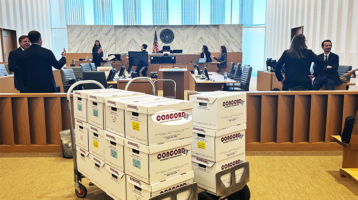
The answers should be specific. A reliable provider can explain its workflow, escalation path, security practices, and staffing model without vague assurances. For matters in Southern California, the ability to deliver properly prepared trial exhibit binders overnight to venues such as Stanley Mosk Courthouse or First Street Federal can be as consequential as the review platform itself.
From Discovery to Trial Without Losing Momentum
Discovery decisions affect trial preparation long before the first exhibit list is served. Documents coded as key, hot, privileged, or subject to a redaction may later need to be retrieved, printed, enlarged, organized into binders, or loaded into a presentation workflow. If the underlying data and physical documents have been managed in disconnected systems, that transition becomes slower and more error-prone.
Concord Document Technologies supports this full continuum, from forensic collection and RelativityOne-based review through scanning, legal copying, digital printing, and trial exhibit production. For legal teams handling sensitive, document-intensive matters, the practical benefit is a single accountable partner that understands both the electronic record and the materials that must be in counsel’s hands when court is in session.
The right time to establish that support is before discovery becomes an emergency. A clear scope, defensible collection plan, and production-ready workflow give the case team room to focus on the legal judgment no vendor can make for them.