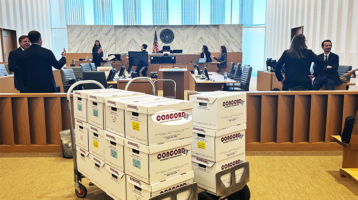
A trial exhibit can be perfectly prepared and still fail the moment it reaches the courthouse. A mislabeled binder, a missing courtesy copy, an unapproved delivery route, or a media file that will not open on the courtroom system can cost a trial team time and credibility when neither is available to spare. This courtroom exhibit delivery guide focuses on the operational details that protect the record, preserve chain of custody, and get materials where they need to be.
Start With the Court’s Actual Requirements
Do not build a delivery plan from last year’s trial or another department’s assumptions. Courtroom practices differ by jurisdiction, judge, courtroom, and type of proceeding. Standing orders, pretrial orders, local rules, and clerk instructions may govern the number of exhibit sets, labeling format, electronic submission method, delivery window, and treatment of confidential materials.
Confirm whether the court wants originals, copies, or electronically lodged exhibits. Ask who is authorized to receive materials, where deliveries are accepted, and whether security personnel, the courtroom clerk, or a designated filing office controls access. A package addressed only to “the courthouse” is not a delivery plan.
This matters especially in active urban courthouses. At locations such as Stanley Mosk Courthouse or First Street Federal Courthouse in Los Angeles, security screening, loading restrictions, elevator access, and clerk availability can affect timing. A courier who arrives at the building may still be far from a completed handoff.
Create a written delivery instruction that identifies the case caption and number, courtroom and department, recipient, delivery date and time, required sets, handling instructions, and a reliable trial-team contact. The instruction should also state whether the contents are confidential, sealed, subject to protective order, or contain personal information requiring controlled handling.
Build the Exhibit Set Before the Delivery Window
Last-minute production is sometimes unavoidable. Last-minute organization is not. The best delivery process begins when the trial team locks the exhibit list, confirms the version to be used, and separates materials by purpose: court set, witness set, opposing counsel set, demonstratives, backups, and internal working copies.
Every physical exhibit set should be checked against the final list before it is packed. Verify exhibit numbers, descriptions, Bates ranges, tab order, legibility, redactions, and whether each item is admitted, marked for identification, or reserved for possible use. If an exhibit is replaced, withdrawn, or renumbered, every affected set must be reconciled. A single stale index can create confusion at counsel table and in the record.
Trial binders should be durable enough for repeated handling. Use clear spine labels, consistent tabs, and indexes that let counsel locate an exhibit under pressure. For oversized maps, photographs, timelines, or technical drawings, determine in advance whether they need mounting, foam board, presentation sleeves, or a digital display alternative. The right format depends on courtroom equipment, witness needs, and the judge’s preferences.
Treat Electronic Exhibits as Production Materials
Electronic exhibits require the same discipline as paper, plus technical validation. Files should be named consistently, organized to match the exhibit list, and reviewed on the actual devices or software expected at trial. A file that opens on a litigation support workstation may not perform correctly on a courtroom laptop.
Provide only approved versions. Confirm that PDFs are searchable where appropriate, video files include usable audio, and presentation files retain fonts and embedded media. If the court permits electronic delivery, confirm the accepted storage medium, upload portal, file-size limits, naming conventions, and deadline. Do not assume a flash drive will be accepted at security or by courtroom staff.
For sensitive materials, use encrypted media or a secure transfer process when permitted, then document the password-sharing procedure separately. Security should not prevent timely access by the authorized recipient.
Protect Chain of Custody From Production Through Receipt
Exhibit delivery is a custody event, not merely a transportation task. The team should be able to answer who prepared the materials, who released them, who transported them, when they changed hands, and who received them. That record is particularly valuable for original records, evidence containing protected information, devices, and materials governed by a sealing order.
Use tamper-evident packaging when the contents warrant it. Label outer packaging with handling instructions without disclosing unnecessary confidential case information. Keep an inventory inside each package and a corresponding release log with the sender’s name, courier information, date, time, package count, and recipient signature or other proof of receipt.
There is a trade-off between minimizing people who touch the materials and building in redundancy. For routine bound exhibit sets, a tracked overnight shipment with documented receipt may be appropriate. For irreplaceable originals or a high-stakes next-morning hearing, a dedicated legal courier or supervised hand delivery may be the better choice. The decision should reflect the value and sensitivity of the materials, the delivery deadline, and the courthouse’s receiving procedures.
Schedule for the Courthouse, Not the Shipping Estimate
An overnight carrier’s commitment is not the same as courtroom readiness. Delivery to a courthouse mailroom at 10:30 a.m. may be too late if counsel needs to review the set, resolve an indexing issue, and provide copies before a 1:30 p.m. hearing. Build backward from the moment the materials must be available in the courtroom.
For an important trial date, aim to deliver non-emergency materials at least one business day early where court procedures allow it. Confirm receipt with the intended recipient, not just carrier tracking. A signature from a building receptionist may prove the package entered the building, but it does not establish that the courtroom clerk received the correct set.
When deadlines require same-day or overnight delivery, identify a backup path before dispatch. That may include a second printed set, a secure electronic duplicate, an alternate courier, or a local production partner able to reprint and assemble replacement binders. The backup should not be hypothetical. Confirm who has authority to activate it and where the replacement materials will be produced.
Use a Final Release Check
Before any package leaves the production floor, conduct a final release check that is separate from document assembly. This is where many avoidable errors are caught: the wrong court address, an outdated courtroom assignment, a missing confidential designation, an incomplete package count, or an exhibit list that does not match the binders.
The release check should cover at least these four areas:
- Content accuracy: correct documents, exhibit numbers, redactions, and indexes.
- Packaging: correct sets, labels, protective materials, and sealed or tamper-evident containers where required.
- Delivery instructions: verified recipient, courthouse location, deadline, contact numbers, and access restrictions.
- Documentation: inventory, chain-of-custody record, tracking details, and receipt procedure.
Assign one person to own the final go/no-go decision. In a high-volume trial operation, shared responsibility can become no responsibility. The responsible person does not need to perform every task, but they should confirm that the production, legal, and delivery components are aligned.
Plan for What Happens After Delivery
A delivery is not complete when the courier departs. The trial team should receive confirmation of receipt, package condition, and any issue that requires immediate attention. If the court will not accept the materials early, document the refusal and escalate to the attorney or litigation support lead rather than leaving materials in an uncontrolled location.
Keep a digital record of what was delivered, including the final exhibit index and a copy of each production set where permitted. During trial, exhibits often evolve through objections, substitutions, admitted versions, and demonstratives created overnight. A controlled source file and clear version history make it possible to respond quickly without reproducing old errors.
For teams managing paper exhibits, electronic evidence, and urgent courthouse delivery under one deadline, the operational advantage is coordination. Concord Document Technologies supports trial exhibit production, Bates labeling, digital printing, secure document handling, and overnight delivery for matters where the materials must arrive ready for use.
The most reliable courtroom delivery is rarely dramatic. It is the one that arrives early enough, reaches the right hands, matches the final exhibit list, and leaves the trial team free to focus on the argument waiting inside the courtroom.