A filing cutoff, an emergency hearing, and a partner asking for a clean set of exhibits can turn a routine production request into a serious operational problem. A capable Century City copy service gives legal teams more than fast machines. It provides controlled handling, accurate reproduction, organized deliverables, and the capacity to move from paper records to review-ready data or trial binders without introducing avoidable risk.
For Century City law firms, corporate legal departments, and litigation teams working against court and deal deadlines, the question is not simply who can make copies. The question is whether the provider understands litigation workflow, confidentiality, chain of custody, and the difference between a draft production and a court-ready set.
What a Century City Copy Service Should Handle
Legal document production often begins with a straightforward request: copy these records, scan these boxes, or prepare these exhibits. The scope can change quickly. A production may require document indexing, OCR, Bates numbering, color copying, redaction support, file conversion, deposition exhibit sets, and overnight delivery to counsel or the courthouse.
A legal-focused provider should be equipped to manage physical and electronic materials in the same engagement. That includes high-volume copying and digital printing, secure document scanning, searchable PDF creation, oversized exhibit reproduction, tabbed binders, and litigation-ready labeling. When the matter expands into electronically stored information, the team should also be able to coordinate collection, processing, and attorney review workflows rather than treating paper and data as unrelated projects.
This matters because fragmented vendors create unnecessary handoffs. One provider scans the documents, another applies Bates labels, another prepares trial binders, and someone at the firm is left reconciling folders, versions, and deadlines. A coordinated document services partner reduces those gaps.
Speed Matters, but Accuracy Matters More
Fast turnaround is valuable only when the output is complete, legible, and correctly organized. A missing page in a deposition exhibit or an inconsistent Bates range can create expensive rework at the worst possible moment. For sensitive matters, a copy service should build quality control into the process instead of treating it as an afterthought.
Before production begins, confirm the specifications. Legal teams should identify whether documents need to be reproduced in color, whether staples and attachments must remain associated, how duplicates should be handled, and which naming convention, numbering format, or confidentiality designation applies. If the deliverable is headed to a hearing, deposition, mediation, or trial, confirm the required number of sets and the destination schedule early.
There is a practical trade-off. Same-day production can be appropriate for a limited, well-defined request. Larger jobs involving scanning, OCR, coding, redactions, or mixed media require a more deliberate timeline. A provider that promises immediate delivery without asking about quality-control requirements may not be planning for the details that protect the work product.
Common Legal Production Requirements
The strongest legal copy operations can support the details that make a production usable, including Bates labeling, slip sheets, document separation, native-file handling, OCR, image quality verification, confidentiality legends, and load-file preparation. For trial work, that can extend to custom tabs, witness binders, jury copies, exhibit stickers, enlargement boards, and electronic presentation files.
The goal is not to add process for its own sake. It is to deliver documents in the form counsel needs them, with no last-minute sorting project waiting for the litigation team.
Secure Handling Is Part of the Service
A Century City copy service may handle employment files, medical records, privileged communications, financial data, trade secrets, government materials, and evidence subject to protective orders. Confidentiality cannot be limited to a promise at intake. It needs to shape how documents are received, logged, transported, stored, scanned, produced, and returned or destroyed.
Ask how the provider tracks originals and who can access the project. Bonded and insured operations, controlled production environments, documented chain-of-custody procedures, and personnel experienced in legal records handling are meaningful indicators. For onsite work, confirm how materials will be secured at the client location and whether the team can work within the firm or agency’s access protocols.
Electronic security also deserves attention. Scanned files should be delivered through an appropriate controlled method, with clear instructions on folder structure, naming, and access. If data is being collected from email accounts, mobile devices, or cloud sources, forensic preservation practices and defensible documentation become essential. Copying and eDiscovery may be different disciplines, but the legal team should not have to manage a security gap between them.
When Scanning Should Lead the Workflow
Paper remains central to many disputes, investigations, and regulatory matters. Yet copying paper without creating a searchable, organized digital record can slow attorney review and make later production more difficult. Scanning with OCR allows counsel to search correspondence, invoices, personnel files, and legacy records while preserving the source material for verification.
The right approach depends on the matter. For a short hearing, printed sets may be the immediate priority. For a document-intensive investigation, scanning, coding, and loading records into a review platform may create more value than producing multiple paper sets. Many matters require both: a searchable collection for ongoing review and polished hard-copy exhibits for testimony or court use.
Concord Document Technologies supports these connected workflows, from legal copying and scanning through RelativityOne-based review, forensic collection, and trial exhibit production. That continuity can be particularly useful when a matter begins as a rush copying request and develops into a broader discovery or trial-preparation engagement.
Court and Trial Deliverables Need a Different Standard
Trial binders are not ordinary binders. They must be complete, navigable, consistently labeled, and durable enough for repeated use by attorneys, witnesses, and courtroom staff. The same is true of deposition sets and hearing exhibits. Poor tab placement, weak copy quality, missing separator pages, or inconsistent exhibit numbering can waste time in front of a judge or witness.
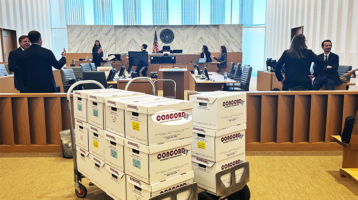
A legal production partner should confirm the exhibit sequence, tab language, binder capacity, color requirements, and delivery instructions before assembling the final sets. If documents will be delivered overnight to Stanley Mosk Courthouse, First Street Federal Courthouse, or another Southern California venue, the delivery plan should account for cutoff times, receiving procedures, and the possibility of late revisions.
For high-stakes matters, retain a clean electronic reference set alongside the physical binders. It gives the legal team a reliable way to verify a page, replace a damaged exhibit, or issue an approved supplemental set without rebuilding the project from scratch.
Questions to Ask Before Assigning the Job
The right provider will answer operational questions directly. Can the team accept originals securely? Is 24/7 production available when a deadline shifts? Who checks page counts, image quality, and Bates sequences? Can the project move from paper scanning to eDiscovery processing if the scope grows? Can completed binders be delivered to the correct courthouse, office, or overnight carrier on time?
Also ask about communication. Legal teams need a named project contact who can confirm status, flag ambiguities, and document changes. A request that says “make five sets” can mean five identical binders, five different recipient-specific productions, or five sets with varying confidential material. Experienced project management prevents assumptions from becoming errors.
Select for Capacity, Not Just Convenience
The closest storefront may be adequate for a small, nonconfidential copying job. It may not be the right choice for a multi-box production with sensitive records, tight review requirements, and a court delivery deadline. Legal teams should select based on the demands of the matter: volume, sensitivity, required turnaround, downstream discovery needs, and the consequence of an error.
For routine work, convenience may lead. For bet-the-company litigation, a regulatory inquiry, or trial preparation, choose a provider with demonstrated legal production discipline and enough capacity to respond when the request changes after business hours. The best time to establish that relationship is before the next emergency production lands on your desk.