A filing deadline can turn a straightforward production job into a serious litigation risk. When exhibits need to be copied, Bates labeled, assembled, and delivered to counsel or court with little notice, a general retail print shop is not an adequate contingency plan. A Beverly Hills copy service for legal matters must understand confidentiality, production specifications, document control, and the consequences of one missing page.
Legal teams frequently need more than copies. They need a production partner that can receive sensitive source materials, maintain chain of custody, scan and index paper records, apply litigation-ready numbering, produce searchable PDFs, and prepare physical trial sets without slowing down the matter. The right provider supports the work already underway rather than creating another item for the litigation team to manage.
What a Beverly Hills Copy Service Should Handle
For legal professionals, copy service is a broad operational requirement. A single request may involve discovery copies, deposition exhibits, subpoena records, pleading binders, expert materials, or a last-minute trial demonstrative. Each has different instructions, and each requires close quality control.
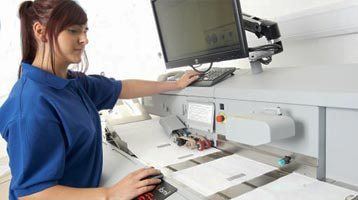
A qualified legal document provider should be equipped to produce black-and-white or color copies at volume, with accurate collation, tabs, dividers, slip sheets, exhibit labels, hole punching, binding, and secure packaging. That baseline matters, but it is only the starting point. High-stakes matters often require OCR scanning, document coding, Bates stamping, confidentiality legends, load-file preparation, and production sets that correspond exactly to an opposing party request or court order.
The difference is not simply speed. It is the ability to follow detailed instructions consistently across thousands or millions of pages. A production that is late, misnumbered, incomplete, or improperly redacted can create unnecessary motion practice and damage client confidence.
Court-ready production is a separate discipline
Court and trial materials need to be usable under pressure. Trial exhibit binders should have clear labeling, correct exhibit order, durable tabs, and a format that lets attorneys locate a document immediately during examination. Deposition binders and witness materials require the same attention to sequence and legibility.
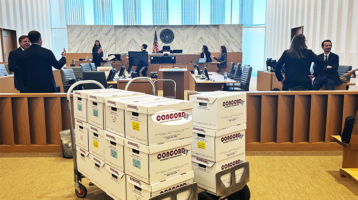
For Southern California matters, overnight delivery to Stanley Mosk Courthouse, First Street Federal Courthouse, and Superior Court locations can be as important as the production itself. A dependable provider plans for filing and delivery windows, confirms instructions, and keeps the process moving when an overnight request becomes unavoidable.
Security and Chain of Custody Cannot Be Assumed
Legal records can include privileged communications, personally identifiable information, trade secrets, medical records, financial data, and materials subject to protective orders. Sending those records to an unknown copier or leaving boxes unattended in a shared production environment is a preventable exposure.
A legal-focused copy service should have documented intake procedures, controlled access to physical records, secure handling during scanning and reproduction, and accountable transfer procedures when materials move between offices, vendors, counsel, and court. Bonded and insured status is also a meaningful indicator that the provider understands the responsibility involved.
Ask how originals are logged, where they are stored, who can access them, and how completed work is returned or destroyed. The answer should be specific. “We handle confidential documents” is not a process. Legal teams need to know whether the provider can support defensible handling when the documents are sensitive, regulated, or central to the dispute.
Redactions require more than black boxes
Redaction is one area where production shortcuts can become costly. A visible black box on a PDF does not necessarily remove underlying text or metadata. Proper electronic redaction requires a process that permanently removes protected content before the file is released.
The same caution applies to paper. Teams need confirmation that redacted pages are reproduced correctly, that no unredacted source pages are mixed into final sets, and that quality checks occur before delivery. For matters involving privacy obligations or protective orders, this level of control is not optional.
Paper Records and eDiscovery Need to Work Together
Many litigation matters still begin with banker boxes, archived personnel files, handwritten notes, contracts, and legacy records. Yet the review, search, and production workflow is increasingly digital. A copy provider that only handles paper may force legal teams to coordinate additional vendors for scanning, processing, hosting, and review.
A stronger model connects physical and electronic workflows. Paper documents can be scanned, OCR processed, Bates labeled, indexed, and prepared for attorney review. Electronically stored information can be collected from email, mobile devices, cloud accounts, and business systems, then processed alongside scanned records in a managed review platform.
This combined approach reduces handoffs and keeps the production record more consistent. It also gives counsel flexibility. The same set of records may need to be reviewed electronically, produced as searchable PDFs, and assembled in hard-copy binders for a hearing. When one provider understands all three needs, the legal team spends less time reconciling versions and vendor instructions.
When forensic collection is necessary
A copy request sometimes reveals a preservation problem. If responsive communications live on an iPhone, in an employee mailbox, or within a cloud application, screenshots and informal exports may not be sufficient. The collection may need to preserve metadata, document the source, and withstand scrutiny from opposing counsel or a regulator.
That is when forensic data collection should be part of the conversation. It depends on the matter, the governing preservation obligations, and the anticipated challenge to authenticity. For a routine internal file copy, full forensic collection may be unnecessary. For a trade secret, employment, regulatory, or high-value commercial dispute, the defensibility of the collection can be central.
Choosing a Provider for Rush Legal Work
Rush capacity is valuable only when it is real. Before assigning a time-sensitive job, legal teams should confirm the provider’s operating hours, production equipment, staffing depth, delivery capability, and quality-control process. A provider that can accept a file at 6 p.m. but cannot begin production until the next business day is not providing the coverage many litigation teams need.
It is also reasonable to ask whether the vendor can scale. A small set of hearing binders and a large discovery production require different staffing, equipment, and supervision. The right choice depends on the assignment. For a few copies, convenience may be enough. For a document-intensive dispute, capacity, legal experience, and documented workflow matter more than proximity alone.
Clear instructions make rush work more reliable. Identify the source files or boxes, required number of sets, color requirements, Bates range, confidentiality language, binding format, delivery recipient, and deadline. If a production must mirror a prior set or comply with a specific protocol, provide that reference at intake. A capable provider will review unclear instructions before production begins rather than make assumptions.
A Better Standard for Legal Document Support
The most effective document partner does not treat a litigation project as a stack of pages. It treats the project as evidence that must remain organized, secure, accessible, and production-ready from intake through delivery.
Concord Document Technologies supports legal teams with scanning, legal copying, digital printing, Bates labeling, exhibit production, forensic collection, and RelativityOne-based review workflows. That breadth is useful when a matter changes direction quickly and the team needs one accountable provider instead of a chain of disconnected vendors.
When deadline pressure rises, the practical question is not whether documents can be copied. It is whether they can be copied accurately, protected throughout the process, and delivered in a form counsel can rely on without hesitation.