CONCORD has been providing overnight Trial Exhibit Binder printing and trusted by Los Angeles’ top law firms for over 30 years.
Get it printed and delivered overnight. Staffed monday – friday til midnight!
Call Concord today! (213) 745-3175
A trial team does not need an ordinary print shop at 8 p.m. when an exhibit list changes, a deposition designation is finalized, or the court requests an additional courtesy set by morning. The best overnight printer in Los Angeles for trials is a legal production partner that can receive instructions clearly, protect confidential material, produce court-ready sets accurately, and deliver them where they are needed without creating another problem for the litigation team.
For high-stakes matters, speed matters. But speed without exhibit control, quality review, secure handling, and knowledgeable delivery is only a faster way to make a costly mistake.
CONCORD TESTIMONIALS (GOOGLE)
REVIEWS FROM YELP
What Makes an Overnight Trial Printer Different?
A conventional commercial printer may be able to run documents after hours. That does not necessarily mean it understands litigation production. Trial materials often require precise Bates ranges, numbered and labeled exhibits, color-coded tabs, deposition transcripts, witness binders, jury copies, judge copies, and strict version control. A legal printing provider should recognize that a missing page, wrong divider, or outdated demonstrative can affect more than appearance.
The right provider also needs to work from incomplete or evolving instructions. Counsel may send a revised PDF late in the evening, ask for a limited set of corrected pages, or need one exhibit removed from every binder. The provider should have a documented process for confirming the scope, isolating the correct files, tracking revisions, and obtaining approval before production moves forward.
This is why “overnight” should mean more than a late pickup and a rush fee. It should mean staffed production capacity, real communication, and accountable handling from file receipt through delivery.
How to Evaluate an Overnight Printer for Trial Work
The strongest choice depends on the volume, sensitivity, destination, and timing of the assignment. A small next-day hearing package has different demands than a multi-week jury trial with several witness sets and daily exhibit changes. Still, every trial team should evaluate the same operational fundamentals.
Legal document experience
Ask whether the provider regularly produces trial exhibit binders and litigation documents, not merely brochures, marketing materials, or general business reports. Legal production experience shows up in the details: consistent pagination, readable color reproduction, durable binding, correctly placed tabs, clean hole punching, and an understanding of confidential or sealed material.
A qualified team should also be prepared to produce from native files, PDFs, scans, and attorney-marked versions. If the assignment involves electronic discovery, it helps when the provider understands the relationship between the production set, the review database, Bates numbering, and the final trial exhibit collection.
Secure intake and chain-of-custody discipline
Trial materials may contain privileged communications, personally identifiable information, trade secrets, medical records, law enforcement materials, or evidence subject to a protective order. File transfer, storage, printing, packaging, and courier delivery should be managed with confidentiality in mind.
Ask who can access the files, how instructions are documented, whether job changes are confirmed in writing, and how packages are identified at handoff. Bonded and insured legal support providers offer an added level of operational assurance, particularly when the matter involves sensitive records or a government agency.
Capacity after business hours
A true overnight provider has more than an answering service. Confirm that trained production personnel can review specifications, release jobs, resolve file issues, and communicate status after normal office hours. This matters when a source file has a broken font, an oversized page, a missing attachment, or a last-minute instruction that changes the number of sets.
Capacity is equally important. One hundred pages in two binders is not the same as 20,000 color pages across witness, counsel, court, and backup sets. Ask direct questions about deadlines, quantities, finishing requirements, and whether the provider can dedicate production resources to the assignment.
Quality control before delivery
No trial team should have to discover a mistake at counsel table. A reliable overnight printer uses a check process that compares the final output against approved instructions. That may include verifying page counts, Bates ranges, tab labels, binding format, copy counts, color pages, and packaging by recipient.
The level of review should match the assignment. For a sensitive exhibit binder, it may be appropriate to request a proof or a photographed confirmation of the cover, spine, tabs, and first pages before the complete set leaves production. For larger rush jobs, the provider should explain what quality-control steps can reasonably be performed within the available window.
Court Delivery Is Part of the Assignment
Production is only half the job when materials must reach a courthouse before a hearing or trial session. A provider may print a perfect set and still fail the assignment if delivery is late, sent to the wrong entrance, or handed to the wrong recipient.
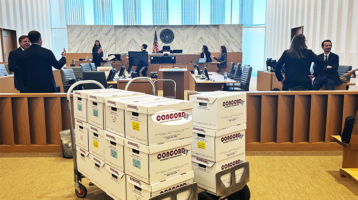
For Los Angeles litigation, experience with courthouse logistics is valuable. Deliveries to Stanley Mosk Courthouse, First Street Federal Courthouse, and Superior Court locations require attention to traffic, security screening, building access, receiving procedures, and counsel’s location. A delivery plan should identify the exact destination, contact person, deadline, package count, and confirmation method.
There is a trade-off here. Direct courier delivery can provide more control for a local courthouse deadline, while an overnight carrier may be appropriate for a trial team outside the immediate area. The correct choice depends on the time window, destination, package size, and whether a signature or named handoff is required. For time-sensitive local deliveries, do not assume a standard shipping label provides the same visibility as a managed courier handoff.
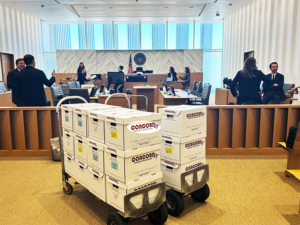
Delivery to First Street Federal Courthouse
Give Your Provider a Production-Ready Instruction Set
Even the best overnight operation works more accurately when it receives clear instructions. A short production order should state the matter name, attorney or litigation support contact, final file name and version, quantity of each set, paper size, color requirements, binding style, tab language, and delivery details.
For complex trial binders, specify whether every set is identical or whether the judge, witness, opposing counsel, and internal trial team require different contents. Identify any documents that must be printed in color, on legal-size paper, double-sided, or as foldouts. If pages must be inserted behind particular tabs, state the intended order rather than relying only on file names.
When time permits, establish a single authorized approver. Last-minute instructions from multiple people are a common source of conflicting changes. If several team members must contribute, designate one person to consolidate revisions and release the final version for production.
Common Failure Points in Overnight Trial Printing
Most overnight production failures are preventable. The issue is rarely that a machine cannot print fast enough. More often, the problem is an unclear file, an unconfirmed revision, an unrealistic production window, or a delivery plan that was never fully defined.
Watch for providers that promise an immediate turnaround without asking about page counts, binding, tabs, color coverage, delivery location, or final-file timing. Those questions are not delays. They are evidence that the provider is assessing the job responsibly.
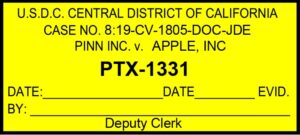
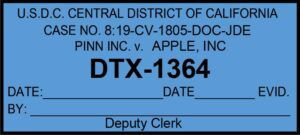
Also be cautious about leaving file preparation until the last moment. A 500-page PDF may look final but still include scanned pages in the wrong orientation, missing exhibit stickers, unreadable redactions, or bookmarks that do not match the intended binder order. A legal production team can flag obvious concerns, but counsel remains best positioned to confirm the substantive content.
Choose a Partner That Can Support the Entire Matter
The best overnight printer in Los Angeles for trials is often the provider that has supported the matter before the night of production. When one team can assist with document scanning, legal copying, Bates labeling, electronic discovery workflows, online attorney review, and final trial exhibits, it has more context for how the materials were assembled and what must be preserved in the final set.
Concord Document Technologies supports legal teams with 24/7 document production, trial exhibit binders, secure handling, and delivery coordination for urgent Southern California matters. For firms managing large or sensitive cases, that combination of physical production and document technology support can reduce handoffs at the point where deadlines are least forgiving.
Before the next trial deadline arrives, identify the provider you would call, confirm its after-hours contact process, and keep a concise production-order template ready. When the exhibit list changes late at night, preparation is what turns an overnight request into a controlled, court-ready delivery.