Concord eDiscovery, Scanning & Data Collection

Southern California's Finest for over 27 years & counting

Request a Free Professional Consultation  (213) 745-3175
eDiscovery · Scanning · Forensic Data Collection · Online Attorney Review · Printing
Serving top law firms and corporations since 1996  
  • About Us
    • Meet Concord
    • Our Blog
    • Testimonials
  • Services
    • Data Collection
    • Deposition Officer Services
    • Managed Services
  • Data Collection
    • Remote Iphone Data Collection
    • Discovery Data Collection
  • E-Discovery
    • What is E-Discovery?
    • Legal Hold, How to handle
    • RelativityOne On-AI-Review
      • Relativity Amplifies Your Efforts with Computer Assisted Review
    • Online Review
    • ESI Calculator
    • Data Mapping in E-Discovery
    • Production of Electronially Stored Information Agreement
  • Scanning
    • On-Site
  • Legal Copying
    • Trial Exhibit Binders
      • How to Prepare a Trial Notebook
      • Stanley Mosk Trial Exhibit Binders Delivered Overnight
      • First Street Federal Courthouse Trial Exhibit Binders
    • Electronic Bates Numbering
    • Legal Copying Services
  • Contact Us

Law Firms Fail to Protect Data When File Sharing

May 29, 2014

LexisNexis survey shows disconnect between security concerns and steps taken to protect data.

May 29, 2014  |10 Comments

U.S. law firms may be worried about the security risks of sharing confidential information online, but a new survey by LexisNexis’ legal and professional division reveals that they are not doing much about it.

Unencrypted email remains by far the most prominent way that law firms share privileged communications with their clients, with 89 percent of respondents reporting that it is the firm’s primary method of distributing information.

In March, the company canvassed about 300 legal professionals in 40 states across 15 different practice areas. Results show that although respondents were aware of the risks, and wary of them, the most common method of securing documents and protecting privilege was the use of a confidentiality statement at the bottom of an email, with 77 percent of firms reporting this was their primary line of defense.

Clearly a disconnect between expressed security concerns and measures law firms employ to protect their clients and themselves, said Christopher Anderson, a senior product manager at LexisNexis, in a statement. Relying on a mere statement of confidentiality when sharing privileged communications by email is a weak measure and further it might protect the law firm but affords very little protection for the client, he said.

A minority of law firms go a step further to protect their information, with 22 percent saying they use email encryption,14 percent using a password to protect documents and 13 percent employing a secure file-sharing site. At the reverse end of the spectrum, 4 percent of respondents said they take no measures at all to protect private information. “Law firms need to perform their due diligence, stay abreast of technology and ultimately protect their clients interest online just as they do in providing legal counsel, said Anderson.

Attorney Marlisse Silver Sweeney is a freelance writer based in Vancouver. Twitter: @MarlisseSS.


 At Concord, we provide secure solutions for your clients.

Call today (888) 522-2800

Filed Under: Blog

RSS Concord eDiscovery, Scanning & Data Collection

  • WhatsApp (Meta) Class Action Lawsuit over Privacy Promises April 9, 2026
    Despite Privacy Promises, Meta, Third Parties Read and Store WhatsApp Messages, Class Action Lawsuit Alleges A proposed class action lawsuit alleges that despite Meta Platforms’ promises of total privacy between sender and recipient, the tech giant has secretly allowed its employees, certain contractors and/or other third parties to intercept, read and store WhatsApp messages. The […]
  • eDiscvoery-predictions-for 2026-AI January 22, 2026
    Predictions for E-discovery in 2026 This year, the e-discovery landscape will likely be marked by the growing prominence of gen AI and court rulings paving the way—or limiting the use of—the technology   More automation and clarity could be coming to the e-discovery space in 2026, with many expecting generative artificial intelligence to change first-pass […]

E-Discovery Services

Document Scanning

Legal Copying

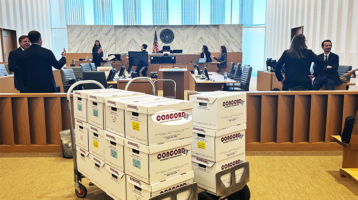
Concord will print & deliver straight to the Federal Courthouse.

Copyright © 2026 · Enterprise Pro Theme On Genesis Framework · WordPress · Log in