A production failure at 4:30 p.m. can become a courtroom problem by 8:30 the next morning. Missing Bates ranges, unreadable scans, improperly assembled exhibit binders, or a delivery that misses the courthouse can put unnecessary pressure on an already demanding matter. For firms looking for the best legal copying service in Los Angeles, the real question is not who can run copies. It is who can protect the record, meet the deadline, and handle the next urgent request without requiring your team to start over.
Legal copying is a litigation-support function, not a commodity print order. The right provider understands that every box, scan, native file, and produced set may be tied to a discovery obligation, deposition, hearing, regulatory inquiry, or trial date. That calls for documented handling, disciplined quality control, and production capacity that holds up when the matter expands overnight.
What the Best Legal Copying Service in Los Angeles Should Deliver
A capable legal copying partner should be able to move between paper and electronic workflows without creating gaps in custody or accountability. Many matters begin with banker boxes, medical records, project files, or agency documents. They may quickly require searchable PDFs, OCR, document coding, Bates numbering, load files, online attorney review, or trial exhibit binders.
The provider should understand the sequence. Documents need to be inventoried before scanning. Scans need to be legible, complete, and correctly oriented before they are coded or Bates labeled. Production sets need to be checked against instructions before they are released or delivered. When any one of those steps is treated casually, legal teams spend valuable time correcting preventable mistakes.
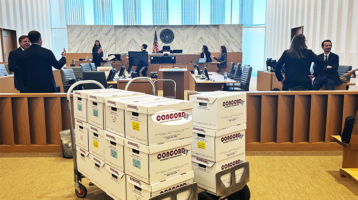
In Los Angeles, local execution also matters. A provider that can deliver trial exhibit binders overnight to Stanley Mosk Courthouse, First Street Federal Courthouse, and Superior Court locations can reduce risk when a hearing or trial schedule changes. That local responsiveness should be supported by the ability to ship production materials overnight when counsel, experts, witnesses, or co-counsel are outside Southern California.
Capacity Is More Than Fast Turnaround
“Rush service” is easy to promise. Reliable rush service requires staffing, equipment, quality-control procedures, and clear communication after normal business hours. Ask whether the provider maintains 24/7 production capacity and whether the team handling your work is equipped for large-volume matters, not just small copy jobs.
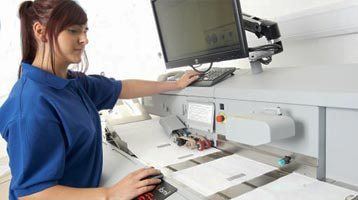
Capacity should include more than black-and-white duplication. Litigation teams routinely need high-speed scanning, color imaging, oversized-document handling, tabs, slip sheets, blowbacks, binders, digital printing, and custom trial boards or demonstratives. A vendor that performs these services in-house can often manage changes more efficiently than one that has to outsource portions of the work.
Speed has a trade-off. A vendor can turn material quickly but still introduce errors if its intake process is unclear. The better standard is controlled speed: a written scope, confirmed production specifications, checkpoints for exceptions, and a final review before release.
Security and Chain of Custody Are Non-Negotiable
Legal files often contain privileged communications, personally identifiable information, financial records, protected health information, trade secrets, or government records. The best legal copying service in Los Angeles should be able to explain how materials are received, stored, tracked, transported, and returned or destroyed.
A professional operation uses documented chain-of-custody procedures from pickup through delivery. That includes controlled access to physical records, secure handling during scanning and production, and clear accountability for each transfer. Bonded and insured status adds another layer of institutional confidence, particularly for matters involving regulated information or high-value evidence.
Security should also extend to electronic files. If documents are uploaded for production or review, ask how access is managed, how data is transferred, who can retrieve it, and how project files are retained at the close of the engagement. The details will vary by matter, but a serious legal support provider should have direct answers before files are released.
Look for a Provider That Understands ESI
Paper records remain central to many cases, but they are rarely the whole case. Email, text messages, mobile-device data, cloud files, and business applications can contain the most consequential evidence. A copying vendor that only handles paper may force the legal team to coordinate several separate providers, each with its own intake, timelines, security practices, and billing structure.
A broader legal document technology partner can coordinate physical copying with eDiscovery workflows. That may include forensic collection of iPhones and email, processing electronically stored information, RelativityOne-based attorney review, document imaging, production preparation, and trial presentation materials. The benefit is operational continuity. Teams can move from collection to review to production without repeatedly transferring data and explaining the matter to a new vendor.
This does not mean every project requires a full eDiscovery platform. A short-notice hearing may only require scanned exhibits and delivered binders. A government investigation or complex commercial dispute may require forensic preservation, rolling productions, and managed review. The right service provider adjusts to the scope while keeping the workflow connected if the matter grows.
Questions to Ask Before You Send the First Box
Before assigning a legal copying project, confirm how the provider will handle the work under actual litigation conditions. Three questions often reveal whether a vendor is prepared.
First, ask who owns the project after intake. You need a reachable project manager or production contact who understands the instructions and can resolve issues quickly. A generic order queue is rarely enough when deposition exhibits must be corrected or a new production deadline is imposed late in the day.
Second, ask how quality control is performed. The answer should cover scan completeness, image legibility, Bates sequence verification, confidentiality checks, and review of final binders or production media. The process need not be identical for every order, but it should be deliberate and documented.
Third, ask what happens when instructions change. Litigation instructions change frequently: a new exhibit is added, a confidentiality designation is revised, an expert needs another set, or a filing date moves forward. A dependable provider can explain the escalation path, cutoff times, delivery options, and expected communication cadence.
For large or sensitive matters, ask about onsite support as well. Onsite scanning and managed document services can be valuable when records cannot leave a client facility, when a firm has a sustained volume of incoming paper, or when teams need immediate control over collection and processing.
Why Experience Changes the Outcome
Legal copying providers are judged most fairly when the matter is not routine. The test comes with a midnight request, a box of mixed originals, a production specification that changes after review begins, or a courthouse delivery that cannot be missed.
Experience matters because seasoned teams recognize the common points of failure before they become emergencies. They know that a mislabeled exhibit can confuse a witness, that a missing page can affect a filing, and that an unclear chain of custody can create questions no legal team wants to answer. They also understand the practical reality of legal work: instructions may arrive incomplete, but deadlines remain fixed.
Concord Document Technologies has supported legal, corporate, and public-sector teams since 1996 with legal copying, scanning, eDiscovery, forensic data collection, digital printing, and trial exhibit production. For complex matters, the advantage is having one accountable partner that can support the physical record and the electronic evidence lifecycle.
The best choice is not necessarily the lowest per-page quote. Price matters, particularly on high-volume work, but a low initial estimate loses value quickly if your team must spend hours fixing image quality, reassembling binders, locating missing pages, or arranging a second emergency delivery. Evaluate the provider on execution, security, communication, and the ability to scale with the matter.
When the next deadline is approaching, give your legal copying provider the same scrutiny you would apply to any litigation-critical vendor. Clear instructions, confirmed custody, defined quality checks, and a direct production contact create the confidence your team needs to focus on the case rather than the copy room.