A warehouse of banker boxes, a locked records room, and a production deadline do not leave much room for improvisation. Onsite scanning litigation gives legal teams a controlled way to convert critical paper records into usable digital evidence without sending sensitive originals through an unnecessary transport cycle.
For matters involving privileged files, regulated records, executive documents, medical information, or high-volume legacy archives, the question is not simply whether documents can be scanned. The question is whether they can be captured, tracked, indexed, reviewed, and produced without creating a gap in custody or a new discovery problem. The right onsite operation turns a physical collection into a defensible litigation workflow.
Why Onsite Scanning Litigation Requires More Than Equipment
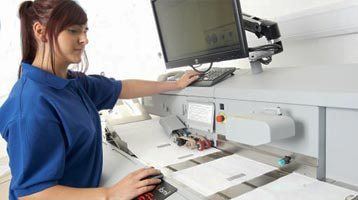
A high-speed scanner is only one part of the job. Litigation teams need a process that accounts for every box, file, folder, and exception from intake through final delivery. That means documented handling procedures, secure work areas, trained personnel, quality control, and a clear plan for how scanned records will enter the review and production process.
Onsite work is often appropriate when originals cannot leave the premises because of confidentiality requirements, internal policy, regulatory restrictions, operational necessity, or client preference. A corporate legal department may need scanning performed inside a secure facility. A government agency may require controlled access to records. Counsel may need to preserve the order and condition of a collection before opposing parties, regulators, or experts request access.
In each scenario, moving boxes to an offsite production center may introduce delay and avoidable risk. A properly managed onsite team brings the production operation to the records, with the same discipline expected of a legal support provider handling a major discovery production.
The Core Controls That Make Scanning Defensible
A reliable onsite scanning engagement begins before the first page is captured. Counsel and litigation support should establish the scope, priorities, access rules, output specifications, and chain-of-custody requirements. If the collection includes potentially responsive and nonresponsive material, the team should also determine whether scanning will be broad-based, custodial, issue-specific, or limited to identified file categories.
Inventory and chain of custody
Every container should be inventoried at intake, assigned a unique identifier, and tracked throughout processing. At a minimum, the log should show where the material came from, who released it, who handled it, when it was scanned, and when it was returned or transferred.
This record is particularly valuable when a matter later turns on the completeness of the collection. It allows counsel to answer practical questions quickly: Which boxes were scanned? Were any files withheld? Did a folder arrive out of sequence? Were damaged or oversized records separated for special handling?
Document preparation and original order
Paper is rarely production-ready when it comes out of storage. Files may contain staples, clips, binders, sticky notes, foldouts, photographs, tabs, mixed page sizes, or handwritten annotations. Preparation must remove scanning obstacles without losing the organization that may carry evidentiary meaning.
Original order is not an abstract concept in this context. A tabbed binder, a chronological personnel file, or a customer complaint folder may show relationships that are obscured if pages are scanned carelessly. The scanning team should identify document boundaries, preserve folder-level associations, and flag materials that need special treatment rather than forcing them through a standard feed scanner.
Image quality and quality control
Poor images create downstream costs. Cropped pages, unreadable handwriting, missing backs, skewed images, or unscanned attachments can slow attorney review and create production risk. Quality control should test more than whether a page count looks plausible. It should confirm legibility, orientation, document completeness, file integrity, and adherence to the agreed specifications.
For some collections, color scanning is essential because highlighting, handwritten notes, color-coded tabs, or redacted material may be significant. For others, black-and-white imaging is sufficient and more cost-effective. The correct choice depends on the record type, anticipated use, and production protocol.
Build the Workflow Around Review and Production
Scanning should not end with a folder of PDFs. The best onsite scanning litigation workflow anticipates what happens after capture: indexing, optical character recognition, attorney review, privilege review, exhibit preparation, and production to another party or agency.
OCR makes paper records searchable, but its value depends on image quality and document condition. Cleanly scanned typed records often produce useful searchable text. Faxes, carbon copies, handwriting, and degraded originals may require more careful validation. Counsel should understand that OCR is a review aid, not a substitute for the source image or a guarantee of perfect text extraction.
Bates numbering also requires planning. Some teams prefer to Bates label after review, once responsive documents and production sets are defined. Others need early identifiers tied to scanned images for tracking and deposition preparation. Both approaches can work, but the numbering scheme must be coordinated with the document database, load files, and any existing electronic evidence.
When paper records will be loaded into a review platform such as RelativityOne, the production provider should prepare files and metadata in a manner that supports efficient searching, coding, and export. Folder names, box numbers, custodian information, document dates, and other available source data can be valuable context. But metadata should not be invented. A defensible workflow distinguishes between data captured from the source and administrative data created during processing.
When Onsite Scanning Is the Better Decision
Onsite scanning is not necessary for every matter. Offsite scanning may be more efficient when records can be securely transported, the collection is large but not time-sensitive, and no site-access restrictions apply. A hybrid approach may also make sense: prioritize critical boxes onsite for immediate review, then move approved lower-priority material to a secure production facility.
Onsite scanning is usually worth the added coordination when one or more of the following conditions exist:
- Original records are restricted, highly sensitive, or subject to facility access rules.
- Counsel needs a rapid assessment of a collection before deciding what requires full processing.
- The records are needed for a hearing, investigation, or accelerated discovery schedule.
- Transportation creates a meaningful custody, security, or business-continuity concern.
- Key documents must remain available to the client while imaging proceeds.
The trade-off is operational complexity. A secure onsite project requires workspace, power, access approvals, staging procedures, and coordination with the client’s facilities and records personnel. Those requirements are manageable when addressed early. They become expensive when a team arrives without a clear scope or when the case schedule leaves no time to resolve access issues.
Planning an Onsite Scanning Project Without Losing Time
The fastest projects are planned with enough specificity to prevent rework. Before production begins, counsel should identify the location, approximate volume, record formats, priority custodians or departments, required turnaround, and intended final deliverables. It is also useful to determine whether the project includes native media, email printouts, bound books, engineering drawings, or other materials that require a separate handling plan.
Security expectations should be explicit. That includes who may enter the scanning area, whether personnel need badges or background clearance, how documents will be staged overnight, whether devices can connect to the client network, and how encrypted deliverables will be transferred. If the matter involves privileged material, the team should establish escalation procedures for potentially sensitive or unrelated records discovered during processing.
A pilot batch can resolve questions before the project reaches full volume. It lets the legal team confirm image settings, naming conventions, OCR quality, unitization rules, and the level of indexing needed for review. A small upfront test is often the difference between a clean, repeatable process and thousands of images that need correction later.
From Paper Collection to Trial-Ready Record
A scanned collection becomes more valuable when it supports the full life of the matter. The same documents may be used for early case assessment, document review, witness preparation, motion practice, depositions, and trial exhibits. Files should therefore be organized for retrieval, not merely delivered as a completed scanning job.
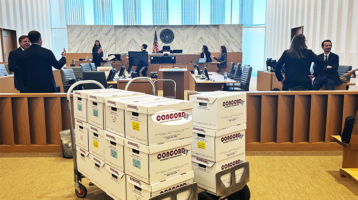
That is where an integrated legal support provider adds practical value. Concord Document Technologies can coordinate onsite scanning, legal copying, Bates labeling, digital printing, review-ready processing, and trial exhibit production under one managed workflow. For legal teams working against court deadlines in Los Angeles, Orange County, San Diego, or other major litigation venues, that continuity reduces handoffs at the point where handoffs are most likely to cause delay.
The goal is not to digitize paper for its own sake. It is to give counsel a reliable record that can be searched, reviewed, produced, and presented with confidence. When sensitive originals must stay where they are, disciplined onsite scanning provides the control that the case record demands.