A filing deadline can turn a room full of paper, emails, deposition exhibits, and native files into an immediate production problem. The right Los Angeles copy service does more than run copies. It gives legal teams a controlled way to scan, organize, label, produce, deliver, and defend the handling of case materials when timing and confidentiality are nonnegotiable.
For litigation support teams, the question is rarely whether documents need to be copied. The real question is whether the provider can manage the full workflow without creating new risk: incomplete productions, inconsistent Bates ranges, compromised originals, missed courthouse deliveries, or a trial binder that does not match the final exhibit list.
What a Legal Los Angeles Copy Service Must Handle
A legal document provider should be prepared to work across both paper and electronically stored information. Matters do not arrive in clean, uniform formats. A single engagement may include bankers boxes from a client site, medical records, oversized engineering drawings, iPhone data, email archives, prior productions, and late-breaking trial exhibits.
Copying is one part of the assignment. The larger responsibility is maintaining order from intake through delivery. That means documenting custody of original records, confirming production specifications before work begins, applying consistent coding, and performing quality control before a production leaves the facility or is released electronically.
For routine internal copies, a general print shop may be sufficient. For a regulatory response, a large-scale discovery production, or a trial set that will be used in court the next morning, legal teams need a provider that understands litigation standards and the consequences of a small error.
Scanning and Image Quality Are Foundational
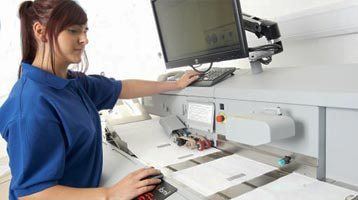
Paper scanning is often the first point at which a matter can become easier to manage or harder to defend. Images must be legible, complete, correctly oriented, and associated with the right document boundaries. Poor scan quality can force attorneys to revisit originals, delay review, and create avoidable questions about whether a production is complete.
A capable legal copy service can process standard documents, color materials, photographs, tabbed binders, oversized records, and fragile originals with appropriate handling procedures. Optical character recognition can make scanned collections searchable, but it should be viewed as a review aid, not a substitute for image quality control. Handwriting, poor originals, and unusual formatting can limit OCR accuracy.
When originals are sensitive, the provider should establish a clear chain of custody. Legal teams should know who received the materials, where they are stored, who may access them, and how they will be returned or securely retained. Bonded and insured operations offer an added layer of assurance for records that cannot simply be replaced.
Bates Labeling and Production Specifications Need Discipline
Bates numbering appears simple until a production includes multiple source sets, rolling deadlines, confidentiality designations, slip sheets, endorsements, or documents that must preserve existing numbers. A production error can affect citations, depositions, meet-and-confer discussions, and trial preparation.
Before imaging or printing begins, the provider should confirm the agreed numbering format, prefix, starting number, confidentiality legend, treatment of attachments, and delivery format. The team should also identify whether the matter requires single-page TIFF images, searchable PDFs, load files, native files, color exceptions, or paper copies for a particular recipient.
Quality control should verify more than page count. It should check that the Bates range is sequential, labels are readable, document breaks are accurate, and required endorsements appear in the correct position. Those controls matter most when a deadline leaves no room for a complete rework.
When Copying Becomes Trial Exhibit Production
Trial materials need a different level of coordination. Attorneys, paralegals, and trial consultants often need exhibits organized by witness, issue, motion, deposition designation, or courtroom sequence. A binder that looks polished but contains the wrong version of an exhibit is not ready for trial.
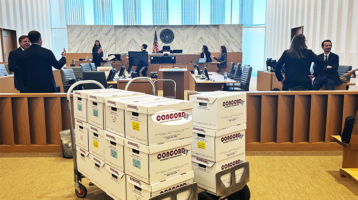
Trial exhibit production can include printed binders, witness sets, judge and clerk sets, electronic exhibit files, presentation-ready PDFs, demonstratives, oversized boards, tabs, labels, and replacement pages. The work becomes especially time-sensitive as rulings change exhibit lists after hours or during a weekend.
The best approach is to designate a point person who can confirm instructions, receive revisions, and maintain version control. A provider with 24/7 production capacity can be critical in the final days before trial, but capacity is only useful when paired with clear communication and documented approvals.
For Los Angeles matters, delivery logistics are part of the service. Overnight delivery to Stanley Mosk Courthouse, First Street Federal Courthouse, and other Superior Court locations can keep a trial team focused on legal strategy rather than transport coordination. The same is true when materials must be shipped overnight to counsel, experts, or co-defendants outside Southern California.
Copy Service and eDiscovery Should Work Together
Modern litigation rarely separates paper from data as neatly as older workflows did. A box of printed emails may correspond to a mailbox collection. A produced PDF may need to be compared with a native spreadsheet. A mobile-device preservation may lead to text messages, images, and attachments that require review alongside scanned records.
Using separate vendors for physical copying and electronic discovery can work, especially when a matter is small or the internal team has established systems. The trade-off is coordination. Every handoff creates another opportunity for mismatched metadata, unclear responsibility, duplicated effort, or delayed production.
A unified provider can support onsite or offsite scanning, forensic collection of iPhones and email, document processing, online attorney review, and final production from one managed workflow. This is particularly valuable for matters involving sensitive employee data, investigations, public-sector records, or accelerated regulatory requests.
RelativityOne-based review can give legal teams a structured environment for searching, tagging, redacting, and producing electronically stored information. It does not eliminate the need for careful collection and processing. Rather, it makes early decisions about preservation, deduplication, metadata fields, and review protocol more consequential. Experienced litigation support personnel can help the team choose an approach that fits the matter rather than applying a standard process to every dataset.
Questions to Ask Before Assigning the Work
Legal teams should evaluate a Los Angeles copy service based on operational readiness, not just per-page pricing. A low initial quote can become expensive if the provider cannot meet a revised deadline, handle a protected record set, or correct an imaging problem quickly.
Ask how originals are received, logged, secured, and returned. Confirm whether the provider can perform work after hours, on weekends, and under short notice. Determine who will manage the project and whether that person understands your specifications well enough to flag an issue before production begins.
It is also useful to ask about quality-control procedures, production formats, color handling, encrypted delivery options, and courthouse or overnight shipping capability. If the matter includes electronic evidence, ask whether the same team can coordinate forensic collection, processing, review hosting, and final production. The goal is not to buy every service available. It is to avoid building a fragmented workflow that fails under pressure.
Selecting a Partner for Sensitive Legal Work
Experience matters because legal document workflows are full of exceptions. A provider that has handled complex productions understands that a late instruction may affect numbering, confidentiality treatment, export settings, binder tabs, and delivery routing at the same time. The team should respond with a process, not improvisation.
Concord Document Technologies supports law firms, corporations, and government agencies with document scanning, legal copying, digital printing, trial exhibits, forensic data collection, and eDiscovery workflows. For teams managing a high-stakes matter, the value is having production resources and litigation technology support available through a single accountable partner.
The right provider should make the work feel controlled, even when the deadline is not. Start by defining the production requirements, identifying the materials that carry the greatest risk, and confirming who owns each approval. That preparation gives your legal team a stronger footing when the next urgent request arrives.