A missed chat thread, a poorly preserved iPhone, or an untested AI-generated privilege call can change the posture of a matter quickly. The eDiscovery technology trends 2026 that deserve attention are not novelty features. They are operational changes affecting how legal teams collect, secure, review, produce, and defend electronically stored information.
For law firms, corporate legal departments, and public agencies, the practical question is not whether new technology is available. It is whether the workflow can withstand scrutiny from opposing counsel, regulators, and the court. The strongest programs will pair advanced tools with documented process, experienced oversight, and production capacity that does not fail when deadlines compress.
eDiscovery Technology Trends 2026: AI Moves Into Controlled Workflows
Generative AI will continue to influence eDiscovery, but its value will be measured by control rather than speed alone. Legal teams are moving beyond broad experimentation toward defined uses: early case assessment, document summarization, issue identification, deposition preparation, chronology development, and quality control during review.
The useful distinction is between AI that helps a legal professional find and understand information and AI that makes an unverified legal decision. The first can reduce time spent on repetitive reading. The second can introduce serious risk when the system misunderstands context, invents supporting details, or fails to recognize privilege and confidentiality.
In 2026, defensible AI use will require matter-specific protocols. Teams should establish which data may enter an AI-enabled workflow, whether the environment retains prompts or documents, who validates outputs, and how those outputs are documented. A prompt containing privileged case strategy is not harmless simply because it is entered into a convenient tool.
Technology-assisted review will remain a core option for large review populations. Its advantage is not that it eliminates attorneys. It helps prioritize likely responsive documents so attorneys can focus attention where it matters most. The approach works best when the review team has clear issue definitions, a sound seed-set strategy, continuing validation, and a documented process for resolving coding disagreements.
Mobile, Messaging, and Cloud Collection Become the Hard Part
Email is still central to discovery, but it is rarely the whole record. Relevant evidence now sits across iPhones, Android devices, collaboration platforms, cloud storage, text messages, encrypted messaging applications, shared workspaces, and personal accounts used for business communications.
This is where collection discipline matters. A defensible collection must preserve metadata, identify the source and custodian, maintain chain of custody, and avoid altering the original information. Forensic collection of iPhones and email may be necessary when the facts require a fuller record than screenshots or user-selected exports can provide.
The difficulty is not always technical. It is often a scope and governance problem. A company may know that a departing executive used a personal phone, but not know which applications were used, whether relevant data is backed up to a cloud account, or whether messages disappear under a retention setting. Counsel needs those questions answered early, before preservation becomes a dispute.
Cloud data also requires more precision than the phrase “collect the folder” suggests. Permissions, version history, linked files, shared drives, and continuously changing content can all affect what is collected and how it is understood later. Collection plans should identify the source, time period, relevant custodians, export method, and whether the source is static or changing.
Security and Data Sovereignty Become Selection Criteria
As data volumes increase, legal teams are scrutinizing where information resides and who can access it. This is especially significant in matters involving government records, financial information, healthcare data, trade secrets, employee files, or cross-border custodians.
A review platform alone does not create a secure matter. Security depends on access controls, authentication, logging, data segregation, encryption, vendor personnel practices, and documented incident response. Procurement teams will increasingly ask whether a provider can support the technical requirements and the operational discipline surrounding sensitive data.
Data residency and cross-border transfer issues will also remain fact-dependent. A multinational matter may require separate workflows for data held in different jurisdictions, while a domestic matter may still involve strict contractual or regulatory handling requirements. The right approach depends on the records, the parties, the governing obligations, and the risk tolerance of the client.
This creates a stronger case for integrated providers that can manage collection, processing, attorney review, document scanning, legal copying, and production within a controlled engagement. Every unnecessary handoff creates another opportunity for a chain-of-custody gap, access-control mistake, or deadline failure.
Review Platforms Must Connect to Real Production Work
Sophisticated review tools are valuable, but a matter is not complete when documents are coded. Teams still need to resolve redactions, privilege logs, production specifications, Bates numbering, load files, exhibit lists, native-file handling, and court-ready presentation materials.
In 2026, the operational trend is toward closer coordination between hosted review and downstream production. A RelativityOne-based review workflow, for example, should be planned with production requirements in mind from the beginning. Decisions about family relationships, native files, placeholders, confidentiality designations, and redaction quality can all create downstream rework if they are addressed too late.
Physical evidence and paper records remain relevant in high-stakes matters. Medical charts, historical business files, handwritten notes, legacy contracts, and agency records may need secure scanning, OCR, coding, and integration into the same review population as electronically stored information. The objective is not to force every record into one format. It is to create a reliable, searchable record while preserving what the matter requires.
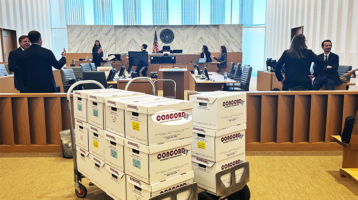
Trial preparation also remains a production test. Attorneys may need exhibit binders, demonstratives, deposition designations, exhibit stickers, and last-minute replacement sets on an unforgiving schedule. A digital workflow is strongest when it can support the physical courtroom demands that still arise in litigation.
What Legal Teams Should Do Before the Next Matter
The best preparation is not a lengthy technology roadmap. It is a tested set of decisions that can be activated when a hold notice arrives. Legal operations, litigation support, information security, records management, and outside counsel should know who owns preservation, what sources require escalation, and how collections are approved and documented.
Start by reviewing your matter intake process. It should capture more than the names of likely custodians. Ask which devices, platforms, shared repositories, and third parties may hold relevant information. Ask whether any sources have auto-delete settings, whether paper records exist, and whether regulated information requires special handling.
Then examine the handoffs. If a matter requires forensic collection, processing, hosting, attorney review, scanning, printing, and trial exhibits, determine where responsibility shifts between teams. Clear ownership reduces the risk that a collection is complete but never processed, a document is reviewed but not produced correctly, or a trial team receives an outdated exhibit set.
Finally, test the reporting. Matter leaders need timely answers about data volume, collection status, review pace, privilege decisions, production readiness, and budget exposure. Reports should support decisions, not merely describe activity. A dashboard that shows review counts but cannot identify missing custodian data or looming production problems has limited value.
Concord Document Technologies supports these connected demands with forensic data collection, RelativityOne-based review, document processing, scanning, legal copying, and trial exhibit production for sensitive, document-intensive matters. For legal teams under deadline, the advantage is executional continuity from source data to courtroom materials.
The technology will keep changing. The discipline that protects a case will not: preserve early, document every critical decision, validate automated work, and use service partners that can deliver accurately when the record is large and the deadline is fixed.